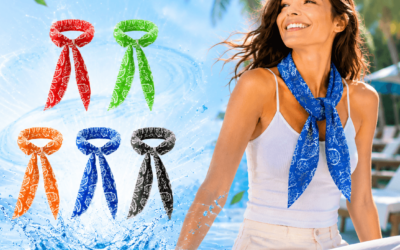
Comparing a cooling scarf to a regular scarf comes down to whether you feel relief when the mercury hits 95°F.
The difference lies in how each is built. Regular scarves rely on fabrics that insulate or decorate. Cooling scarves use evaporative materials, often PVA-based, that absorb water and release it slowly to pull heat away from your skin.
Below, we cover how each option works, when a cooling neck wrap earns its price tag over a cotton bandana, and how to tell genuine heat relief from damp marketing.

What Is a Cooling Scarf?
Soak it, snap it, wear it. That’s the entire learning curve for a cooling neck scarf.
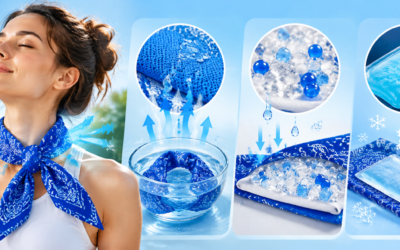
A cooling scarf is a neck accessory made from water-retentive fabric or polymers, often PVA cooling material. It works without batteries, cables, or freezer time. You activate it with plain water, and the evaporative cooling fabric handles the rest.
The routine takes five steps:
-
Soak the scarf (about a minute for PVA)
-
Squeeze out the excess water
-
Wrap it around your neck
-
Let stored water evaporate and pull heat from your skin
-
Re-wet once the cooling fades
That evaporation step does all the work. As moisture leaves the fabric surface, it absorbs heat from your neck and the surrounding air through basic thermodynamics.
This sets cooling scarves apart from PCM neck coolers, which require pre-freezing to work. A cooling scarf skips that preparation. Water and a quick squeeze provide hands-free relief for outdoor work, sports, or any heat-exposed grind.

What Is a Regular Scarf?
A regular scarf covers your neck with a rectangle or square of fabric meant to insulate, shade, or decorate. It contains no water activation layers, evaporative fabric, or interior PVA cooling material.
The fiber determines what you get:
|
Material |
Warmth |
Best For |
|---|---|---|
|
Wool |
High |
Winter knits, can itch |
|
Cashmere |
Very high |
Lightweight luxury, pricey |
|
Cotton |
Medium |
Spring/summer, slow to dry |
|
Acrylic |
Medium-high |
Budget wool substitute |
|
Polyester |
Low-medium |
Quick-dry, sun protection |
|
Linen |
Low |
Breathable, wrinkles easily |
Most options fall into four main categories: warmth scarves (wool and cashmere knits for cold weather), sun-protection wraps (lightweight cotton or linen for heat), fashion scarves (silk and patterned pieces worn for looks), and cultural or ceremonial scarves (hijabs, keffiyehs, and team colors).
Traditional scarves lack an active cooling mechanism. A lightweight fabric can let air circulate or wick some sweat, but that provides passive comfort. Evaporative and PCM-based designs deliberately pull heat away from the skin. If a product listing mentions “breathable” or “cooling yarn,” check for a soak-and-wear structure before assuming it performs like a dedicated cooling scarf.
Cooling Scarf vs Regular Scarf: Key Comparison Table
The comparison across these fourteen rows comes down to whether you need to shed heat or hold onto it.
|
Dimension |
Cooling Scarf |
Regular Scarf |
|---|---|---|
|
Core Function |
Removes heat through evaporation or cold-media absorption |
Traps air to insulate and limit heat loss |
|
Ideal Temp Range |
~75–90°F outdoor use |
Below ~60°F |
|
Duration Per Soak |
45 min–4 hrs (microfiber 1–3 hrs, PVA 2–4 hrs, high-absorbent polymer up to 6 hrs) |
No time limit; warmth fades as the material wears |
|
Humidity Impact |
High. Dry air speeds evaporation, while humidity slows cooling |
Minor. Damp wool or cotton feels less comfortable |
|
Reactivation |
Re-wet or shake every 15–30 min during heavy activity |
None needed |
|
Wet-Weight Feel |
Heavier and damp against the skin; can feel bulky if SAP-based |
Stays dry and light |
|
Maintenance |
Hand wash in cold water and air dry; do not use bleach or fabric softener |
Varies by fiber; wool often requires dry cleaning, while cotton is machine washable |
|
Best For |
Construction and warehouse crews, runners, outdoor laborers, hot commutes |
Cold-weather dressing, wind protection, fashion, business wear |
A cooling scarf works best when you need measurable heat relief in hot, dry conditions. PVA and microfiber models activate fast to deliver several hours of cooling. A regular scarf makes sense when warmth, everyday style, or staying dry matters more than lowering your skin temperature.
How to Use an Evaporative Cooling Scarf
Four steps separate a working cooling towel from a dry strip of fabric doing nothing for you.
Soak times vary by fill. PVA material and standard microfiber take 30–60 seconds in cool water, while thicker weaves need 1–3 minutes. For SAP bead or polymer fills, soak the fabric for 5 minutes, then wait another 15–20 minutes for the beads to swell. Check the tag, because leaving it in longer just adds useless water weight.
Wring, don’t twist. Press the fabric flat between your palms until water stops dripping. Twisting stresses the seams and can tear the inner absorbent layer.
Shake it 5–10 times before wrapping it around your neck. Snapping the fabric moves air through the weave so heat does not stay trapped against your skin.
Position matters. Drape it across the back of your neck and along both sides, right over the carotid arteries where cooling registers fastest. Keep the wrap flat instead of rolling it into a thick bundle, which blocks airflow right where you need it most.
How to Tell It’s Time to Re-Wet
A working cooling scarf feels damp, spreads water across the weave without pooling, and chills whenever air hits it. Re-wet it when:
-
The surface feels dry or barely damp
-
You stop feeling the chill against your skin
-
The fabric stiffens or dries in patches
-
You are working in heat, wind, or dry air, which burns through moisture faster
Re-wetting cycle: take it off, dunk it for 30–60 seconds (1–3 minutes for thick fabric), press out the excess water, shake it for 3–10 seconds, and put it back on. You will repeat this loop much faster on a dry, breezy afternoon than inside a humid garage.
Fit and Care Notes
-
Wrap it snug, not tight. You still need to breathe and swallow without pinching.
-
Do not wear it dripping. Excess water slows evaporation and soaks your shirt collar.
-
If it has bead fill, smooth the gel beads flat after soaking so they do not bunch into lumps.
-
Airflow drives the chilling effect — a steady breeze or fan cools you faster than extra water.
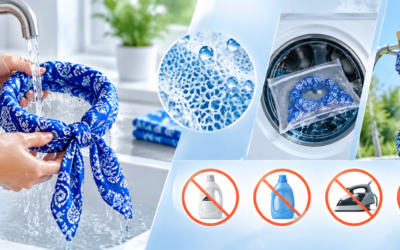
After use, rinse out sweat and salt with tap water, using mild detergent only when needed. Avoid bleach, fabric softener, and the dryer, which break down the absorbent layer. Lay the wrap flat to air-dry before packing it away, since storing it damp breeds mildew. Once a towel smells sour, turns slimy, or stops swelling evenly, throw it out and replace it.
Best Use Cases: When to Choose Each Scarf
Your zip code and your job description decide this more than brand loyalty ever will.
Running, cycling, hiking: Grab a SAP or microfiber cooling scarf. Soak it for 2–3 minutes to get 1–2 hours of relief, depending on the temperature, wind, and humidity. Runners should stick to 4–5 inch widths to cut down on bounce and weight.
Construction, forestry, auto repair: Go wider. A 6-inch-plus PVA or SAP cooling scarf handles long shifts in direct sun. Portwest’s CV05, for example, uses a PVA-filled polyester mesh rated for up to 8 hours of cooling and blocks 98% of UV rays—a practical pick for anyone clocking overtime outdoors.
Hot commutes, transit hubs: A thin microfiber neck wrap packs small and activates fast. It performs best in dry, breezy city air. Once you move indoors where airflow stalls, that cooling time shrinks.
Cold weather: Skip evaporative fabrics. Wool or cashmere scarves handle 0–15°C ranges without needing water.
High humidity, low wind: Evaporative fabrics struggle in still, damp air. Switch to PCM or gel-based options instead. They do not rely on evaporation, so muggy air will not kill the cooling effect.
Office or client meetings: A lightweight silk or fine wool scarf looks professional without the bulk.
Advantages & Limitations of Each Type
The numbers show how both options perform in the field.
Cooling Scarf: Where It Wins and Where It Struggles
Advantages:
– Evaporative cooling pulls heat away from your skin, giving you 2 to 3 hours of relief in dry, breezy weather and a noticeable chill seconds after activation.
– Needs no power source; re-wet it and shake it for 10 seconds to bring the chill back.
– Reusable all day across multiple soaks, particularly with dense microfiber.
– Packs light, folds small, and slips into a pocket or work bag.
Limitations:
– Humidity limits performance. Cooling stays strong at 30% relative humidity, but stalls at 90%. Above 70% humidity, cooling capacity drops by about half.
– In a humid kitchen, expect 30 to 45 minutes of relief rather than the advertised 2 to 3 hours.
– It stays wet against your neck. If you under-wring it, water drips down your collar and irritates your skin; PVA versions can also feel stiff or rubbery.
– Needs steady access to water. Pack a bottle or carry two wraps to rotate through long outdoor shifts.
– Once it dries, cooling stops. High humidity, dead air, or a covered neck shuts down evaporation fast.
– Needs a wash and a full air-dry after every shift to keep it from smelling sour.
Regular Scarf: Where It Wins and Where It Struggles
Advantages:
– Wool, cashmere, and alpaca insulate by trapping air in the fiber loft. They work reliably for winter commutes and cold offices without needing water or dry air.
– Wide material selection: cashmere, silk, cotton, linen, modal, viscose, and blends.
– Delivers a clean look for business settings, gifts, and uniforms where athletic cooling gear looks out of place.
– Requires no prep, soaking, or drying time, making it simple to pack year-round.
Limitations:
– Heavy wool, cashmere, and tight synthetics trap heat and sweat in summer.
– Offers zero active cooling. Thin, breathable fabrics ease warm weather passively at best.
– Fiber choice dictates performance: cotton holds moisture and dries slowly, wool overheats in summer, and silk wears out faster than synthetic fabric.
– Winter fabrics add bulk, making them awkward for sports or physical labor.
– Can stick to sweaty skin in high heat, feeling worse than a well-wrung cooling wrap.
How to Choose: Buying Guide for Cooling Scarves
Seven variables separate a smart cooling scarf purchase from a return-shipping label. Run through this checklist before you buy.
Material type drives everything. PVA and polymer fibers soak up water and cool through evaporation, making them your best choice in dry heat. PCM (phase-change material) absorbs heat and melts internally without losing effectiveness when humidity climbs. Gel or ice-pack inserts deliver fast, localized chill with swappable cores. Pick PVA for arid climates, and choose PCM or gel for humid weather.
Activation time matters on the clock. PVA needs 60 seconds to 3 minutes under running water. Most PCM requires refrigeration, though room-temperature-setting versions re-solidify near 28°C without a freezer. Gel inserts need 15–30 minutes of pre-chilling.
Cooling duration claims deserve scrutiny. PVA runs 2–4 hours, reaching up to 5 under ideal conditions. PCM holds steady past 45 minutes, with larger cores lasting 1–3 hours. Standard gel inserts last 15–30 minutes, though bigger ice packs stretch to 30–90 minutes. Always check the test conditions (temperature, humidity, and wind speed) behind any “maximum duration” claim.
Size, Comfort, and Compliance
Standard scarves run about 100 x 5 cm. Check how the scarf adjusts—whether through buttons, Velcro, or drawstrings—and confirm if it wraps multiple times for different neck sizes. For comfort, check wet weight, drip tendency, edge binding, and how the fabric feels against bare skin during long shifts.
Before buying in bulk, request OEKO-TEX Standard 100, ISO 9001:2015, and REACH documentation, particularly for items worn directly against skin. Review the safety data sheets for dyes, fillers, and gel formulas. Treat these certificates as non-negotiable for EU, North American, or enterprise procurement.
Quick Decision Guide: Which Scarf Fits Your Needs?
Three questions will settle this faster than reading through another spec sheet.
Is cooling your main goal? If not, grab a wool or cashmere scarf and skip the rest of this guide. If yes, keep reading.
What’s your environment? Hot, dry air calls for an evaporative cooling scarf. Hot, humid, and still air favors PCM or gel. For long, continuous shifts in the heat, choose PCM or a rechargeable absorbent scarf.
Do you need warmth, wind protection, or style? Go with wool, cashmere, or a thick blend without cooling tech.
Match Your Scenario to the Right Pick
|
Scenario |
Best Pick |
Key Spec |
|---|---|---|
|
Hiking, camping, gardening |
Evaporative cooling scarf |
2–4 hrs cooling; some include UPF 50+ |
|
Running, cycling, outdoor commuting |
Fast-activation cooling scarf |
~1 min activation; 1–3 hrs cooling |
|
Hot + humid + low wind |
Comfort range 20–28°C; 2–4 hrs cooling |
|
|
Factory, warehouse, long shifts |
High-density PCM scarf |
3–5 hrs; pre-chilling required |
|
Heat with limited water access |
SAP cooling scarf |
4–6 hrs vs. 1–3 hrs for standard microfiber |
|
Cold-weather commuting |
Wool or cashmere scarf |
CLO rating ~0.3–0.8 |
|
Wet, cold conditions |
Wool scarf |
Absorbs ~30% of its weight in water, still feels dry |
|
Fashion, light indoor layering |
Silk or thin wool blend |
Cashmere density ~200–300 g/m² |
If sun exposure worries you, look for explicit UPF 50+ labeling, because a cooling tag alone does not guarantee sun protection. If you want to skip freezers and running water entirely, PCM and gel scarves cut out the repeated soaking evaporative fabrics need.
FAQ: Common Questions About Cooling Scarves vs Regular Scarves
Here are direct answers to the questions that come up most often.
Does a cooling scarf really work? Yes. Once soaked in water, an evaporative scarf pulls heat away from your skin. You get the best results in dry, breezy air, whereas heavy humidity blunts the effect.
Can a regular scarf substitute for a cooling towel? A dry scarf just traps heat against your neck. A wet cotton scarf gives brief relief, but it drips, gets soggy fast, and dries out in roughly 20-30 minutes. A dedicated cooling towel holds its chill for hours.
Cooling scarf vs ice pack—which wins? That depends on the situation. Ice packs deliver intense, localized cold for about 1-2 hours, but you need a freezer handy. Cooling scarves activate with plain tap water and stay in place easily while you move.
Are cooling scarves reusable? Most can be soaked and used indefinitely. Crystal-polymer models often claim up to 30 activations, though whether they actually hit that number depends on seam durability.
What do reviews flag most? Look out for complaints about slow drying times, uneven cooling, and leaking seams before you buy.
Conclusion
The choice comes down to fabric chemistry. A cooling scarf uses evaporative fabric, often PVA cooling material, to pull heat away from your skin through moisture-wicking action, while a regular scarf traps warmth. If you are sweating through summer shifts, training outdoors, or commuting in brutal heat, that evaporative material keeps your temperature down.
When your routine involves sun, sweat, or scorching commutes, a dedicated neck cooling wrap will outperform any traditional scarf. Save the classic scarf for cooler days.
Browse IceBearTech’s lineup of cooling scarves and cooling towels built for real heat relief.