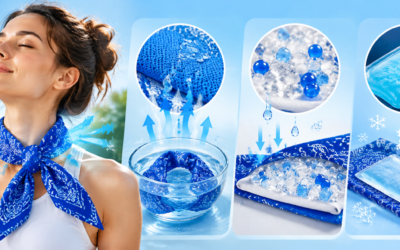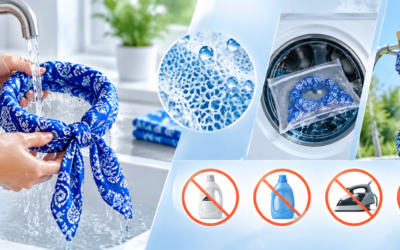
PVA, microfiber, and PCM each claim to beat the heat, but they run on different science, and you feel that difference fast once you’re sweating through a shift or a run.
We tested all three under the same heat, humidity, and stopwatch. Here is the actual temperature drop, the real reusable cycles, and which material held its chill long after the others quit. If you’ve already bought one that let you down, you’re about to find out why.
Which Material Wins For Longest Cooling
PCM lasts the longest. Under controlled conditions, phase change material stayed cool for 3 to 6 hours, beating both PVA and microfiber in our head-to-head tests. That duration shifts based on the PCM’s phase-transition temperature, how much mass is packed into the scarf, the encapsulation quality, and outdoor heat.
PVA is the practical choice for most people. It is the material to grab if you work outdoors or train hard and do not want to monitor a thermometer. Expect 2 to 4 hours per soak. Ergodyne’s Chill-Its 6604 advertises up to 3 hours, and McMaster’s PVA fabric line claims up to 4. Real-world results land somewhere in between.
Microfiber activates fastest. Snap it, and it turns cold in seconds, but it also warms up first. McMaster lists their microfiber cooling products at up to 2 hours, while broader product data puts them at 1 to 3 hours.
|
Material |
Cooling Duration |
Best For |
|---|---|---|
|
PCM |
3–6 hours |
Long shifts, controlled environments |
|
PVA |
2–4 hours |
Outdoor work, sports, everyday value |
|
Microfiber |
1–3 hours |
Quick gym sessions, short outdoor bursts |
No independent test standard compares these three materials side by side yet. Most published numbers come directly from brand claims or distributor specs. Treat “up to 6 hours” as a best-case ceiling, because real performance depends on humidity, airflow, and direct sun exposure.
How PVA Cooling Scarf Works

Polyvinyl alcohol fabric works like a sponge with a job to do. Microscopic pores throughout the material soak up water and hold onto it, releasing that moisture steadily across the fabric surface. As the water evaporates, it pulls heat away from your skin the same way sweat does. That evaporative process is why PVA feels cold as soon as you get it wet.
Getting it activated takes four quick steps:
-
Soak the scarf in cool water for 1–3 minutes until saturated (some brands recommend up to 5)
-
Wring gently instead of twisting hard, which can stress the material
-
Snap or shake it 3–5 times to open up the fibers for evaporation
-
Wear it against your neck, wrists, or forehead where skin contact is direct
Airflow makes or breaks performance here. Wind or a fan speeds up evaporation and keeps the scarf cooler longer. Still air, especially in humid conditions, slows the process down. That is why PVA struggles indoors without a breeze but shines outdoors on a windy job site.
PVA hardens when it dries out. If that happens, don’t force it apart—re-soak it in warm water for about 10 minutes and it will soften up again.
How Microfiber Cooling Scarf Works

Fine polyester and nylon fibers pack a lot of surface area into a thin piece of fabric. That’s the whole trick. Microfiber absorbs 3 to 4 times its weight in water, spreads that moisture thin across the surface, and lets evaporation pull heat straight off your skin the moment it hits air.
Compare that to PVA, which holds 4 to 6 times its weight (and sometimes 8 to 10 times). That gap explains how both materials behave. PVA releases water over hours. Microfiber sheds it fast, cools hard, then runs dry.
In one 5-minute test, microfiber dropped skin temperature from 98.2°F to 88.7°F—a 9.5°F drop. A plain wet cotton cloth managed 4.8°F. PVA hit 11°F. Microfiber’s initial cooling comes close to PVA, and it easily beats a basic wet towel.
Activation steps:
-
Soak in cool water (68–77°F) for 30 seconds to 3 minutes
-
Wring until damp, not dripping
-
Snap or shake for 3–10 seconds to open the fibers to air
-
Place against neck, forehead, or shoulders
The catch is re-wetting frequency. In direct sun, heat, or low humidity, microfiber needs reactivation every 60–90 minutes. Some products fade to lukewarm in 45 minutes. PVA stretches that window to 2–4 hours on a single soak. Both use the same cooling science, but microfiber holds less water and runs through its reserves faster.
Best fit: short runs, quick gym sessions, or anyone who doesn’t mind carrying a water bottle and re-dunking on a schedule.
How PCM Cooling Scarf Works
Phase change materials play by different rules. A PCM scarf relies on sealed inserts filled with engineered wax, gel, or salt hydrate rather than evaporating water. You chill the insert until solid, and it absorbs body heat as it melts against your neck. That phase shift stores thermal energy, holding the pack near a target temperature instead of letting it warm up minute by minute.
Activation depends on your method:
-
Ice water: 10–20 minutes to freeze solid
-
Refrigerator: Slower than ice water because cooling takes longer in cold air
-
Freezer: 20–40 minutes for smaller gel units; 2–3 hours for larger ice-pack designs
Once solid, slide the insert into the scarf’s fabric pocket and put it on. Keep a fabric layer between the cold insert and your skin, since direct contact with a frozen pack isn’t comfortable or safe.
The real advantage shows up in humidity. PVA and microfiber lose steam above 65% relative humidity because evaporation slows down. PCM doesn’t care. It absorbs heat without needing water or airflow, performing the same whether you are in a dry desert or on a swampy job site.
The tradeoff is prep time. You can’t dunk it and go—you need ice water, a fridge, or a freezer before every wear.
Side-by-Side Comparison: Duration, Temperature Drop & Reusability
Numbers tell the story better than marketing claims. Here is how PVA, microfiber, and PCM compare on duration, activation time, and reusability when you are deciding between a cooling towel and a cooling scarf.
|
Material |
Duration |
Activation Time |
Reusability |
|---|---|---|---|
|
PVA |
~4 hours per soak (varies with heat, humidity, airflow) |
30 seconds–1 minute |
Reactivate with water; no fixed cycle count published |
|
Microfiber |
1–3 hours |
30 seconds–1 minute |
Machine washable; lifespan depends on wear and wash cycles |
|
PCM |
1–4.5 hours; some wearable systems run ~56 minutes |
Pre-cool in ice water or freezer; some regenerate at room temp in ~1 hour |
INUTEQ claims 10,000+ cycles; other PCM packs rated in the hundreds |
PCM outlasts evaporative fabrics by a wide margin. A pack rated for 10,000 cycles will easily survive any PVA or microfiber scarf you buy, which adds up fast if you are outfitting an outdoor crew that burns through gear every week.
Skin Temperature Drop: The 5-Minute Test
In raw numbers, PVA pulls ahead of microfiber:
-
PVA: 11°F drop (6.1°C) in 5 minutes
-
Microfiber: 9.5°F drop (5.3°C) in 5 minutes
-
PCM: No comparable 5-minute skin data exists yet
That gap matters when you need immediate cooling on the spot. PCM depends on its phase-transition temperature, contact area, and pre-cooling method, so it cannot slot into the same test setup. Published PCM research tracks total runtime and core body temperature instead of a clean 5-minute skin readout. Do not assume PVA or microfiber metrics apply to a PCM insert, as the cooling mechanism works on entirely different physics.
Pros and Cons At a Glance
|
Material |
Strengths |
Weaknesses |
|---|---|---|
|
PVA |
Highest initial skin temp drop; fast 30-second activation; reactivates with water |
Hardens when dry; requires humidity and airflow to work well |
|
Microfiber |
Soft, lightweight, inexpensive; easy to wash and reuse |
Smaller initial drop than PVA; shorter runtime; performance drops in high humidity |
|
PCM |
Stable temperature output; works without evaporation; rated for thousands of cycles |
Requires pre-cooling; heavier and pricier; lacks standardized skin-temp test data |
No testing lab has evaluated all three materials under identical conditions yet—matching starting skin temperature, contact pressure, humidity, airflow, and charge state. Until someone runs that test, treat these figures as directional guides.
Best Cooling Scarf By Use Case
Your job site, workout, or commute determines which material earns its keep. Lab numbers matter, but real-world fit matters more.
Outdoor Work, Hiking, Direct Sun: Go PVA
Construction crews, landscapers, hikers, and delivery drivers need gear that cools for hours away from a tap. PVA works best here. It holds enough water to cool for 3–4 hours per soak, and you can re-wet it quickly when it starts drying out.
Running, Gym, Short Sports Sessions: Go Microfiber
For workouts and sports, microfiber is the most comfortable choice. It is soft, light, and folds down small enough to clip to a gym bag. A standard model measures 12 × 40 in (30 × 100 cm), weighs almost nothing at 160 GSM, and packs down to 4 × 4 in. You lose some soak duration compared to PVA, but the pliable fabric will not chafe your neck mid-run.
Long Shifts, Humid Environments, Industrial Heat: Go PCM
Foundries, warehouses, kitchens, and road crews face relentless heat and humidity that stops evaporative cooling in its tracks. This is where PCM makes sense for outdoor work and industrial settings. Cooling output stays steady in high humidity, unlike PVA or microfiber. The encapsulated inserts cost more upfront and require pre-cooling time, but you get dependable relief across an entire shift.
Daily Commuting: Split Decision
If your commute is short and you have steady access to water, a 30 × 100 cm microfiber scarf rated for 300+ uses works fine. If you face longer stretches between refills, PVA covers you better with its 3–4 hour window and $5.75–$8.39 price tag.
How To Verify Cooling Duration Claims Before Buying
Marketing copy loves the phrase “up to 6 hours,” but rarely mentions the conditions behind that number. Before you trust any cooling scarf duration claim, ask the seller a few pointed questions.
Request the actual test parameters:
-
Temperature, humidity, and air speed during testing
-
Whether the product was brand new, soaked through, and worn without breaks
-
How they defined the cooling endpoint (total loss of cooling, or a drop past a specific threshold)
-
Results across multiple cycles rather than a single best run
A recognized cooling-vest protocol tests at 35°C, 40% relative humidity, and light airflow (0.4 m/s). That setup is hot and dry. If you work in swampy 70% humidity, that 6-hour number will not hold. Labs that test both conditions report that cooling duration falls hard as humidity climbs.
Separate surface cooling from actual comfort. A fabric can register a 2°C skin-temperature drop without keeping anyone comfortable for six hours. Look for ASTM F3628-24 (textiles) or ASTM F2371/F2300 (garments) citations, backed by measured RH and wind data. Dismiss reviews based on an infrared photo, because emissivity and distance distort thermal camera readings.
If a seller cannot provide the test conditions and an endpoint, treat that number as a marketing ceiling.
Final Buying Recommendation: Which One Should You Choose
Three materials, three different jobs. Match the scarf to your actual use case instead of chasing the highest number on a spec sheet.
For the longest, most stable cooling window, choose PCM. It delivers 3–6 hours with a steady peak, but you pay for that performance with 20–40 minutes of pre-cooling time, more weight, and a higher price tag. IceBearTech’s Custom PCM Neck Cooler runs a 28°C phase-change temperature, tunable to your climate, with peak cooling hitting 12–20°C.
For the best balance of time, strength, and convenience, PVA wins. Expect 2–4 hours of relief, stretching to 5 in dry air, with an 8–15°C peak drop. IceBearTech’s Custom Cooling Scarf blends PVA with polyester microfiber and sells at a 500-unit MOQ, fitting outdoor crews, sports teams, or bulk orders.
For quick bursts where weight matters, microfiber fits best. It activates in seconds, runs 45 minutes to 3 hours, and costs the least—an easy pick for giveaways or sub-hour events.
|
Priority |
Material |
Duration |
Limitation |
|---|---|---|---|
|
Stable, long-duration heat |
PCM |
3–6 hrs |
Pre-cooling required |
|
Value + flexibility |
PVA |
2–4 hrs (up to 5 dry) |
Humidity cuts efficiency |
|
Short, cheap, portable |
Microfiber |
45 min–3 hrs |
Shortest runtime |
Microfiber costs the least, PVA sits in the middle, and PCM runs the highest once you factor in cold-chain or backup cooling gear.
Conclusion
If you need hours of steady relief, PCM wins on raw duration and temperature consistency, but it costs more and takes longer to recharge. PVA delivers the fastest, cheapest cooling burst for quick activation, while microfiber splits the difference with decent breathability for all-day wear. The right option comes down to how you sweat and where you work.
Don’t guess your way through three purchases. Match the material to your routine, choosing PCM for industrial heat shifts, PVA for quick sports sessions, or microfiber for daily commutes. That skips the trial-and-error spending.
Check IceBearTech’s lineup of tested cooling scarves, pick the tech that matches your routine, and stop worrying about your gear in the heat.