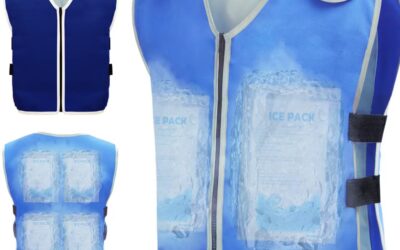
In the sweltering summer, whether on construction sites, in factory workshops, or during extended outdoor activities, cooling vests can help alleviate the discomfort caused by high temperatures. Among common passive cooling vests, Gel Cooling Vests and Ice Pack Cooling Vests are often compared.
From the outside, both products use internal pockets to hold cooling packs, but the actual user experience is not entirely the same. Gel Packs are generally softer and conform better to the body; Ice Packs provide a more direct and noticeable cooling sensation. At the same time, they also differ in cooling time, weight, freezing preparation, comfort, and applicable scenarios.
So, what are the differences between Gel Cooling Vests and Ice Pack Cooling Vests? Which one is more suitable for high-temperature work or outdoor activities?
This article will start by explaining how the two cooling vests work, comparing their actual cooling effects, duration, weight, cost of use, and applicable environments to help you choose the most suitable cooling solution based on your workload, usage time, and freezing conditions.
How Gel Cooling Vests Work and Their Core Features
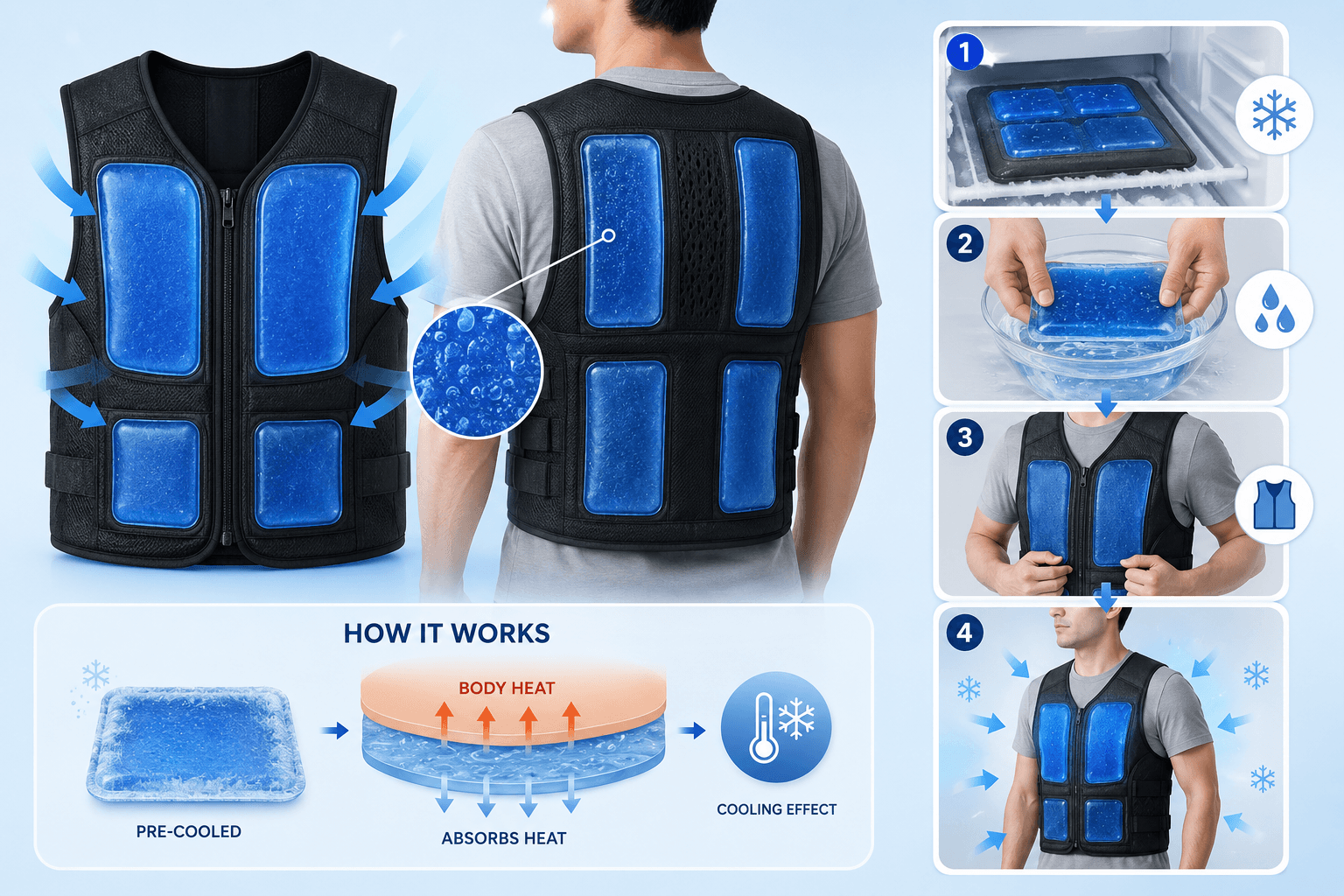
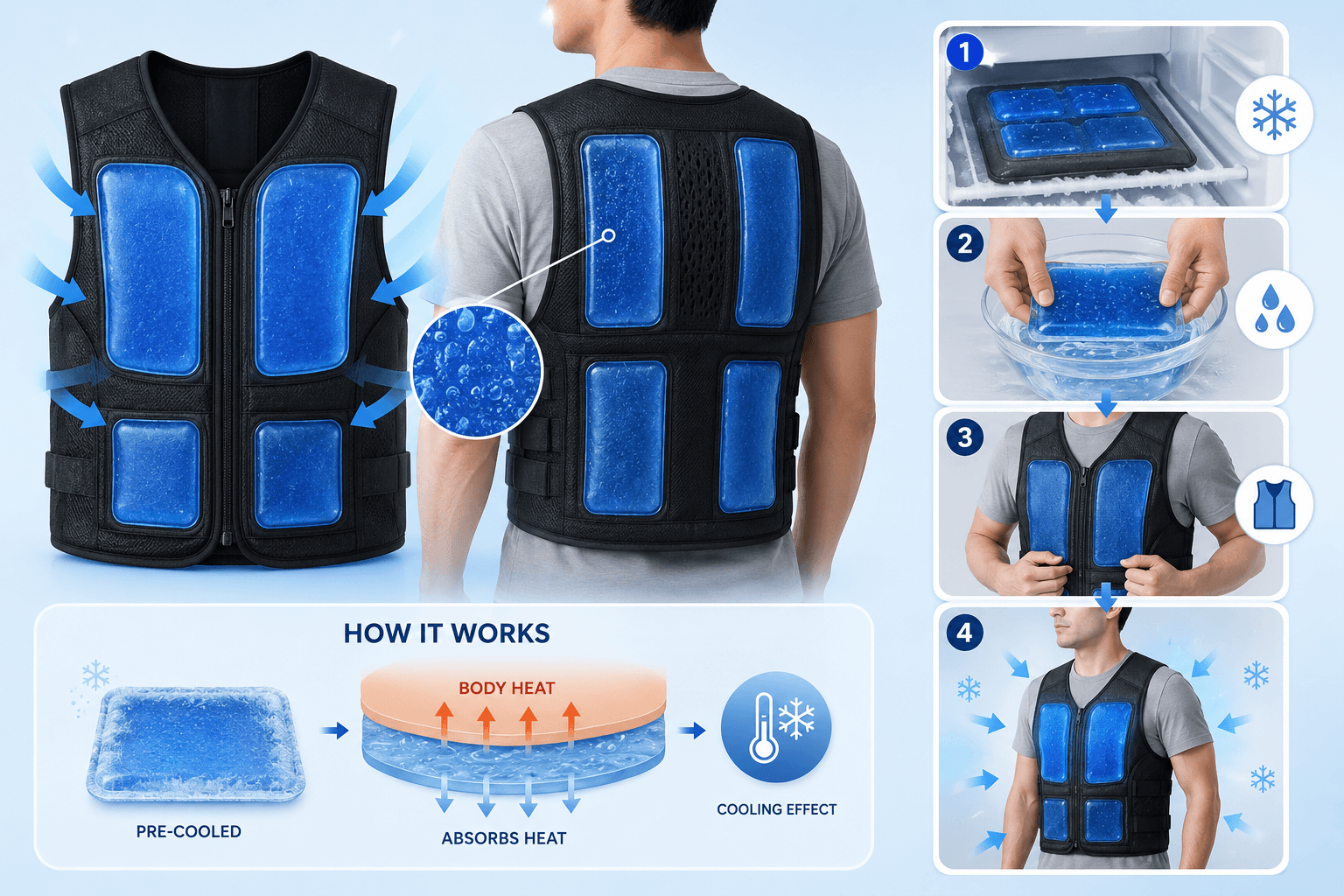
Inside a gel cooling vest, sealed pouches filled with gel, hydrogel, or phase change material sit in pockets sewn into the vest lining. Once pre-cooled, they absorb your body heat. Some are freeze-activated — you toss them in the freezer before wearing them. Others use formulas built from starch, water, and other nontoxic fillers that mimic an ice pack’s chill once frozen. A subset of hydrogel packs push past 95% water content and use evaporative cooling to stretch out the effect.
Charging time varies more than most buyers expect. Charging time ranges from 5 minutes to 2 hours, but the sweet spot is a full 2-hour freeze, which typically buys you 2 to 5 hours of usable cooling. Skip the freezer and dunk the packs in ice water for 5–10 minutes instead, and you get roughly 60 minutes of relief — a fraction of the freezer method’s payoff.
Actual cooling vest temperature duration runs 1–3 hours for most gel and ice pack vests, with 2–3 hours being the norm in 22–30°C conditions. Some ice-gel hybrids rated at 0°C deliver a sharper, more intense chill but tap out faster — around 1–2 hours — making them better suited to short, high-intensity bursts than an all-day shift.
Weight-wise, most gel vests stay under 5 pounds (2.27 kg), though industrial-grade options can hit 6.5 pounds (2.95 kg) once fully hydrated. Ultralight hydrogel versions weigh as little as 250g dry but balloon to roughly 2200g once activated — a detail that catches first-time buyers off guard.
How Ice Pack Cooling Vests Work: Core Features

Ice pack vests work on a simpler premise: freeze it, wear it, let it melt. As the ice or phase change material inside warms up, it absorbs heat straight from your skin through direct contact — no batteries, no pumps, just basic thermodynamics doing the work.
There are two flavors here, and they behave differently. Traditional ice pack vests use frozen gel packs stuffed into pocket sleeves. These deliver a fast, intense chill right out of the freezer, but that cooling curve drops off quickly as the ice melts. Water-based PCM (phase change material) vests take a different approach. They’re engineered to melt within a narrower 55–65°F (13–18°C) range, which means they release cold more evenly instead of blasting you with an initial deep freeze followed by a fast fade.
Cooling duration depends heavily on which type you’re wearing. Standard ice pack vests typically last 1.5 to 4 hours, with most industrial and athletic models settling into a 2–3 hour window — FlexiFreeze vests, for instance, run about 2–3 hours and weigh roughly 5.5 lbs once loaded. PCM vests trend toward more consistent output: Ergodyne’s Chill-Its 6210 and 6260 hold a steady 64°F (18°C) for about 2 hours, while Polar Products’ Kool Max Frozen Water-Based Cooling Packs stretch that to 3–4 hours.
Weight lands between 2.8 and 5.5 lbs (1.3–2.5 kg) fully loaded. Lighter PCM builds hover around 4 lbs, trading some cooling capacity for less shoulder strain during repetitive movement.
Core Comparison Dimensions: Cooling Duration, Intensity, and Comfort
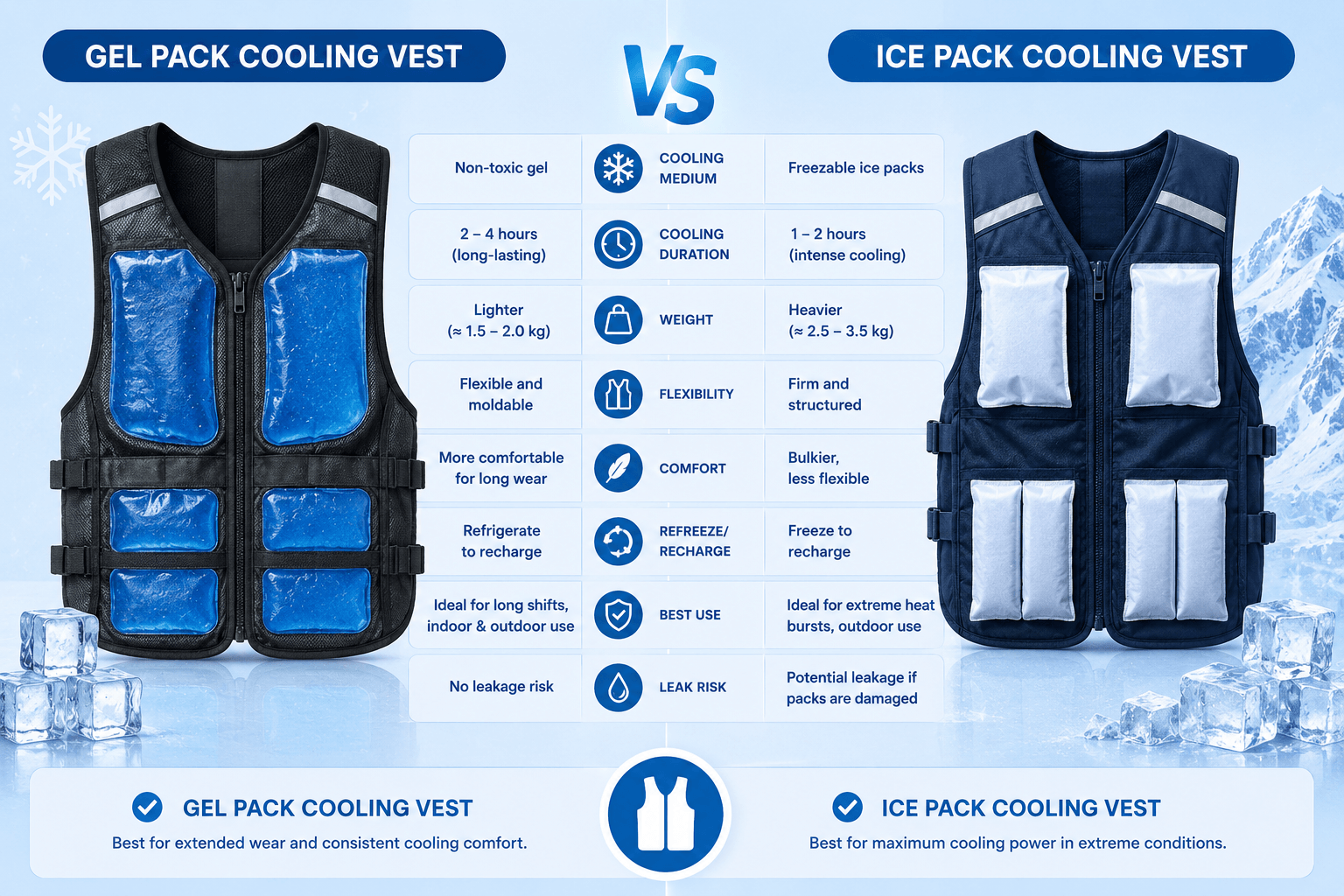
The numbers are clear, and they aren’t close. Ice pack vests hit hard and fade fast. PCM vests hold steady and last. That single distinction shapes everything else in this comparison — how long you’re cooled, how the cooling feels, and how much you’ll want to wear the vest again tomorrow.
Duration and intensity work in opposite directions. Ice pack cooling vests deliver their coldest blast in the first 30–60 minutes, then taper off. Push the right conditions, like lower ambient heat or a lighter workload, and you can stretch that to 1–3 hours, but the drop-off comes quicker than most buyers expect. PCM cooling vests trade that initial punch for staying power: 2–4 hours is standard, premium builds reach 2.5–4 hours, and some manufacturers claim 4–6 hours under ideal conditions. Reviewers consistently describe PCM as “high-intensity but stable,” while ice packs get labeled as “short bursts of hard cooling.”
Comfort follows the same logic. Ice packs run cold enough to feel numbing against the skin, especially where the pack sits flush against your back or chest. PCM material stays in a tighter, more forgiving range — commonly 58–65°F (14–18°C) — which the cooling vest industry treats as the sweet spot between actual temperature drop and skin comfort. Wearers report less of that “iced-over” sensation with PCM, since there’s no sharp thermal spike to adjust to.
Weight and mobility separate the two further.
|
Dimension |
Ice Pack Cooling Vest |
PCM Cooling Vest |
|---|---|---|
|
Cooling duration |
30–60 min intense, up to 1–3 hrs |
2–4 hrs, up to 2.5–4 hrs |
|
Comfort temp range |
Drops sharply, less stable |
58–65°F (14–18°C), steady |
|
Full-load weight |
2–5 kg |
1.5–3 kg |
|
Mobility |
More restrictive, stiffer movement |
Better range of motion |
|
Recharge method |
Freezer overnight, or 5–20 min ice water |
Ice water 15–20 min, fridge ~25 min, or AC room 1–2 hrs |
A 10 oz segmented gel strip runs about 9.5″ x 5″ x 0.5″ per pack. Small enough that split designs reduce the pressure points you’d feel from one solid ice slab. That’s one reason gel and PCM designs work better for cooling vests used in outdoor work and for athletes — where bending, climbing, or running matters more than raw chill.
Recharge cycles matter too. Ice packs depend on freezer access. No freezer, no cooling. PCM packs recover faster on-site, so they’ve become the default choice for reusable cooling pack vests on job sites without break-room freezers nearby.
Price and Cost-Effectiveness Comparison Analysis
Sticker price tells you almost nothing about what a cooling vest costs over a season of use. Gel and ice pack vests span a wide range—$14 to $245+—and where you land on that scale depends on how often you wear it and how long you need it to last.
Entry-level gel and ice pack vests run $14–$30. Walmart’s basic ice pack vest sells for $14.38. HENNCHEE comes in at $29.74, and Amazon’s common low-price models hover around $29.99. These work fine for occasional outdoor use or short commutes, but don’t expect them to survive daily job-site abuse.
Mid-tier options land between $30–$100. FlexiFreeze sits at $99.99–$129.99, while several gel/ice pack vests fall in the $36.99–$70 window. This is where fit and pack configuration start improving noticeably.
Professional and industrial-grade vests push $100–$245+. Steele’s 5 Pocket Vest Starter Kit runs $190; the Preferred Cooling Kit hits $245. Broader industry pricing puts phase-change vests at $100–$500 and circulating water-cooled systems as high as $1,545.
|
Budget Tier |
Price Range |
Best For |
|---|---|---|
|
Entry |
$14–$30 |
Occasional, short-duration use |
|
Mid-range |
$30–$100 |
Repeated use, better fit stability |
|
Professional |
$100–$245+ |
Job sites, long shifts, high durability needs |
|
Premium (PCM/water-cooled) |
$250+ |
Extreme heat, all-day performance |
Long-term cost matters more than sticker price. Replacement gel strips—Steele’s 10 oz 4-pack at $30, 18 oz 4-pack at $40, single 15 oz packs at $16–$48—add up fast for heavy users. Budget 20–40% of your initial vest cost each year for pack replacement if you wear it daily. The vest shell usually outlasts the packs; you replace the whole unit only once straps, zippers, or seams fail.
Bottom line on value: light, occasional use favors the cheapest gel/ice pack vest you can find. Frequent, high-heat use favors mid-tier vests with replaceable packs—the per-use cost ends up lower even though the upfront price is higher.
Choosing the Best Cooling Vest by Use Case
Your job dictates your gear. A welder standing next to molten metal for eight hours needs something completely different from a runner cooling down between intervals. Match the vest to the scenario, and the “best” choice becomes obvious fast.
Construction, warehouse loading, welding, road work. Grab an industrial cooling vest built around ice packs or PCM. Configure it with 4–8 cooling packs, and you’re looking at 2–3 hours of protection. Some upgraded job-site rigs stretch that to 2.5 hours, with rotating spare packs pushing coverage to 4–6 hours across a full shift. When the environment is brutally hot and the labor is heavy, you want forced cooling. Ice delivers that.
Athletes and interval training. A cooling vest for athletes should prioritize fit over raw chill. Gel and PCM vests hold steady at roughly 58–65°F (14–18°C) for 1–3 hours, enough to bridge the gap between sets without weighing you down. Ice-based options hit harder in the short term but tend to fade faster, making them better suited to quick bursts between rounds than sustained wear.
Medical care and heat-sensitive workers. The research on cooling vest for heat stroke prevention gets specific here. Field studies across four industries clocked average effective cooling at about 75 minutes. Construction workers reported roughly 76 minutes, kitchen staff around 84 minutes, and airport tarmac crews closer to 69 minutes. PCM packs typically need about 45 minutes to prep, though some quick-reset versions activate in just 5–12 minutes. If heat exposure runs past an hour, lean on a reusable cooling packs vest with backups on hand.
Short outdoor tasks and casual wear. For jobs under 90 minutes, patrols, deliveries, market stalls, a lightweight gel or PCM vest wins on convenience alone. You grab it and go with no power source or fuss.
Pros & Cons Deep Dive
Real users talk in complaints and compliments.
Gel Cooling Vest: What Works
-
Comfortable and discreet. Reviewers repeatedly call gel vests “easy to wear” for commuting, travel, and light outdoor work.
-
Better mobility. Compared to ice-loaded designs, gel vests get described as “less bulky” — a real advantage for anyone bending, climbing, or hauling gear.
-
No power source required. Most gel and phase change material vest models skip batteries entirely, which cuts down on maintenance headaches.
-
Runtime up to 4 hours under the right conditions, according to product testing on reusable cooling packs vest models.
Gel Cooling Vest: Where It Falls Short
-
Long prep time. Some gel packs need 6–8 hours in the freezer before you can wear them. Plan your shift around that, not around your arrival at work.
-
Weaker performance in extreme heat. Users describe cooling power as “limited” or “uneven” once temperatures spike.
-
Uneven cooling distribution. Cold spots and warm spots show up more with gel than with ice.
-
Humidity kills evaporative designs. Sweat-heavy environments cut efficiency fast.
Ice Pack Cooling Vest: What Works
-
Longer, more intense cooling. Reviews consistently rank ice pack cooling vest options as best for short-term, high-intensity heat stress, such as industrial cooling vest use on job sites.
-
More even heat absorption. Frozen water blocks reduce dead spots better than standard gel.
-
Reliable per-rotation performance, typically 2–3 hours before a swap.
Ice Pack Cooling Vest: Where It Falls Short
-
Bulk restricts movement. A recurring complaint among athletes and workers who climb or crouch.
-
Fit and weight distribution vary wildly between brands, driving mixed comfort reviews.
-
Freezer dependency. No pre-cooled backup packs means your cooling vest temperature duration drops sharply mid-shift.
-
Packs can crack or leak with repeated use, according to several buyer complaints.
Alternative Options: Are Evaporative Cooling and Phase-Change Material Vests Better?
Gel and ice aren’t the only players here. An evaporative cooling vest and a PCM cooling vest solve the same problem with different physics, and depending on your climate, one of them might beat both gel and ice outright.
Evaporative vests win in dry heat. They rely on water-soaked fabric and airflow, so they thrive in low-humidity, high-wind conditions like desert job sites, gardening, or cycling. Effective runtime sits around 1–4 hours, but performance drops fast once humidity climbs. They’re also the lightest option on the market, typically 400–600g, and the cheapest, running $15–$80.
PCM vests win almost everywhere else. They don’t depend on evaporation, so they work under FR-rated clothing, Level A suits, or in humid, closed-space industrial environments where evaporative designs fail.
An 8-hour efficiency study backs this up. Active cooling vests topped the chart, PCM insert vests pulled roughly 164 Wh/m², and evaporative vests trailed at 113 Wh/m².
Quick Decision Guide
|
Scenario |
Best Choice |
|---|---|
|
Dry outdoor heat, lightweight priority |
Evaporative vest |
|
Humid, PPE-heavy, industrial shifts |
PCM vest |
|
Short, intense pre-cooling or breaks |
Gel/ice pack vest |
Frequently Asked Questions (FAQ)
Which cools better, gel or ice pack/PCM?
Ice pack and PCM designs win on raw cooling power and consistency. Expect 2–4 hours of cooling versus 1–2 hours from gel. Gel wins on comfort and weight if raw chill isn’t your top priority.
How often do I need to swap out cooling packs?
Plan around your freezer, not your shift. Most packs need 2–8 hours to charge. One set covers a single 2–4 hour block. If you work back-to-back shifts, keep at least two rotations charged and ready.
What’s best for motorcycle riders?
Lightweight gel or a compact ice pack vest. Riders need something that stays flat against the back without shifting at highway speed. Around 2–2.5 hours of cooling is typical.
What about warehouse and industrial crews?
PCM vests hold up better through 2–4 hours of continuous standing and lifting, and they’re often paired with hi-vis safety gear.
Conclusion
The choice between a gel cooling vest and an ice pack cooling vest comes down to how long you need to stay cool and how much bulk you’re willing to carry. Gel packs win on comfort and flexibility for moderate heat. Ice packs deliver harder, faster cooling in extreme conditions but demand more prep and swap-outs.
Don’t guess your way into heat exhaustion. Match the vest to your job, your climate, and your body’s tolerance—then test it before you’re relying on it in a 100°F warehouse or trail run. Browse IceBearTech’s cooling vest lineup and find the one built for your next shift, workout, or expedition.