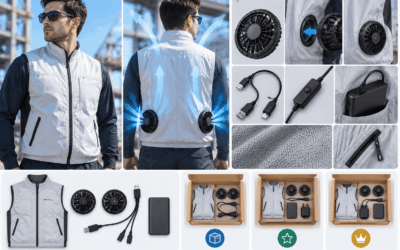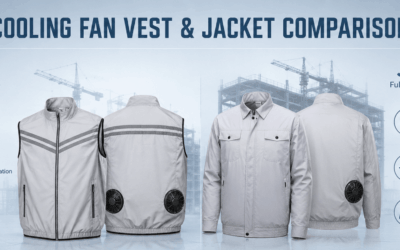
In the sweltering summer heat of construction sites, warehouses, or outdoor work environments, you’ve likely seen an increasingly common piece of equipment—the Cooling Fan Jacket. With two small fans mounted on the back, powered by batteries, it seems structurally simple, but does it actually make you feel cooler in high temperatures?
The answer isn’t a simple “effective” or “useless” answer. The core principle of the Cooling Fan Jacket is to continuously draw air into the garment, creating air circulation around the body and accelerating sweat evaporation, thus helping to remove heat from the skin’s surface. However, its actual effectiveness is influenced by various factors, including ambient temperature, humidity, airflow, clothing structure, and work intensity.
This article will begin by explaining how the Cooling Fan Jacket works, then further analyze what temperature it can actually lower, how noticeable the cooling sensation is, in which environments it works best, and how it differs from other cooling methods such as PCM and Water Cooling.
If you’re considering buying a Battery Powered Cooling Fan Jacket, or evaluating such products for workers, teams, or your own brand, this information can help you determine whether a Cooling Fan Jacket is truly practical high-temperature work gear or only effective under specific conditions.
Does a Cooling Fan Jacket Actually Work?
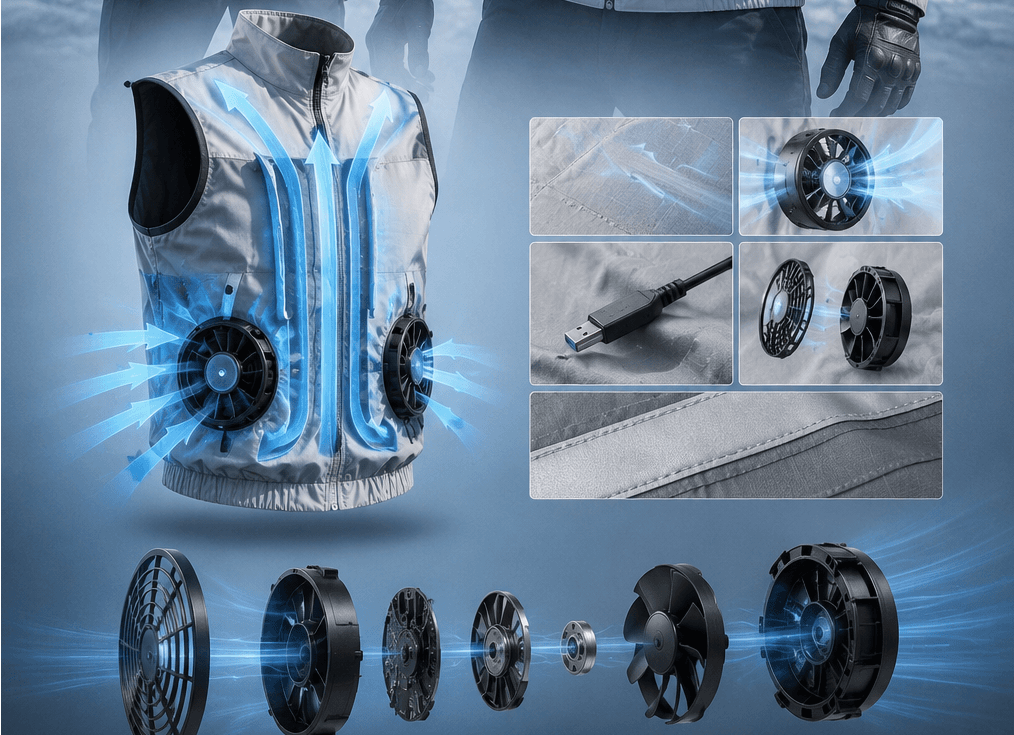
Yes, a cooling fan jacket works — but with limits. It won’t chill the air around you like a window AC unit. What it does is speed up evaporation on your skin. That’s a fancy way of saying it turns you into a slightly more efficient sweating machine.
The data backs this up. In a study at 40°C with 50% humidity, subjects wearing a fan-powered jacket had rectal temperatures 0.5°C lower than the control group after two 30-minute exercise sessions. That beat a cold-water circulation vest, which managed only a 0.3°C drop. Skin temperature responds even faster: upper-body cooling kicked in within five minutes, lower-body within ten.
As a heat stress prevention tool, it does something real. Just don’t expect it to cool your core the way it cools your skin.
Fan Cooling Jacket Breakdown: How Does a Cooling Fan Jacket Work
A cooling fan jacket doesn’t make cold air. It just moves the air you already have, and it turns out that’s most of the battle.
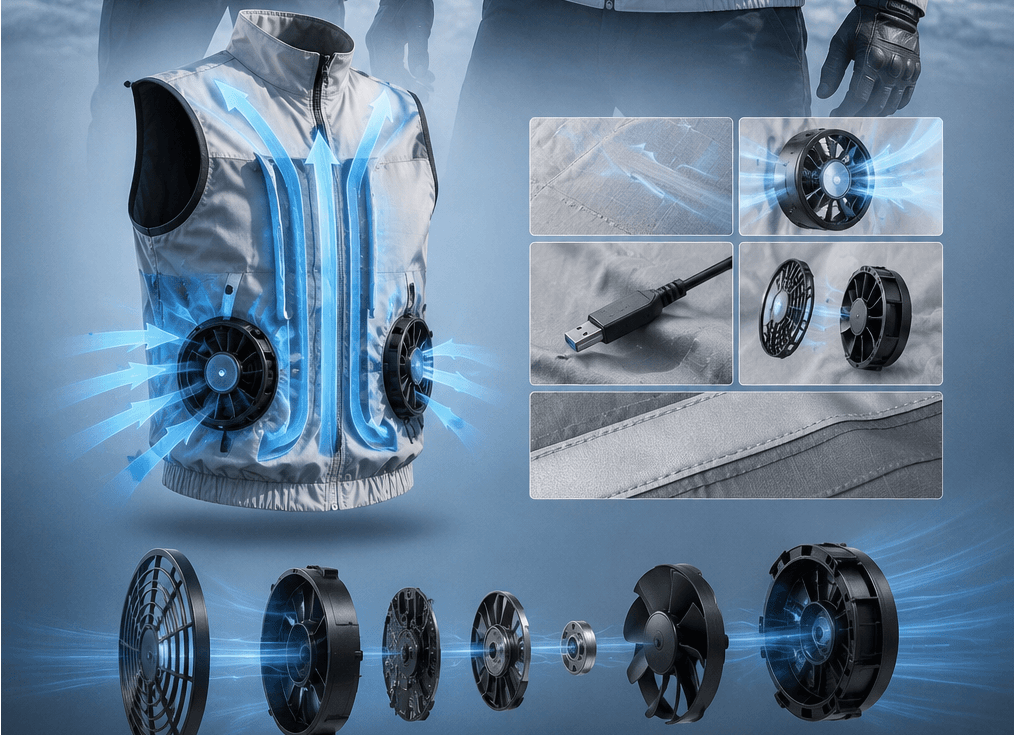
The setup is almost embarrassingly simple. Two small fans, usually parked at the lower back, pull in whatever air is floating around outside (hot, humid, doesn’t matter) and push it into the space between the jacket and your skin. Those fans move about 17.8 L/s, or 37.7 CFM if you like your numbers in car-engine units. That air then races across your torso, back, armpits, and the inside of your arms at speeds between 3.0 and 7.6 m/s, depending on where you’re measuring.
Three things happen in sequence:
The fans pull in ambient air. A small motor does what a desk fan does, tucked inside your shirt.
That air becomes forced convection once it’s trapped between fabric and skin. Pushed air pulls heat off your body faster than still air ever could.
Your sweat evaporates faster, and this is where the actual cooling happens. Moving air grabs the moisture off your skin and carries it away as vapor, taking heat with it. This is evaporative cooling clothing doing its one real job.
Fit is not optional. If the jacket is loose, the airflow swirls around in the extra fabric like a balloon that never quite deflates; it never touches your skin, never picks up sweat, never cools anything. A snug cooling vest with fan channels forces air along a real path: in through the fans, across your back and chest, out through the collar and cuffs.
Best Use Cases for Cooling Jackets

Not every hot day calls for the same gear, and not every job benefits equally from a fan powered workwear setup, construction sites are where the evidence is strongest. Researchers testing hybrid cooling vests on Hong Kong construction crews found rest-break cooling comfort scores jump by 0.93 to 1.34 points. 91% of workers said they’d actually choose to wear one during breaks. That’s people voting with their sweat.
Agriculture lands right behind construction. Long hours under direct sun, sustained physical output, little shade. This is exactly the profile where personal cooling devices earn their keep. Outdoor cleaning, horticulture, and municipal maintenance crews showed the same pattern: body temperature and heart rate rose less, comfort stayed solid throughout the shift.
Airport apron workers and warehouse loading crews round out the list. Radiant heat off tarmac, reflected heat off concrete, minimal airflow between deliveries — a heat stress prevention layer during shift breaks does real work here.
The sweet spot on a thermometer:
– WBGT of 29–33°C, the range where most construction-site cooling studies happened
– Air temp at 40°C with 30% humidity: 60 minutes of continuous activity, core temperature rise clearly blunted
– Air temp at 30°C with 85% humidity: still effective, so this isn’t just a dry-heat trick
One caveat: fan cooling performs best when air temperature stays below skin temperature (roughly 95°F/35°C). Push past that, and you’re relying almost entirely on sweat evaporation to do the heavy lifting.
The winner is high heat, high humidity, moderate-to-heavy physical labor, with breaks built into the shift. That’s when a cooling vest with fan becomes a genuine outdoor cooling gear tool.
What are the limitations of a cooling fan jacket in high humidity environments?
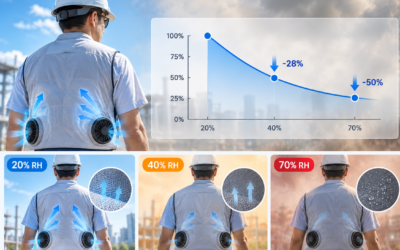
The cooling effect of a cooling fan jacket largely depends on airflow and sweat evaporation. The fan forces outside air into the jacket, accelerating the evaporation of moisture from the skin’s surface, thus carrying away heat. However, when ambient humidity is high, the air itself already contains a large amount of moisture, slowing down sweat evaporation and reducing the cooling effect of the fan.
Generally, a cooling fan jacket performs better in dry, well-ventilated, high-temperature environments. When relative humidity exceeds 70%, the efficiency of sweat evaporation is significantly affected. If the humidity approaches 80% or even higher, even with a high-volume fan, the perceived cooling effect may be far less than in a dry environment.
This is why the same fan cooling jacket might provide a very noticeable cooling effect in a dry outdoor construction site, but a completely different experience in coastal areas, during the rainy season, or in a high-humidity factory.
Besides humidity, the airflow within the garment is also crucial. If inner clothing is too thick, the vents are blocked, or the clothing is too tight, the air generated by the fan cannot flow smoothly from the waist to the back, armpits, and collar. Even with a large airflow, it’s difficult to create effective internal air circulation.
Therefore, a Cooling Fan Jacket is not a “wearable air conditioner.” Its more accurate function is to help sweat evaporate and dissipate heat from the skin through forced air circulation.
If the work environment is consistently hot and humid, consider PCM Cooling Vest, Water Cooling Vest, or other cooling methods that do not rely on evaporation; a combination of Fan Cooling and PCM can also be used.
Simply put: the drier the environment and the smoother the airflow, the more effective the Cooling Fan Jacket is; the higher the humidity, the more limited its cooling advantage through evaporation.
Cooling Fan Jacket: Pros and Cons Analysis
Every product has a highlight reel and a director’s cut, and the cooling fan jacket is no exception. Let’s talk about both.
The wins are real. The battery setup is genuinely convenient — most jackets run on a rechargeable 10,000 mAh pack, with brands promising up to 10 hours on the box. Industrial versions push that to 7–15 hours, with a 4–6 hour recharge window. No cords, no outlets, no compressor. Occupational health research backs up the bigger claim too: fan-attached jackets measurably lower core temperature, skin temperature, heart rate, and even the rate of body-weight loss (a proxy for sweat loss) in both hot and humid-hot conditions. In one head-to-head at 40°C and 50% RH, the fan jacket beat a 10°C circulating water-cooled vest at keeping core temperature from creeping up. And on price, personal cooling devices stop feeling like luxury gear — retail runs around $149.99, with wholesale samples as low as $23.23–24.9 per set, a fraction of what water-cooled or compressor-based systems cost.
In terms of details. Battery life on paper rarely matches battery life in your hands. On the highest fan setting, real-world testers report closer to one hour before it dies. Medium setting stretches to about three. That’s the actual trade-off: more airflow, more noise, more power draw, less runtime — pick two. This also isn’t air conditioning clothing in the literal sense; it’s amplified ventilation and evaporation, so it loses steam once humidity climbs and sweat can’t evaporate as fast. And fan placement matters more than people expect. Most jackets use two fans with 3–4 speed settings; industrial models add 9-blade brushless motors spinning at 4,800 rpm on DC 12V. Good design spreads airflow evenly; bad design just blasts your lower back while your shoulders bake.
User consensus, boiled down: immediate relief when you switch it on, frustration when the top speed dies in an hour, and a practical compromise — mid-speed, roughly 3 hours, slightly less punch but far more usable through a real shift.
What are the differences between a Cooling Fan Jacket and other cooling methods?
Cooling Fan Jackets, PCM Cooling Vests, Ice Pack Vests, and Water Cooling Vests can all be used in high-temperature environments, but their cooling principles are completely different. Therefore, rather than simply comparing “which one is cooler,” it’s more important to consider the working environment, usage time, and whether battery charging or cooling pack reactivation is available.
Cooling Fan Jacket vs. PCM Cooling Vest
The biggest difference lies in their cooling methods.
Cooling Fan Jackets use a fan to continuously blow air into the clothing, creating air circulation and accelerating sweat evaporation. It doesn’t produce the noticeable low temperature of an ice pack, but its advantage is a relatively continuous cooling process. Depending on battery capacity and fan speed, common battery life can reach approximately 4–8 hours or longer, making it suitable for construction, warehousing, and long-term outdoor work.
PCM Cooling Vests, on the other hand, absorb body heat through phase change materials and do not rely on airflow, therefore they typically perform more stably in high-humidity environments. It can maintain the set phase change temperature, but the cooling module needs to be reactivated by a refrigerator, freezer, or ice water after the phase change is complete.
Therefore, they are not simple substitutes: a fan jacket is more suitable for dry, well-ventilated environments requiring long-term operation; a PCM is often more suitable for high humidity or situations requiring stable contact cooling.
Cooling Fan Jacket vs Ice Pack Cooling Vest
The advantage of an ice pack cooling vest is its direct cooling effect. The frozen ice pack, placed close to the body, quickly absorbs heat, but the cooling effect gradually weakens as the ice pack warms up, and it usually requires a spare ice pack for rotation.
A fan jacket does not have this noticeable “icy sensation,” but it is usually lighter and does not require frequent replacement of the cooling pack. Therefore, for users who need to walk continuously, bend over, or perform physical labor, fan cooling is often more flexible.
Cooling Fan Jacket vs. Water Cooling Vest
Water Cooling Vests use a pump to circulate a cryogenic liquid through internal tubing, providing a more direct and active cooling effect, unlike Fan Jackets which rely on sweat evaporation.
However, it requires a water pump, piping, cooling water supply, and power supply, making its overall structure more complex. Therefore, it’s more suitable for fixed workstations, extreme high temperatures, or professional environments with higher cooling requirements, while Fan Jackets are simpler to use and maintain in everyday industrial work.
If you need long working hours, freedom of movement, and relatively simple daily maintenance, Cooling Fan Jackets are generally more advantageous.
If the working environment has high humidity, PCM Cooling Vests are a better choice; if you need a more noticeable cooling effect in a short time, consider Ice Packs; while for professional scenarios with continuous high heat loads and fixed workstations, Water Cooling Vests warrant further evaluation.
The final choice should not be based solely on “Cooling Duration” or the lowest temperature, but should be determined by considering factors such as temperature, humidity, workload, battery life requirements, and recharging conditions.
Key Criteria for Choosing a Cooling Jacket
Marketing copy lies about battery life more than anything else. Every box says “18 hours!”, and that number is almost always from the lowest fan speed, the one nobody actually uses. Real-world testing on medium speed, which is where most people live, usually clocks 7–9 hours. If you need it for a full 8–12 hour shift, look for hot-swappable batteries or dual-battery setups. A common industrial pattern uses one battery lasting 4–6 hours, giving you 8–12 hours total after a swap. Check watt-hours, not milliamp-hours. A 5000mAh cell at 3.7V is roughly 18.5Wh, but expect a 25–40% drop under real load. USB-C with fast charging matters more than people think. A jacket that recharges in under two hours fits actual work life.
Airflow design is where cheap jackets fall apart. You want a clean path: intake, fan, channel, exhaust. Poor designs let air short-circuit, meaning intake and outflow fight each other and you feel nothing. Industrial fan jackets often list max airflow around 2.7–4.0 m³/min. That’s useful if the mid-speed setting stays consistent, not just the marketing max.
Fabric should be light mesh, breathable, thin enough that the outer layer doesn’t choke the airflow. When you try one on, turn the fans on: the jacket should puff slightly without gripping your skin, and you should feel steady air across your back.
Fit means snug. Loose leaks air, tight compresses the channel. Check shoulders, chest, and hem, and confirm it layers under PPE or a reflective vest without bunching.
Noise and maintenance round out the checklist. Aim for low noise on mid-speed (some brands claim ~4.0 dB(A) on the lowest setting, but mid-speed is what you’ll actually hear all day). Prioritize tool-free fan removal, washable fabric, and replaceable batteries. Most lithium packs handle 300–500 cycles, so heavy daily use means checking capacity loss after one or two seasons.
Practical Verdict: Is It Worth Buying?
Buying one of these jackets is betting on your local weather app. Get the humidity wrong, and you’ve bought an expensive personal fan that also makes you feel vaguely damp.
Who should buy one:
– You work outside, or somewhere hot and dry, like a garage, a rooftop, a job site, or a campsite.
– Your climate sits under 40% RH. In that range, cooling can hit 15–20°F, and dip below 30% RH and you’re looking at 20–30°F of real relief.
– You want something portable, low-power, no compressor required.
Who should skip it:
– You’re picturing central AC. Evaporative cooling doesn’t do that.
– Your humidity regularly sits above 60% RH. At that point, cooling shrinks to almost nothing, and it starts acting like a humidifier with a fan bolted on.
– You’re humidity-sensitive. These units push out air around 70–80% RH, which in a sticky climate feels stickier.
The quick-reference verdict:
– Under 30% RH – buy it, it earns its price.
– 30–50% RH – situational; fine for short, ventilated, localized use.
– 50–60% RH – proceed cautiously, expect modest results.
– Over 60% RH – save your money.
When shopping, check the rated humidity ceiling, advertised cooling range in °F, airflow output, refill frequency, and runtime of a product like icebeartech’s cooling gear. If those numbers hold up under RH 40–50%, you’re looking at something genuinely useful, not a fan wearing a marketing costume.
Conclusion
A cooling fan jacket is just physics doing its quiet job of moving air across sweat so you feel a few degrees more human on a brutal afternoon. It works with your body, so humidity, fit, and battery life matter more than flashy marketing claims. If you’re standing in dry heat for hours on a job site, in a warehouse, or a backyard project that got out of hand, this is genuinely worth the investment. If you’re drowning in humidity, manage your expectations or grab a cooling vest with fan as backup. Don’t guess your way through summer. Check the specs, match the jacket to your actual conditions, and let the science decide if it earns a spot in your gear bag.