Nearly every first-time buyer gets tripped up on whether to go OEM or ODM. The choice shapes your budget, your timeline, and how much control you actually have over your product’s design and branding.
Get it wrong, and you could end up locked into minimum order quantities you can’t move, paying for tooling you didn’t need, or launching a product that looks exactly like your competitor’s. Get it right, and you’ll cut months off your development cycle while protecting your margins.
This guide breaks down exactly what separates OEM and ODM fan cooling vest production, where each model shines, and how to pick the right partner for your business stage, whether you’re a startup testing the waters or a workwear brand scaling bulk orders.
What Is OEM Fan Cooling Vest Manufacturing?

You bring the design, the factory builds it. As a cooling vest manufacturer, an OEM partner takes your tech pack — fan module specs, battery type, wiring layout, fabric choice, logo placement, packaging — and executes it exactly as specified. You own the product concept. The factory owns the build.
The typical OEM manufacturing process runs like this:
-
You submit design drawings, specs, or a full tech pack
-
The factory reviews materials and confirms manufacturability (fan/battery layout matters here)
-
A prototype gets built for fit and function testing
-
You approve the pre-production “golden sample”
-
Bulk production begins, followed by QC and packing
Lead times vary depending on complexity. A fast custom program might deliver a prototype in 7 days and ship in 15. More typical OEM apparel benchmarks run 5–10 days for sampling, then 30–40 days for production — climbing to 35–60 days if you’re introducing new fabric, custom fan modules, or custom wiring.
This route works best when you already have a fixed product concept, defined performance targets, and brand guidelines locked in. If that’s you, OEM manufacturing skips the guesswork.
What Is ODM Fan Cooling Vest Manufacturing?

In ODM product development, the factory already has a working cooling vest platform, so you’re customizing what already exists. Most suppliers ask you to send your target style, quantity, voltage requirement, and branding needs, and they’ll send back an ODM proposal.
You can customize branding, look, function, the power system (voltage and battery capacity matched to your use case), and extras (pocket layout, reflective strip placement, minor structural tweaks).
MOQ and timing also differ. For a bulk order, the common baseline is 500 pcs, though some cooling vest factory operators offer 50 pcs per SKU for sampling or pilot runs. More structural changes push the MOQ toward 1,000 pcs.
Lead times run 15–20 days for standard ODM runs, faster than most full-custom OEM builds, and stretch to 25–45 days for technical modifications. Icebeartech, for example, quotes samples in 7–10 days and production in 25–30 days on a 500-piece MOQ. That makes ODM the go-to for private label cooling vest brands who want speed without designing from scratch.
Core Differences: OEM vs ODM Fan Cooling Vest

Boil it down to one line: OEM means you define the product and the factory builds it. ODM means the factory defines the platform and you pick a version. Everything else flows from that.
Here’s the side-by-side breakdown:
|
Dimension |
OEM |
ODM |
|---|---|---|
|
Product origin |
Brand supplies design, tech pack, structural specs |
Factory already has a working fan cooling vest platform |
|
Design control |
Brand controls fabric, structure, fit, hardware |
Factory controls the base pattern; brand picks color, logo, minor tweaks |
|
Time to market |
Slower — sampling, patternmaking, material development |
Faster — order directly off an existing platform |
|
Customization freedom |
High, full-chain custom development |
Moderate, limited to factory’s existing options |
|
Structural customization |
Full rebuild possible — fan placement, airflow channels, vents, pattern, pockets, zippers, battery compartment |
Constrained — surface-level tweaks only, core pattern and airflow channel stay fixed |
|
Development cost |
Higher — design, sampling, tooling investment |
Lower — factory has already absorbed design costs |
|
Typical MOQ |
Usually higher, often 300–500 pcs/style for apparel OEM |
Usually lower, easier for small pilot orders |
|
IP ownership |
Brand owns the design and structural IP |
Factory retains the base pattern IP; brand owns branding rights only |
The structural customization line is the one that matters. With OEM, you can rebuild the entire cooling system architecture — where the fans sit, how air moves through the vest, wall thickness, battery routing. That’s where you build a defensible, patent-worthy product. With ODM, you’re working within a fixed shell. You can change the color, swap the logo, adjust a pocket. You can’t touch the airflow channel or the core pattern.
If your goal is a proprietary structure or a signature product feature, OEM wins. If your goal is validating demand fast with minimal upfront spend, ODM wins. There’s no universally better option here — just the one that matches where your business stands.
Fan Cooling Vest Technology & Customization Points
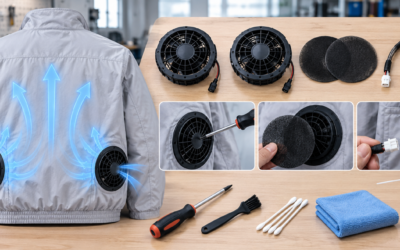
A fan cooling vest is mechanically simple, but the engineering details decide whether it actually works in the field. Rechargeable batteries power small motors that pull outside air into internal channels sewn into the vest lining. That air moves across your chest, back, and underarms, speeding up sweat evaporation and pulling heat off your skin. The system is forced-air-plus-evaporative-cooling, and it’s the dominant structure across the entire wearable cooling technology category.
Core build components most manufacturers work with:
-
Dual-fan or multi-fan configurations
-
Internal airflow channels (ducting)
-
Zoned airflow — separate delivery to chest and back
-
Removable battery packs
-
USB power or standalone lithium battery packs
Fan placement, duct shape, and exit airflow path are where high-end factories differentiate performance. Two vests can look identical on the outside and cool completely differently based on internal channel design alone.
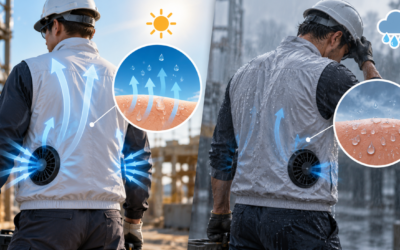
Where this technology performs best: dry-to-moderate humidity, high heat, high physical exertion — construction, logistics, mining, outdoor inspection work. Most product data points to effectiveness dropping off above roughly 95°F/35°C in humid conditions, since the whole system depends on evaporation. In saturated or muggy air, sweat doesn’t evaporate fast enough, and performance suffers.
Where OEM and ODM Customization Actually Split
This is where buyers get confused. Not every customization request fits the same production model.
OEM covers: logo printing or embroidery, Pantone color matching, reflective strip placement, minor fan count or battery capacity swaps, packaging, hangtags, manuals, carton labeling, size specs, and standard fabric substitutions.
ODM territory starts when you touch the internals: new airflow channels, repositioned fan mounts, redesigned ducting, new pattern blocks, different fabric combinations, altered airflow distribution, or a private mold housing.
The dividing line is simple. If you’re changing how air moves through the vest, you’re in ODM territory. If you’re changing how the vest looks or is labeled, OEM handles it.
OEM Advantages & Disadvantages for Cooling Vest Buyers
Every OEM decision comes down to balancing control and speed. Before you sign with any cooling vest manufacturer, weigh both sides against your order size and timeline.
The Advantages
Design control tops the list. You lock a written technical spec before production starts. That spec covers construction, materials, dimensions, colorways, certification requirements, everything. Once that spec is signed and the sample approved, it becomes your production reference. That’s tighter IP ownership than you’ll get anywhere else in this industry.
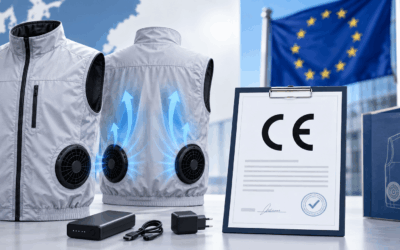
OEM also unlocks real differentiation. You can change fabric, cooling system architecture, pocket layout, branding, and packaging to build SKUs that don’t exist anywhere else. And if you’re selling into industrial, government, or safety-regulated markets, OEM suppliers typically support certification requests like CE, RoHS/REACH, ISO 13688, NFPA 2112, plus factory audits such as ISO 9001 and BSCI. For fleet contracts and compliance-heavy tenders, that documentation trail matters more than lead time.
The Disadvantages
The cost is upfront cash and patience. Sampling runs 7–15 working days, then bulk production adds another 25–45 days. Full custom programs often take 30–40 days for production alone.
MOQ climbs fast with complexity. Logo-only customization might clear at 50–100 pcs. Logo plus color pushes to 200–500 pcs. Full structural OEM customization runs 500–1,000+ pcs, with some factories quoting 2,000–5,000 pcs for mold changes.
Sample approval is binding too. Get the spec wrong, and that mistake locks into your entire production run. No cheap fix once bulk starts.
ODM Advantages & Disadvantages for Cooling Vest Buyers
Speed is the whole pitch here. ODM strips out the design phase, so you skip straight to branding an existing platform.
The Advantages
Development timelines shrink to 1–2 weeks for sampling and 3–6 weeks for bulk production, which fits a “launch first, validate later” strategy. Investment stays light — expect roughly $5,000–$25,000 for a private label cooling vest program, well below full OEM tooling and development.
MOQs are low too. Because you’re customizing an existing structure, factories accept orders of 100–200 pieces. That lets you test the market without risking your whole budget. That’s why startups use ODM to validate product-market fit before committing to deeper customization.
Branding flexibility includes logo placement, woven labels, color swaps, packaging, and minor fabric substitutions. These changes let you differentiate on the shelf without touching the vest’s core engineering.
The Disadvantages
The tradeoff is exclusivity. ODM platforms get sold to multiple buyers, so your “custom” vest may look nearly identical to a competitor’s. Differentiation comes from marketing, not product architecture.
Structural control is limited by design. Fan placement, airflow channels, and pattern blocks stay fixed. You’re locked into whatever the factory built, and IP for that base design stays with them, not you.
That dependency compounds over time. Reorders, style updates, and line extensions all run through the same supplier. Over the long term, that limits pricing power and makes it harder to build a defensible brand moat. A real concern if you’re aiming past short-term seasonal demand into a lasting product line.
How to Choose Between OEM and ODM for Your Cooling Vest Brand
Three questions settle this decision faster than any factory sales pitch. Do you already have drawings or a locked tech spec? Do you need a unique airflow, battery, or pocket configuration nobody else has? Or do you just need to get a branded product to market fast, without burning six months on development?
If you answered yes to the first two, go OEM. If the third question hit home, go ODM.
Match the model to your company stage:
-
Mature brands with a defined use case — OEM wins. You’ve already got a differentiation plan and a target market. OEM gives you the structural and material control to execute it.
-
Startups and private-label retailers — ODM wins. Enter fast using a proven base model, rebrand it, tweak a few features, and start selling.
-
Industrial and safety buyers — OEM is the safer bet. If your vest needs to integrate with hi-vis workwear or meet jobsite-specific functional demands, you can’t hand that off to a generic ODM shell.
Budget and timeline benchmarks worth knowing:
-
ODM: 7–14 days production, with some factories running up to 3,000 units/month capacity.
-
OEM standard customization (logo/color): 30–35 days.
-
Full OEM (custom design, fabric, packaging): 35–40 days.
-
MOQ starts around 500 pieces for basic OEM changes and climbs to 3,000–5,000 pieces for deep customization involving new molds.
Don’t forget the cooling method itself. Fan-cooled isn’t the only option here. PCM, water-circulation, and ice-pack vests all run through similar OEM/ODM paths. Pick the method that fits your target market and price band before you pick a supplier.
Tight budget, need speed — ODM. Differentiation and product control matter more than launch date — OEM. Factory capacity across this category ranges from 3,000 units/month on the low end to 50,000+ pieces/month for high-volume manufacturers, so match your order size to a supplier built for it.
Fan Cooling Vest Supplier Selection Checklist (OEM/ODM Supplier Screening List)
Vetting a cooling vest factory takes more than a price quote. Run every candidate through this checklist before you sign anything.
Customization depth. Confirm what’s changeable: shoulder/back openings, lining zones, fan mounts, airflow channels, reflective strip layout, pocket or battery compartment position, buckles and zippers. On fabric, check outer material, industrial or medical-grade options, thickness, abrasion resistance, washability, breathability, and Pantone color matching. Verify size grading — men’s, women’s, plus sizes. Confirm packaging flexibility: retail boxes, poly bags, hangtags, carton markings, multilingual care labels. Check branding methods offered: embroidery, screen printing, heat transfer, woven labels.
MOQ, lead time, reorder capability. Standard tiers run 50–100 pcs for logo-only work, 200–500 pcs for logo plus color, 500–1,000 pcs for full OEM, climbing to 1,000–5,000 pcs for structural or fabric changes. Typical lead times: 30–35 days standard, 35–40 days for deep customization, or 7–15 days sampling plus 25–45 days production depending on the factory. Ask whether they keep your signed sample as the reorder baseline and support small-batch repeat runs by color or SKU. Confirm long-term component supply — fans, batteries, wiring harnesses, switches, replacement battery compartments — and whether spares ship separately. Some factories run 50,000 pcs/month capacity with 30-day OEM cycles; rush orders can compress to 15–20 days at roughly a 15% premium.
Branding and OEM/ODM flexibility. Confirm each option individually: logo printing/embroidery, woven labels, hangtags, wash-care labels, carton markings, retail boxes, gift boxes, barcode stickers, multilingual manuals. Prioritize suppliers offering both OEM and ODM — ODM gives you a ready platform, OEM lets you modify structure, fabric, function, and packaging as needed. For cross-border sales, ask about compliant export packaging, barcode systems, marketplace-compliant labeling, and carton drop-test requirements.
Industry-specific experience. Match the factory’s track record to your use case — construction (heat, dust, reflective strips, abrasion resistance, quick don/doff), logistics/warehousing (lightweight, long-wear comfort, back ventilation), mining (heat, dust, PPE compatibility, safety certs), or municipal/utility work (durability, standardized sizing, bulk reorder support). Request real case studies, application photos, test data, and existing client types.
Eight questions to send suppliers directly:
– Which elements — structure, fan position, fabric, size, packaging — can be modified, and what’s the MOQ for each?
– What’s the lead time for standard vs. deep OEM customization, both sampling and bulk?
– Do you support logo printing, embroidery, hangtags, gift boxes, carton customization?
– Do you offer both OEM and ODM? How far can an existing platform be modified?
– Do you retain patterns, dies, and component specs for fast reorders?
– Can fans, batteries, and connectors be supplied long-term, with spares available separately?
– Do you have construction, logistics, mining, or municipal project references with photos and specs?
– What’s your monthly capacity, QC process, and AQL/inspection standard?
Conclusion
OEM or ODM – the real question is whether you already have a design or need one.
If your team has already engineered the fan, battery layout, and fabric specs, an OEM cooling vest manufacturer gets your product to market fast and at lower cost. If you’re starting from scratch, an ODM partner brings ready-made engineering, R&D speed, and lower risk—at the tradeoff of less exclusivity.
Either path works if you pair it with the right cooling vest factory. Certifications, MOQ flexibility, and proven wearable cooling technology experience separate reliable partners from costly mistakes.
Don’t guess your way into a supplier relationship. Talk to a manufacturer who’s built both OEM and ODM cooling vest programs at scale, and get a quote that matches your actual business stage—not a generic sales pitch.