Disadvantages of fan-cooled clothing: humidity can turn that airflow into a useless breeze, the fans hum loud enough to matter in quiet workspaces, and battery life has a habit of dying right when you need it most.
We’re breaking down the real disadvantages, from noise complaints to why fan vests underperform in sticky, humid conditions compared to ice or PCM alternatives. You’ll also get a side-by-side comparison table, honest guidance on who should skip fan vests entirely, and answers to the questions you’re probably already asking.
Fan Cooling Vests Struggle In High Humidity Environments

Fan cooling vests work by speeding up sweat evaporation—that’s the entire mechanism. Air moves across your skin, moisture lifts off, you feel cooler. Simple, until the air itself is already saturated with water.
Evaporative cooling works well below 50–60% relative humidity. Above that, it gets sluggish. Cross 70% RH, and it’s basically dead weight with a fan attached.
The numbers back this up. At 50–60% RH, expect a 5–10°F temperature drop—decent, workable. Push past 70% RH, and you’re down to 5°F or less. Some field data shows the drop-off even sooner: a solid 10°F at 50% RH, but only 5–7°F once you hit 60%. Evaporative cooling vest effectiveness falls off a cliff, not sliding gently.
A fan-jacket study backs this science: in 40°C/50% RH lab conditions, the fan suppressed core temperature rise—right at the edge of where evaporation still works.
Where this bites hardest:
– Southeast Asia outdoor work (routinely above threshold)
– Coastal construction and port jobs (marine air pushes RH past 60%)
– Rainy-season builds (humidity spikes make vests feel damp, not cool)
If you’re shopping for a cooling vest for humid weather, treat fan vests as airflow aids, not cooling solutions. For genuinely humid climates, contact-cooling or phase-change vests outperform anything relying on evaporation.
When Ambient Temperature Exceeds Skin Temperature, Airflow May Backfire
Your fan cooling vest has a temperature ceiling. Cross it, and the fan stops helping and starts hurting.
Skin temperature averages around 35°C, according to NIOSH heat-stress data. Push ambient air past that number, and the “cool breeze” you’re feeling is actually warmer than your skin. You’re not cooling down—you’re basting. One study on fan-attached jackets was blunt: manufacturers don’t recommend these vests in hot, humid conditions because the fan pulls in air that can be hotter than your body surface and blows it directly onto your skin.
But the science gets nuanced. In that same study, tested at 40°C and 50% relative humidity, the fan jacket outperformed a 10°C circulating-water vest at suppressing core temperature rise. The catch is that it only held because the design relied on evaporation and ventilation structure, not raw airflow alone. A basic personal cooling fan vest without that engineering won’t get the same result.
Compare that to PCM (phase-change material) vests. In medical PPE trials, 21°C PCM vests dropped heat discomfort reports to just 18%, versus 81% for unprotected workers. Liquid-circulating vests did even more—lowering skin temperature from 36.3°C to 35.5°C and heart rate from 111 to 101 bpm during walking activity.
The takeaway for cooling vest for outdoor work: dry heat and moderate activity—fans hold up fine. High heat plus high humidity plus long shifts is PCM or liquid-cooling territory, not fan territory.
Fan Noise Becomes A Real Problem In Quiet Work Settings

Most fan cooling vest reviews skip the decibel math. Here’s the number that matters: typical fan-jacket products run 35–55 dB, with higher-speed settings pushing toward 50–55 dB. Compare that to a quiet office benchmark of 40–45 dB, or a library’s target of 30–35 dB. Do the subtraction yourself—your vest might be louder than the room you’re sitting in.
This fan vest noise problem hits hardest in:
-
Call centers—fan hum bleeds into headset audio and muddies speech clarity
-
Labs and computer rooms—specced at 40–45 dB or lower, easily disrupted by a 50–55 dB vest
-
Medical and patient-facing areas—low ambient noise isn’t optional here
-
Libraries and study rooms—targeting 30–35 dB means a fan vest stands out immediately
-
Meeting rooms—40–45 dB design ranges leave zero room for whirring fans
Fanless vests sit under 30 dB, essentially silent. If your workplace demands quiet, that’s your real benchmark—not the marketing photos.
Battery Dependence Limits Long-Shift Reliability
Runtime claims live in a fantasy world. Manufacturers test fan cooling vest battery life on low-speed settings in mild, air-conditioned rooms — not on a job site in July.
Here’s the real spread. Low fan speed gives you roughly 8 hours. Medium: 5 hours. High: 3 hours. Battery capacity matters too — a 10,000mAh pack gets you about 5.5 hours at mid airflow, while a 20,000mAh pack stretches to 8+ hours at low speed or 5–6 hours at mid.
Shift length changes the math entirely. Industrial buyers group battery packs this way: 2,000–4,000mAh covers 2–4 hours, 5,000–7,000mAh covers 5–8 hours, and only 8,000mAh+ reaches the 12+ hour territory a full warehouse or construction shift demands.
Now the part nobody puts on the box: 95°F+ heat at higher fan speeds can cut real-world runtime by 50–70%. A vest advertised at 6–10 hours might deliver 1–2 hours of strong cooling before you’re back to a warm vest and four hours left on shift. Recharging takes 2–3 hours at room temperature — no help mid-shift. For long-shift work, prioritize hot-swap systems (under a minute to switch) over single-battery setups.
Cooling Intensity Is Milder Than Ice Or PCM Vests

Fan vests trade intensity for duration. Ice and PCM vests deliver a sharp cold hit. Fan vests deliver steady airflow. Those are not the same thing.
The numbers make this obvious. PCM vests start at roughly 22W of cooling power and hold that for about 60 minutes. Ice pack vests start lower—around 10W—then decline to 0W as the ice melts. Fan systems, by contrast, can sustain 108W to 320W of continuous output for 3 hours, but that power targets your head and exposed skin, not your torso. There’s no “cold shock” moment.
PCM inserts typically hold 60–120 minutes, dropping skin temperature 3–4°C. Low-melt PCM options cut torso temperature by 1.5°C within 60 minutes. Water-based vests, for comparison, averaged just 0.2°C across a full session—proof that passive cold sources feel more direct than airflow.
Bottom line for cooling vest cost comparison: if you want that instant icy sensation, fan vests won’t deliver it. They excel at sustained, moderate relief—not intensity.
Airflow Efficiency Drops Under Tight Clothing Or PPE
Fan cooling vests need breathing room. Literally. Squeeze one under a harness or FR coveralls, and you’ve built a cage around the exact thing that makes it work.
The physics here isn’t subtle. Forced ventilation in protective garments increases heat loss by 45W with just 9 L/s of air movement, but that gain depends entirely on maintaining a gap between skin and fabric. Tighter-fit clothing already runs 6%–31% lower insulation than looser gear, which sounds helpful until you realize it also means fewer airflow pathways for the fan to push through.
Vendor guidance is blunt about this: fan cooling vests work best as an outer layer. Try wearing one under hi-vis, fall-arrest harnesses, or SCBA gear, and the compression can shut down intake and exhaust channels entirely. One vest-structure study even found that pushing airflow from 0.4 to 1.0 m/s reduced cooling capacity in certain designs—more air, less benefit.
Where this fails hardest:
-
Fall protection and construction: harnesses compress the torso, blocking vest channels
-
FR/arc-rated work: sealed outer layers leave zero air gap
-
SCBA and hazmat: airtight ensembles are structurally incompatible with airflow-dependent designs
If your job stacks PPE tight against the skin, request fit-on-gear test data before buying, or default to non-airflow systems like PCM or water-cooled vests instead.
Bulk And Fit Issues Reduce Wearability In Certain Scenarios
Strap on a fan cooling vest, and you’re adding hardware to your body—batteries, fans, sometimes tubing. One published vest spec clocks in at 2.64 kg, covering roughly 20% of body surface area. That’s not nothing when you’re already carrying tools or gear.
Design studies push the other direction, targeting ~1.5 cm thickness and under 1.25 lb above the waist to protect mobility. A 2026 thermoelectric vest claims ~700g, sub-20 dB operation, plus a separate battery backpack—proof that manufacturers still treat weight and external packs as adoption barriers.
Fit matters too. Vests need a snug, close-body seal to work, yet product guidance also flags tubing, outside reservoirs, and protruding mechanical parts as recurring complaints. Motorcycle liquid systems tether riders to a 6.0L chest, adding bulk that fan-only vests avoid, but neither escapes the weight-versus-cooling tradeoff.
Maintenance And Water Sensitivity Require Ongoing Care
Fan cooling vests aren’t set-and-forget gear. They need weekly attention, and skipping that shortens their lifespan fast.
Cleaning schedule that works:
– Weekly: Check the intake grille for dust buildup
– After every use: Wipe the housing, inspect for moisture, confirm the intake isn’t blocked
– In dusty or sweaty environments: Check the grille after each shift, not just weekly
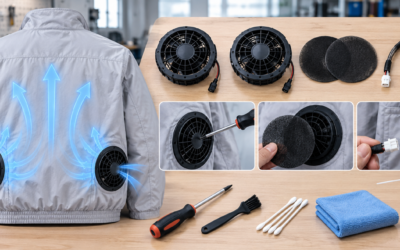
Use a dry brush, cotton swab, or compressed air on the intake. A dry or barely-damp cloth handles the housing. Never submerge the fan or motor housing. Maintenance manuals are explicit: motors shouldn’t get hosed down or steam-cleaned. Power off and pull the battery before cleaning, then let everything dry completely before reassembly. Trapped moisture corrodes connectors.
Blocked vents force the motor to work harder, cutting its lifespan.
Water resistance is limited. IPX4 handles sweat and light splashes, not direct rain. IPX5 tolerates low-pressure jets. Without a clear IPX rating, assume your vest handles sweat only. After rain or heavy humidity, pull the battery and fan, dry thoroughly, and check the connector and fan cavity for condensation before reuse.
Who Should Avoid Fan Cooling Vests (Not Ideal For)
Not everyone should own one of these. Some jobs and body types clash with how fan cooling vests work.
Skip fan vests if you fall into these groups:
-
Tropical or Gulf Coast outdoor laborers: 30–35°C heat with 70–85% RH means you’re already soaked before the fan starts. There’s no dry air left to evaporate.
-
Warehouse pickers in sealed distribution centers: constant walking, limited airflow, sweat trapped under layers. One industrial comparison flags “blowing warm air” once temps hit 30–32°C and RH crosses 70%.
-
PPE-dependent workers: fan vests are bulky outer layers by design. They can’t go under hi-vis or FR gear.
-
Anyone needing quiet: office staff, control rooms, retail floors—battery hum and visible bulk don’t belong there.
-
Short-errand users: tasks under 60 minutes in mild weather (≤26°C/79°F) make the whole setup overkill.
-
High-MET athletes in humid conditions: sustained exertion plus saturated air overwhelms airflow entirely.
Above 85% RH, industry guidance points toward hybrid or non-evaporative alternatives.
FAQ: Common Concerns Before Buying a Fan Cooling Vest
Here’s the stuff you’re still Googling at 11pm before checkout.
How long does the battery actually last? Standard fan vests run 1–8 hours depending on speed and battery size. High-endurance active-airflow models stretch to 8–32 hours. PCM vests hold 2–4 hours, often marketed as “about 3 hours” before you need to recool.
Can you wash it? Remove the fan and battery first, always. The fabric shell handles hand or machine wash depending on the model. The electronics never touch water, period.
Are there side effects? Not medical ones. The real issues are wearing-related: sluggish airflow at low speed, muggy discomfort in humid conditions, noise, added weight, and battery upkeep. Follow the manual’s climate guidance and keep electronics dry.
Five specs to confirm before buying: runtime match to your shift, charging method (USB-compatible? charge-while-wearing?), washability (removable fan/battery), climate fit (humid = fan, dry = evaporative, brief = PCM), and wear scenario (under PPE, riding gear, or workwear affects thickness and noise tolerance).
Conclusion
Fan cooling vests aren’t magic, once humidity climbs past 60% or temperatures exceed your skin’s, effectiveness drops sharply, and battery life will always be the ceiling on how long you can rely on one. That’s physics, not a product flaw. The real win is knowing whether your environment, budget, and work demands line up with what fan technology can deliver.
So before you add to cart, run a cooling vest cost comparison against ice and PCM options. Humid job site? Look elsewhere. Quiet office or long unplugged shifts? Same advice. But if you work in dry heat with outlet access nearby, a fan vest might be exactly right.
Select the appropriate technical solution based on actual operational requirements; if you would like to learn more, please contact the technical team at icebeartech.com.