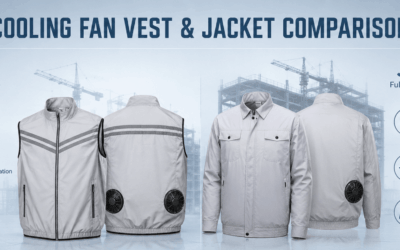
When working in high-temperature environments around 35°C (95°F), many people consider the following question: should they wear a cooling vest or choose a cooling suit with a fan, and which one truly helps reduce the heat burden?
Both provide cooling effects, but their working principles are completely different, and they are suitable for different usage scenarios.
Cooling vests typically absorb and remove body heat through ice packs, PCM phase change materials, or moisture evaporation; while fan-cooled suits use battery-powered fans to continuously deliver air into the garment, aiding heat dissipation by enhancing airflow and sweat evaporation.
The main differences between the two solutions lie in the cooling method, duration, weight, cost, maintenance requirements, and the actual experience during long working hours.
The suitable choice differs for construction workers, industrial workers, and weekend outdoor enthusiasts who need to work continuously for 8 hours. This article will compare the advantages and limitations of the two technologies to help you choose the more suitable high-temperature cooling equipment based on your actual needs.
What is a Cooling Vest? Core Technology and Working Principle
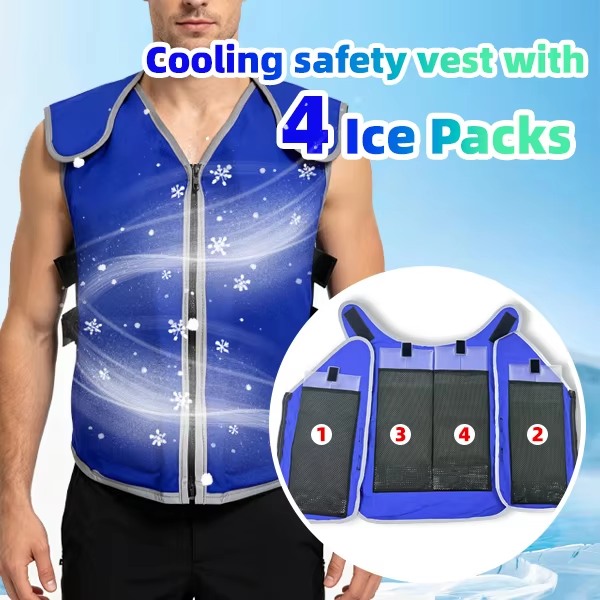
A “cooling vest” is not a single product, but a collective term encompassing various cooling technologies. Different types of cooling vests reduce body heat in different ways.
For individuals who need to work in high-temperature environments for extended periods, choosing the wrong cooling technology may result in the product failing to meet their needs. Therefore, before focusing on brand and price, it’s essential to understand the cooling principle employed by the product.
Currently, cooling vests on the market primarily utilize the following technologies:
Evaporative Cooling Vest
Evaporative cooling vests store moisture through absorbent materials and then use the evaporation of this moisture to carry away body heat.
When the moisture is released from the fabric surface into the air, it absorbs heat from the surrounding body, creating a cooling effect. These products are simple in structure, lightweight, and do not require batteries or refrigeration equipment, making them widely used in outdoor construction, logistics, and sports scenarios.
However, its effectiveness is highly dependent on environmental conditions, performing best in dry environments with good air circulation.
Ice & Gel Pack Cooling Vest
Ice pack cooling vests use direct contact cooling.
Frozen ice packs or gel packs are placed on areas such as the chest and back, absorbing body heat through heat conduction. This method provides rapid cooling and a noticeable cooling sensation, suitable for short-term, high-intensity cooling needs.
Its drawbacks include its relatively high weight and the need for pre-prepared freezing conditions, making it more suitable for applications in fixed locations or environments with refrigeration equipment.
PCM Phase Change Material Cooling Vest
PCM cooling vests utilize phase change materials to absorb heat during the solid-liquid transition.
PCM does not provide continuous rapid cooling but maintains a relatively stable cooling state within a set temperature range, resulting in a more stable and comfortable wearing experience.
Because it is not dependent on air humidity, PCM is more suitable for high-humidity environments, such as factories, tunnels, and steel manufacturing sites—high-temperature scenarios with poor air circulation.
Water Circulation Cooling Vest
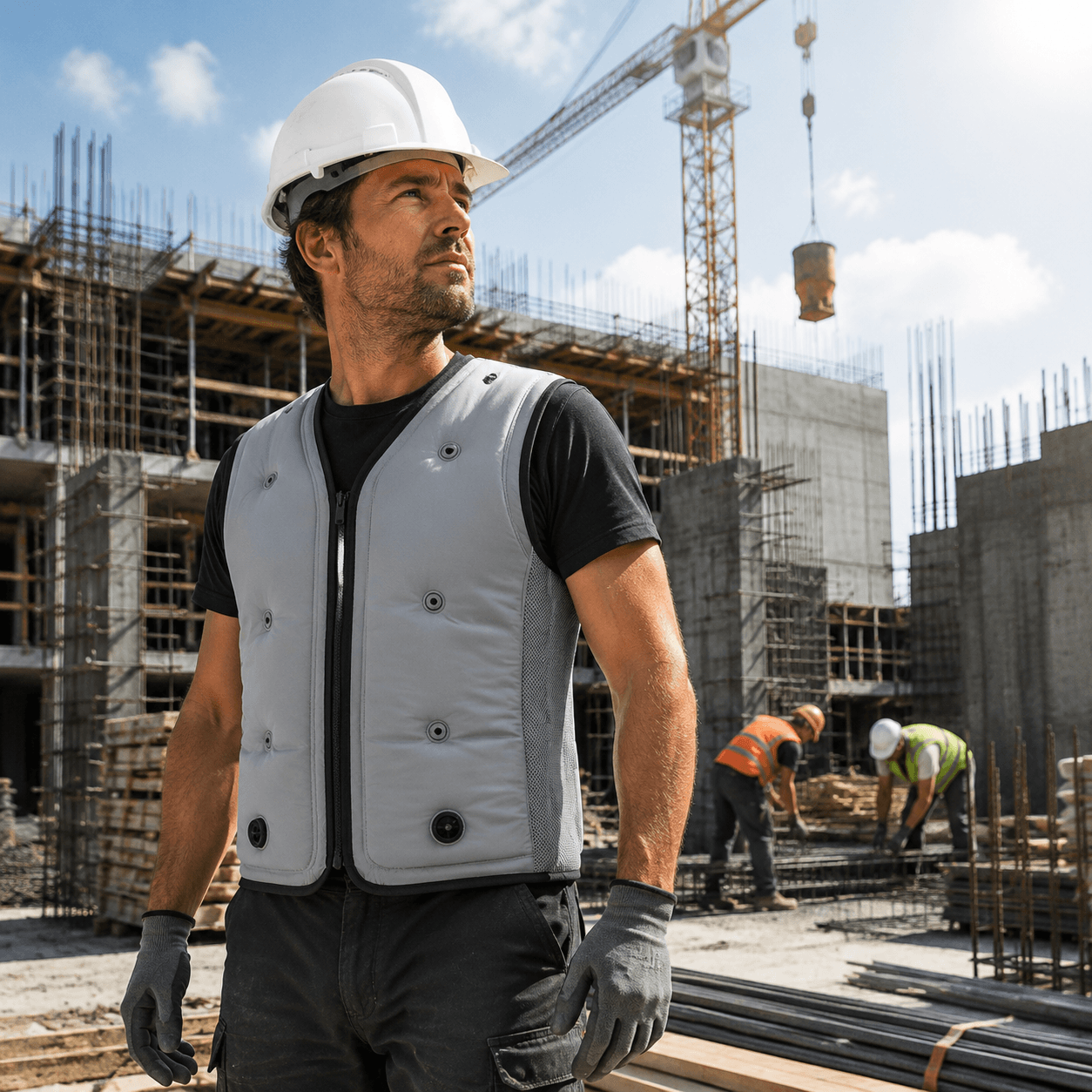
Water circulation cooling vests are currently one of the most effective active cooling products.
They use a battery-powered water pump to continuously circulate coolant within the garment’s internal tubing, transferring coolness to the body surface. Unlike passive cooling methods that rely on storing cold, water circulation systems provide continuous active cooling.
These products are typically more complex, requiring batteries, water pumps, and refrigeration equipment, resulting in higher cost and weight. However, for industrial applications requiring prolonged, high-intensity cooling, such as high-temperature manufacturing, laboratory environments, or special protective scenarios, they offer more stable cooling performance.
What are fan-cooled jackets? How does fan-cooling technology work?
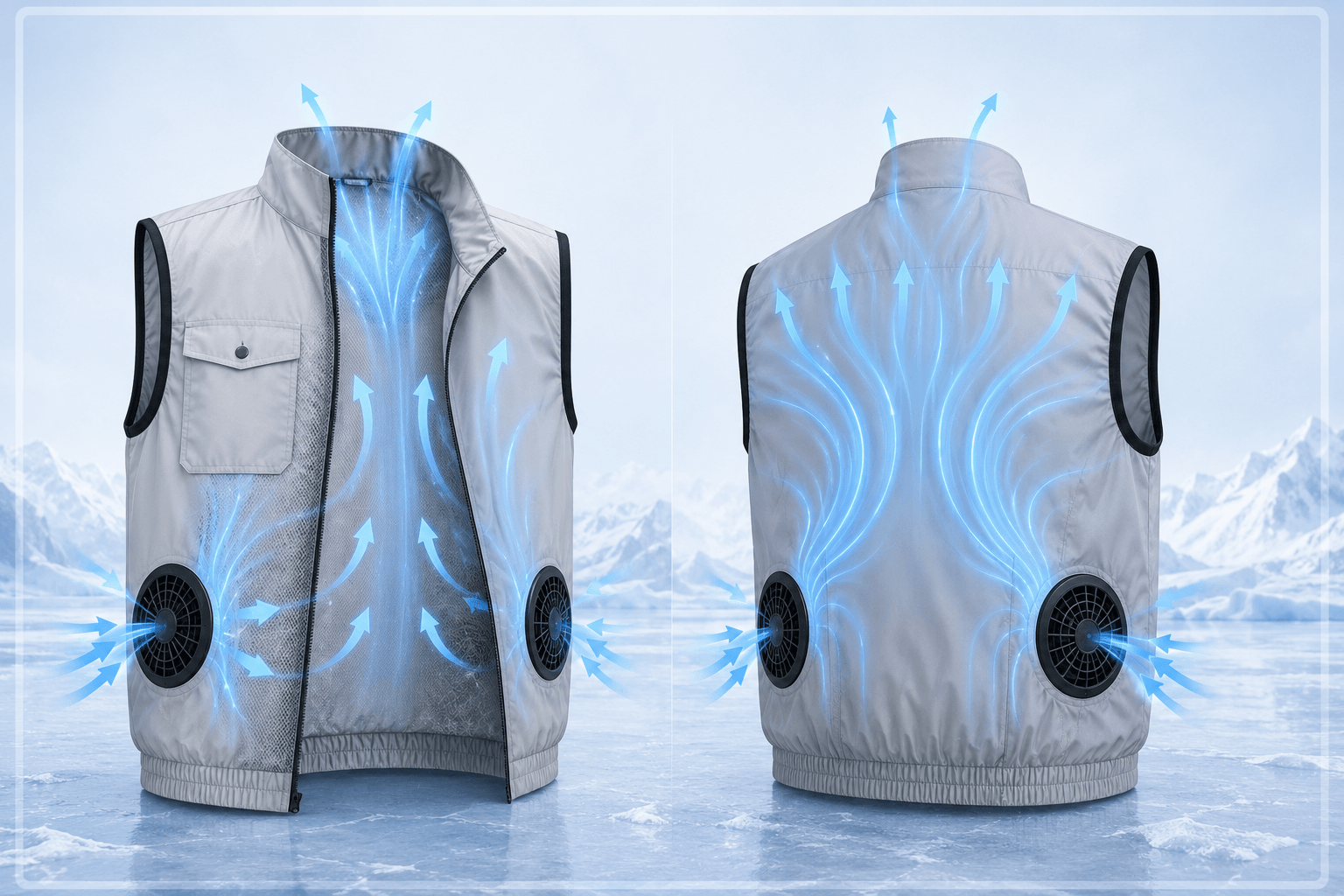
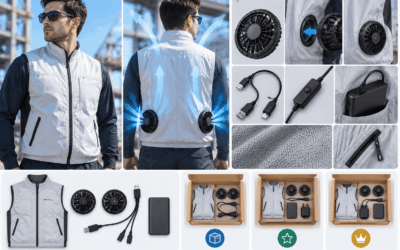
Fan-cooled jackets look similar to ordinary work clothes, but their core feature is the small fans hidden inside the garment.
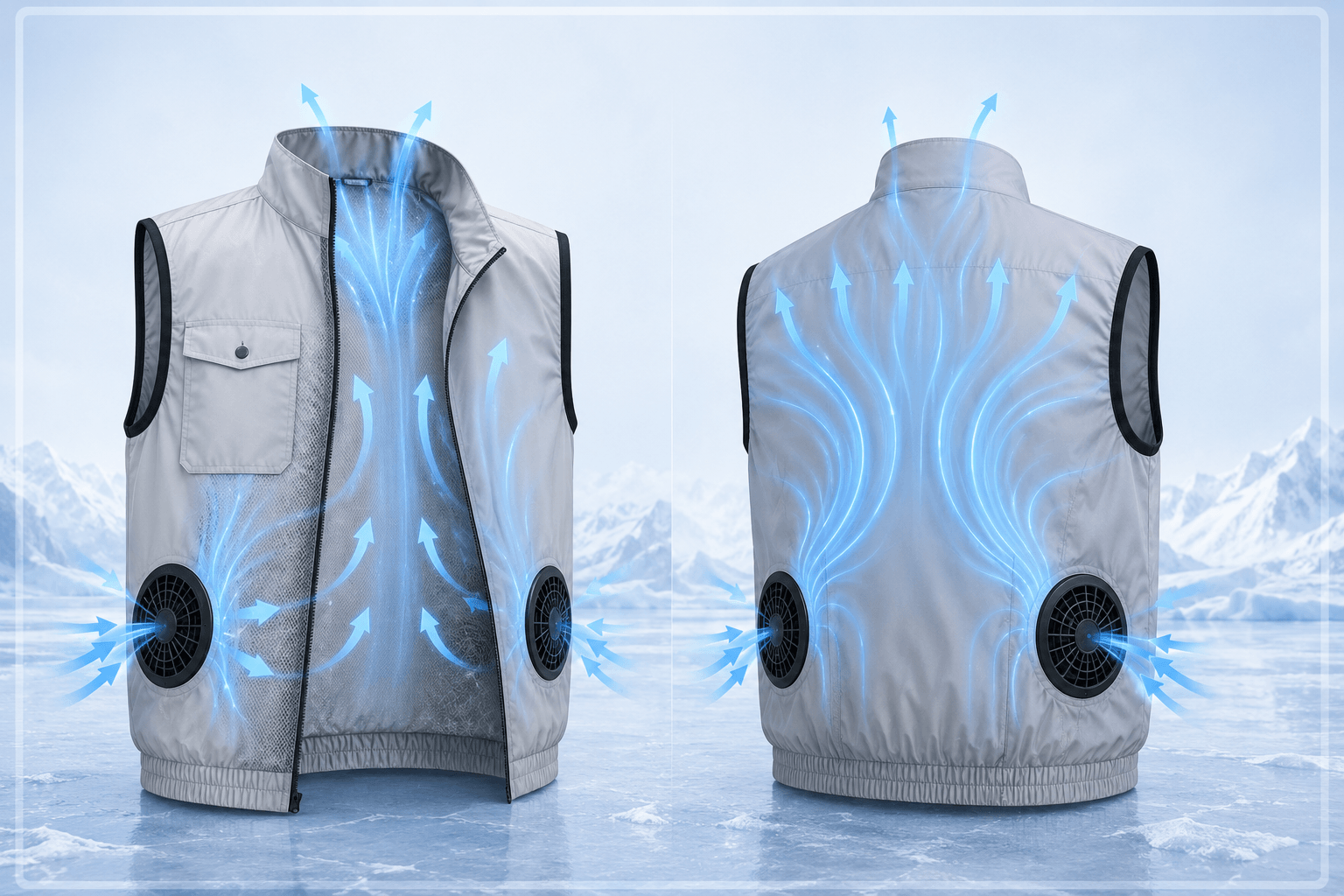
These products typically have 2-4 brushless DC fans installed inside the clothing, powered by a rechargeable battery. A common design features fans mounted on either side of the waist, drawing outside air into the garment, circulating it along the body’s surface, and finally expelling it through the collar, cuffs, and hem.
Through this continuous airflow, fan-cooled jackets improve the stuffy environment inside the clothing, allowing body heat to dissipate more quickly.
Why is fan-cooling effective?
Fan-cooled jackets primarily rely on two methods to dissipate heat:
First, forced convection cooling. The airflow generated by the fan carries away hot air accumulated around the body, allowing more cool air to reach the skin.
Second, accelerated sweat evaporation. When air continuously flows over the surface of moist skin, sweat evaporates faster, and this evaporation process carries away heat, making the body feel cooler.
Therefore, even in high ambient temperatures, as long as airflow promotes sweat evaporation, fan-cooled clothing can still help reduce heat and improve comfort during long work sessions.
Battery life depends on usage intensity.
The battery life of fan-cooled clothing primarily depends on battery capacity and fan speed setting.
Typically:
Low fan speed: Approximately 8 hours, suitable for ordinary working environments;
Medium fan speed: Approximately 5 hours, suitable for most outdoor work;
High fan speed: Approximately 3 hours, suitable for the hottest periods or high-intensity work.
Some high-end products also incorporate PCM phase change materials or Peltier semiconductor cooling modules to further enhance cooling effects. However, these additional features usually increase weight and energy consumption, requiring a balance between battery life, weight, and cooling capacity.
What scenarios are fan-cooled clothing suitable for?
Compared to cooling vests that rely on a cold source, the biggest advantage of fan-cooled clothing is its ability to continuously provide air circulation.
Therefore, it is more suitable for:
-
Construction work;
-
Warehousing and logistics;
-
Factory workshops;
-
Outdoor maintenance;
-
Long-term mobile work.
Especially in environments with some air circulation but high work intensity, fan-cooled clothing can help reduce stuffiness and improve wearing comfort.
Cooling Vest Vs Fan Jacket: Core Comparison Table
Numbers tell the story better than opinions. Lab data at 40°C and 50% humidity gives you real benchmarks instead of marketing claims. Here’s what matters when you’re standing in a supply aisle trying to decide.
|
Dimension |
Cooling Vest (PCM/Water) |
Fan Jacket |
|---|---|---|
|
Core temp reduction |
0.3°C (10°C water circulation) |
0.5°C (2–4 fan design) |
|
Runtime |
2–4 hrs before reheating |
6–18 hrs depending on fan speed |
|
Weight |
1.5–3.5 kg |
0.6–1.2 kg |
|
Noise level |
Near-silent (<30 dB) |
35–55 dB |
|
Humidity dependence |
Low—works in RH 60–80% |
High—performance drops above RH 60% |
|
Maintenance |
Freezing cycles, pump/hose cleaning |
Battery charging, fan mesh cleaning |
|
Price range |
$30–$1,000+ (disposable to industrial) |
$80–$300 (full kit) |
|
Best for |
High humidity, enclosed spaces, quiet settings |
Outdoor, long shifts, high airflow environments |
The noise gap matters more than people expect. Fan jackets hit 50–55 dB on high speed, about the same as office conversation. That’s fine on a construction site, less fine in a clinic.
Advantages and Disadvantages of Cooling Vests: Strengths and Weaknesses
Cooling vests primarily extend testing time and increase peak power output by lowering skin temperature rather than core temperature—a difference more significant than most buyers realize.
Advantages of Cooling Vests
Quiet, zero-energy operation is their biggest selling point. PCM, ice packs, and evaporative cooling vests contain no fans or motors, making them completely noiseless. The ultra-thin PCM design adds only 1-2 cm to torso thickness, thin enough to be concealed under standard work clothes or personal protective equipment (PPE).
Each technology has its advantages:
Evaporative cooling vests absorb moisture within 15-30 minutes and provide 2-6 hours of cooling in dry environments with relative humidity below 60%. Industrial-grade ANSI-certified models, priced at $48-61, are the most economical option in this category.
Ice packs/gel packs offer significant and rapid cooling. They cool quickly and refreeze within hours, making them ideal for high-intensity work sessions of up to 2 hours. Phase change material (PCM) panels maintain a stable temperature of 15–22°C and feel dry to the touch. They can be recooled in ice slurry within about 10 minutes without becoming too cold or sticky.
Water-cooled vests offer the strongest core body temperature suppression effect; laboratory data shows they can reduce heart rate and perspiration at temperatures as low as 40°C.
Disadvantages of Cooling Vests
Weight gain is rapid. Covering the entire torso with PCM or ice adds 1–3 kg, while wet evaporative fabric adds another 300–500 grams. This weight becomes very noticeable under harnesses or tight-fitting personal protective equipment.
Battery life is a real limiting factor. Most cooling vests only last a maximum of 2 hours before requiring a cooling pack replacement, and once the temperature rises, the user feels “warm water sticking to their skin.” Humidity levels above 60-65% significantly affect evaporative cooling performance, sometimes even hindering it.
Higher performance comes at a higher cost. Hybrid Peltier/active cooling systems cost between $120 and $220, while basic evaporative systems cost only $48 to $61, and the former requires more maintenance—pipes, pumps, and connectors are all potential points of failure.
Ice vests should never replace full-body cold water immersion in the treatment of exercise-induced heatstroke; they are only supplementary methods.
Fan Jacket Advantages and Disadvantages: Practical Advantages and Limitations
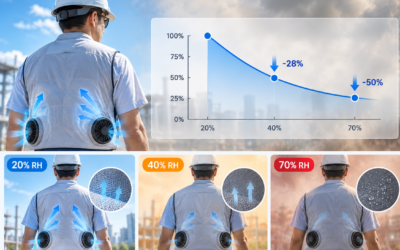
Test data shows that fan jackets perform exceptionally well in dry, hot environments, but their cooling effect diminishes significantly once humidity increases.
Advantages of Fan Jackets
In dry, hot environments, the performance of fan jackets is virtually unmatched. At 40°C and 30% relative humidity, individuals wearing fan jackets experienced significantly lower perspiration, heart rate, and skin temperature compared to those without any cooling measures—the airflow effectively removes heat absorbed from the hot ambient air.
No pre-cooling required. Unlike phase change material (PCM) or evaporative cooling vests that require freezing or soaking, battery-powered fan jackets only need to be charged. This is a real advantage for everyday workwear cooling solutions, as no one wants to go through the hassle of preparing for cooling. Industrial users report a 47% reduction in overheating incidents and an increase of 1.8 hours of work productivity per day compared to other cooling clothing users.
Disadvantages of Fan Jackets
Humidity can diminish their effectiveness. When temperatures exceed 30–32°C and relative humidity surpasses 70%, users describe it as “blowing warm air.” Even with continuous airflow, the inner layer remains soaked with sweat. This personal cooling device is unsuitable for humid and hot climates.
Noise and appearance also limit its usability. The fan noise can interfere with conversations in quiet environments, and the exposed vents on the back look overly industrial and unsuitable for office settings.
Weight and cost also increase rapidly. A full fan jacket weighs between 800–1200 grams and costs over $150–300, while a lighter fan shirt weighs only 450–600 grams and costs over $80–130.
Which cooling solution should you choose? Should be based on your actual work environment.
There is no single “best choice” between cooling vests and fan-cooled suits. The product truly suitable for you depends on your work environment, duration of use, humidity, and activity intensity.
Don’t just look at product images; consider your actual daily usage scenarios first. This will simplify the selection process.
Long-duty outdoor physical labor: Construction, road work, equipment maintenance
If you need to work outdoors continuously for more than 4 hours a day, such as in construction, road repair, or power line inspection, fan-cooled suits are generally more suitable.
These work environments are often high-temperature, and workers need to continuously lift, bend, and climb, generating a significant amount of heat. Compared to PCM or ice pack cooling products that require regular cooling source replacement, fan-cooled suits help evaporate sweat through continuous air circulation, allowing them to continue working as long as the battery has power.
Additionally, fan-cooled suits are usually lighter and don’t add significant burden like multiple PCM modules. Comfort is also an important factor for workers who need to be active for extended periods.
In practical use, it can be paired with a sweat-wicking inner layer to facilitate air circulation within the clothing, thereby improving the overall cooling experience.
High Humidity Indoor Environments: Warehouses, Factories, Production Workshops
If the working environment has high humidity, the effectiveness of fan-cooled clothing may be limited.
For example, in some high-humidity workshops, warehouses, or enclosed spaces, the air already contains a large amount of moisture, slowing down sweat evaporation. Even with increased airflow, the ideal cooling effect may not be achieved.
In such cases, PCM cooling vests are usually a more stable choice.
PCM does not rely on air humidity but absorbs body heat through phase change materials, thus maintaining a relatively stable cooling experience even in environments with poor air circulation.
If the work area also has a stable power supply and requires prolonged high-intensity cooling, a water-circulating cooling system is also a higher-performance option.
Commuting and Short-Term Outdoor Activities: Cycling, Running, Daily Use
For short-term activities of only 1-3 hours, the choice is more flexible.
For activities like cycling and running, lightweight evaporative cooling vests are usually sufficient in dry weather, and they are very convenient as they don’t require batteries or charging equipment.
If a more stable cooling effect is needed, such as for city commutes, motorcycling, or long outdoor waiting times, a lightweight PCM cooling vest is also a good choice. It can provide continuous cooling even in the absence of significant airflow, making it particularly suitable for waiting at traffic lights or low-speed movement.
In short:
High temperatures outdoors + prolonged work → Fan-cooled clothing
High humidity + low airflow environment → PCM cooling vest
Short-term activity + prioritizing portability → Evaporative cooling or lightweight PCM
When choosing cooling gear, the most important thing is not to pursue the “strongest cooling,” but to choose technology that truly matches the work environment.
A More Efficient Cooling Strategy: Combining Fan-Cooled Suit and PCM Cooling Vest
In extremely high-temperature environments, sometimes a single cooling method is insufficient. In such cases, combining a fan-cooled suit as an outer air circulation system with a PCM cooling vest as a close-fitting cooling layer creates a complementary cooling solution.
The two work differently:
The fan-cooled suit accelerates sweat evaporation through continuous airflow, improving the stuffy environment inside the garment; the PCM cooling vest, in direct contact with the body, provides a stable cooling experience through phase change heat absorption, especially effective when airflow is insufficient or sweat cannot evaporate quickly.
Simply put, the fan “removes hot air,” while PCM “continuously absorbs heat.” The combination of these two technologies can cover a wider range of complex high-temperature working environments.
When is this combination suitable?
This combination solution is more suitable for high-temperature, high-humidity, or prolonged heavy physical labor scenarios.
For example, in high-humidity environments, sweat evaporation slows down, and relying solely on fans to increase airflow may have limited effect, while PCM can continue to provide close-fitting cooling.
For work environments sensitive to noise or airflow, such as precision manufacturing, spraying, and woodworking, the usage can be adjusted as needed, making PCM the primary cooling source, with fans only used when appropriate.
For high-intensity work such as construction and industrial maintenance, fan-cooled clothing reduces the accumulation of hot air inside the garment, while PCM can provide additional cooling support during rest periods or peak heat periods.
When is combination not recommended?
While combining can enhance cooling capabilities, it’s not suitable for all situations.
First, if the outer fan-cooled clothing is too tight, it can impede air circulation, reduce fan effectiveness, and even allow moisture to accumulate inside the clothing.
Second, if the work environment lacks stable charging facilities and backup PCM cooling, long-term use requires advance planning for battery life and replacement options. Any active or passive cooling device has its own usage time limitations.
How to combine for better results? When choosing an outer fan-cooled suit, consider the following:
Is the airflow design reasonable?
Are there sufficient air intake areas in the waist and back?
Is the fabric lightweight and breathable?
When choosing an inner PCM cooling vest, consider the following:
PCM phase change temperature;
Duration per application;
Module weight and wearing comfort.
For the inner layer, it is recommended to choose a moisture-wicking fabric and avoid using heavy cotton clothing, as cotton easily absorbs sweat and affects air circulation.
Is the combination solution worthwhile?
Using a fan-cooled suit and a PCM cooling vest together usually costs more than using either product alone. However, for personnel working in high-temperature, high-humidity, and high-intensity environments for extended periods, the “active ventilation + stable cooling” mode formed by the two technologies provides a more comprehensive thermal management solution.
However, the final choice should still be based on the actual working environment. For ordinary outdoor work, using a suitable cooling product alone may be sufficient; while for extreme high-temperature conditions, a combination solution can provide a higher level of protection and comfort.
Cooling Vests vs. Fan Jackets: Frequently Asked Questions by Workers
Workers often ask the same questions before buying cooling vests.
Which cools faster in temperatures approaching 40°C?
Water-cooled vests. The ice water tubes absorb heat through direct contact, and each ice pack can maintain a cooling effect for 3-4 hours. Fan jackets, on the other hand, primarily blow out air at 35-40°C. Once you sweat heavily and feel fatigued, this airflow becomes almost ineffective.
Which works best in humid indoor work environments (such as kitchens and food processing plants)? Avoid fan jackets. When relative humidity exceeds 70%, sweat cannot evaporate, so the airflow is almost ineffective. Phase-change or ice pack vests are recommended because these cooling methods do not rely on evaporation.
I can only afford one; which should I buy first?
For outdoor work with general airflow, fan jackets are recommended; they are cheaper and can cover more people. For enclosed, high-temperature work environments, cooling vests should be given to the workers at the highest risk.
How long do they each last?
A fan jacket using a 10,000mAh battery can operate for 6-8 hours; an ice water vest can work effectively for 3-4 hours before needing to change ice packs; and a water pump itself can run all day on the same battery.
Is a fan jacket useful for motorcycle commuting?
The effect becomes less noticeable at speeds above 40 km/h, as the wind pressure exceeds the cooling effect of the fan. In this situation, physical cooling (ice packs, vests) is more effective.
Conclusion
The choice between a cooling vest and a fan jacket depends on your specific work needs. If you work in a dry, hot environment, need rapid cooling, and have no power source, then an evaporative cooling vest is your best option. However, if you wear multiple layers of clothing, are constantly moving, or work in a humid environment, then a battery-powered fan jacket, by maintaining airflow around the skin, will always provide better cooling.
There’s no one-size-fits-all solution, only tools that suit your environment, budget, and physical condition. Some of the harshest environments can combine both to alleviate the stress of high temperatures around the clock.
Choose the right technology based on your work needs, test it before peak season, and be well-prepared. If you have purchasing needs, please contact us at icebeartech.com.