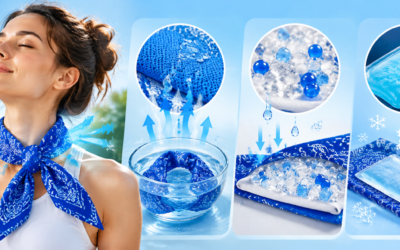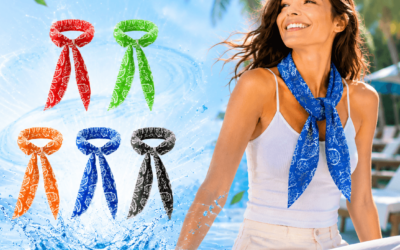
You strap on your cooling scarf, feel that satisfying chill hit your skin, and think, “Finally, relief.” Then twenty minutes later, you’re wondering if it’s already given up on you. Sound familiar?
Cooling gel technology isn’t magic, but it’s not a gimmick either—you just need to know what you’re working with. The cooling effect lasts anywhere from 1 to 3 hours, depending on factors most people never think about (spoiler: it’s not just “quality” or “bad luck”). Whether you’re grinding through a summer shift, chasing a PR in July heat, or just trying to survive your commute, the difference between a scarf that quits on you and one that keeps performing often comes down to a few small, fixable habits. Let’s break down what’s happening inside that gel—and how to make it work harder for you.
Cooling Gel Scarf Duration: The Real Numbers

Real-world cooling scarf duration clusters around 1.5 to 3 hours. That is less than the 15-20 hours some product pages flash. This gap causes buyer’s remorse in this category.
The range depends on what is inside your scarf. The material makes the difference.
Here is a breakdown by cooling scarf material:
|
Material Type |
Typical Duration |
Best-Case Duration |
|---|---|---|
|
Microfiber / evaporative |
1-3 hours |
Rarely exceeds 3 hrs |
|
PVA cooling towel (water-activated) |
2-4 hours |
Up to 4 hrs in dry conditions |
|
Polymer bead / crystal-bead |
4-6 hours |
6+ hrs in ideal conditions |
|
PCM (phase-change material) |
3-6 hours |
Depends heavily on ambient temp |
Every material has a floor and a ceiling. Conditions like humidity and activity determine where you fall in that range.
Your actual use case matters more than the label. If you are sitting in shade or indoors, a PVA cooling towel lasts 2-4 hours. With moderate outdoor movement, expect 1.5-3 hours. Under high heat and heavy exertion, weaker materials may last only 30 minutes to 2 hours. In dry, breezy, ideal conditions, evaporative styles can stretch to 4-6 hours.
The “up to 20 hours” claim is usually tied to storage stability or reactivation cycles, not continuous neck-cooling performance. One product page says the scarf “stays cool for 48+ hours”. The fine print clarifies that this is how long the product holds its charge in storage, not how long it cools your skin while you wear it.
Humidity, wind, temperature, and skin contact all affect the cooling duration.
How long different cooling materials actually last
Gel packs, PVA towels, and PCM wraps cool your skin through different mechanisms. That’s why their cooling times don’t match.
Gel neck wraps use stored cold energy. They cool fast—instant relief when you put them on—but the chill fades in 15 to 30 minutes. Larger gel packs might last 90 minutes, tops. Once the gel warms to skin temperature, it’s done. No fanning or shade brings it back without a fresh freeze.
PVA cooling towels work by evaporation. Water leaves the fabric, pulls heat with it, and the process keeps going as long as there’s moisture and airflow. In dry air, they run 2 to 4 hours, occasionally pushing to 5 in ideal conditions. Humidity kills it—crank it up and you’re back down to 1-2 hours.
PCM wraps absorb heat through phase-change reactions—basically, they melt slowly and steadily. That gives you a more even cooling effect, usually 1 to 3 hours, with high-capacity versions hitting 3.5 to 4+ hours.
If you need a quick blast of relief, go with gel. If you’re outside in dry heat for hours, PVA towels outlast everything. If you want steady, predictable cooling through a humid shift, PCM splits the difference. Match the material to your environment, not the marketing claim on the package.
5 Key Factors That Determine Your Cooling Scarf’s Duration

Two people can wear the same cooling scarf and get wildly different results. One gets 3 hours of relief, the other barely makes it past 45 minutes. The conditions around it make the difference.
1. Humidity and Airflow
Evaporative cooling scarf material needs dry air to work. Once relative humidity climbs past 65%, evaporation slows down hard, and your 2-4 hour PVA cooling towel can drop to 1-2 hours. Push into 80-90% RH (think tropical afternoons), and that same towel might only deliver 30-60 minutes of real cooling before it’s just a damp piece of fabric around your neck. Wind helps, but only to a point. Light-to-moderate airflow speeds up evaporation and extends the effect. Strong, gusty wind does the opposite: it strips moisture too fast, giving you an intense chill upfront that crashes hard soon after.
2. How Tight You Wear It
A snug fit against your skin transfers heat faster, so it feels colder immediately. But that direct contact also burns through the cooling reserve quicker. Thicker, looser fabric slows heat transfer and evaporation, which stretches out duration but with less intensity. If you want a strong initial hit, wear it snug. If you want it to last through a full shift, keep it slightly looser without letting it slide off.
3. Pre-Soaking vs. Pre-Chilling
These aren’t the same thing, and mixing them up leads to disappointment. Soaking your PVA cooling towel fully before wear is non-negotiable: it’s how you activate the cooling scarf material. Pre-chilling it in the fridge makes that first five minutes feel colder, but it doesn’t extend total duration. Humidity, wind, and activity level still decide how long it lasts.
4. Material and Structure
Material makes the biggest difference. Microfiber runs 1.5-3 hours. PVA stretches to 2-4, occasionally 5. Polymer bead and crystal-bead styles push 4-6 hours. Some evaporative fabrics, under ideal lab conditions, hit 4-8 hours, even 12 in rare cases, but that’s with near-perfect humidity and airflow.
5. Thickness and Size
Thicker fabric holds more water but releases heat slower, so cooling feels less intense but lasts longer. Thinner microfiber cools fast and dries fast, often 45-90 minutes before you’re back to square one. Bigger scarves with higher water capacity can push toward 6 hours, at the cost of extra weight and longer dry time.
How to Extend The Cooling Effect: 4 Practical Techniques
Most people sabotage their own cooling scarf without realizing it. The difference between “this thing barely worked” and “I got four solid hours out of it” usually comes down to four small adjustments—none requiring a different product.
1. Nail the “Damp, Not Dripping” Sweet Spot
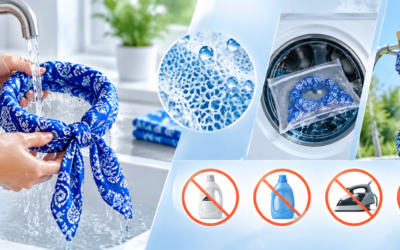
Oversoaking is the number one mistake. Dunk your cooling scarf in cold water for 30 seconds to 3 minutes, then wring it out gently. You want it moist enough to activate the cooling gel technology, but not dripping down your collar. Polymer bead or crystal-bead versions need longer, 3 to 5 minutes, so the crystals fully absorb water before you shake off the excess. Wrapped around your neck, it should feel snug against skin without leaving a wet trail. Too much water and you’re just diluting the evaporation efficiency that makes the whole thing work.
2. Control Your Environment When You Can
Airflow matters more than you might think. A portable fan placed roughly 30 cm from your neck can boost evaporative cooling by 30-40%, though that benefit shrinks once you’re moving around. Keep humidity below 60% RH when possible; anything higher reduces both cooling intensity and duration.
3. Rehydrate the Moment You Feel It Slipping
When the scarf shifts from noticeably cool to roughly body temperature, that’s your signal. For evaporative and PVA cooling towel styles, recharging is simple. Resoak, wring out, done. Bead-based scarves that feel hard or flat need repositioning and rehydration to redistribute the gel evenly.
4. Match Placement to Your Activity
Back-of-neck placement over the carotid area gives you the most efficient full-body cooling effect. For outdoor work, add wrist or forehead contact points to stretch relief further without needing a fresh soak.
How to Reactivate Your Cooling Scarf: Step-by-Step by Type

Every cooling scarf material recharges differently. Use the wrong method and you might think the thing died after one wear. Here is what actually works for each type.
Evaporative / PVA cooling towel
-
Submerge in cold or room-temp water (20-25°C works fine—no ice needed) for 30-60 seconds. Some products call for 1-3 minutes.
-
Wring gently until damp, not dripping.
-
Snap or shake it for 3-10 seconds to let air into the fibers and kick-start evaporation.
-
Put it on and go. Repeat as many times as you want—resoaking is the entire recharge cycle.
SAP / gel crystal-bead scarves
-
Soak in cold water for 2-5 minutes. If the beads still feel firm at the core, extend to 15-25 minutes.
-
You are done when the crystals feel plump but not stiff—no hard lumps left.
-
Wring off surface water and put it on.
-
No reactivation limit here. Just resoak whenever it goes flat.
PCM (phase-change material) wraps
-
Freezer: 20-60 minutes, with 40 minutes being the common sweet spot.
-
Ice water: 10-20 minutes for a faster charge.
-
Refrigerator: about 60 minutes, though some products range from 25 minutes to 3 hours.
-
Let it sit 5 minutes after removal before wearing. Straight-from-freezer contact can feel harsh on skin.
Gel / ice pack scarves
-
Lay flat in the freezer for 4-6 hours for full reactivation. Lightweight versions may need only 15-60 minutes.
-
Rest 5 minutes post-freezer before putting it on.
-
Expect 30-60 minutes of strong cooling per cycle before you are back to step one.
Which Cooling Scarf Type Should You Choose Based On Duration Needs
Pick a cooling scarf by the window of time you need it to cover. A gel pack that crushes a 20-minute sprint will feel useless during an 8-hour landscaping shift. Match the material to that window, not the flashiest number on the packaging.
The decision framework boils down to one table:
|
Your Time Need |
Best Cooling Scarf Type |
Typical Real-World Window |
|---|---|---|
|
≤30 minutes |
Gel / ice pack |
15-30 min (up to 90 min for large packs) |
|
1-3 hours |
PCM (phase-change material) |
1-3 hrs, up to 2-4 hrs in stable conditions |
|
2-5 hours, dry/breezy |
Evaporative / PVA cooling towel |
2-4 hrs, up to 4-5 hrs ideal |
|
4+ hours or full shift |
Hybrid PCM |
Commonly rated up to 4 hrs, most consistent for long stretches |
Short, intense bursts — sprints, HIIT circuits, event breaks — call for gel or ice pack scarves. You’re not trying to stay cool for hours. You want an immediate blast, use it, done.
Outdoor labor, delivery routes, landscaping — pick evaporative if you’re in dry conditions and can rewet on the go.
Commuting, camping, standing in line, long outdoor stretches call for PCM or hybrid PCM.
If your need exceeds four hours, hybrid PCM is your safest bet. Straight PCM options commonly land in the 1-4 hour range, and evaporative styles that promise 4-5 hours in dry lab conditions can drop to 1-2 hours the moment humidity or sweat gets involved.
The biggest mistake buyers make is shopping by max-stated duration instead of real-use windows. A “5-hour” cool scarf for hot weather claim usually assumes ideal humidity and airflow, not your actual Tuesday afternoon in July.
Quick rule of thumb:
– Under 30 min → gel/ice pack
– 1-3 hrs → PCM
– 2-5 hrs, dry and rehydratable → evaporative/PVA
– Over 4 hrs or full shifts → hybrid PCM
If you’re shopping for a reusable cooling scarf built around this logic, icebeartech.com breaks down their lineup by exactly these use cases.
Conclusion
Your cooling scarf will keep you comfortable for roughly 2-3 hours per activation, but that number changes with heat, humidity, and how you wear it. Smart reactivation techniques and the right cooling gel technology let you stretch that window longer, whether you’re on a job site, out for a run, or just surviving July.
Don’t let a scarf sit in its packaging waiting for the right moment. Soak it, snap it, wear it, then reactivate and repeat.
If you’re shopping for your first one or replacing a scarf that’s lost its magic, browse IceBearTech’s cooling lineup. Match the duration specs to your actual day, not the marketing copy. The right scarf disappears into your routine.