In hot weather, whether it’s outdoor sports, long hours at work, or daily commutes, many people experience similar feelings: increasing sweating, a stuffy neck and body, and a desperate need for a simple way to quickly relieve the heat.
This is why many people first pay attention to cooling scarves.
However, problems often arise when actually choosing a product. The market offers different types of cooling materials, such as PVA, PCM, SAP super absorbent materials, and ordinary absorbent fibers. Different products have significantly different cooling methods, durations of cooling, and applicable environments.
So, how exactly does a cooling scarf work? Does it really help reduce the feeling of heat? What materials and designs are effective in real-world high-temperature environments?
This article will start with the principles of evaporative cooling, the characteristics of different materials, and practical application scenarios to help you understand how to choose a cooling scarf that suits your needs, rather than buying an ordinary scarf that only “keeps you damp.”
What is a cooling scarf? How does it work?
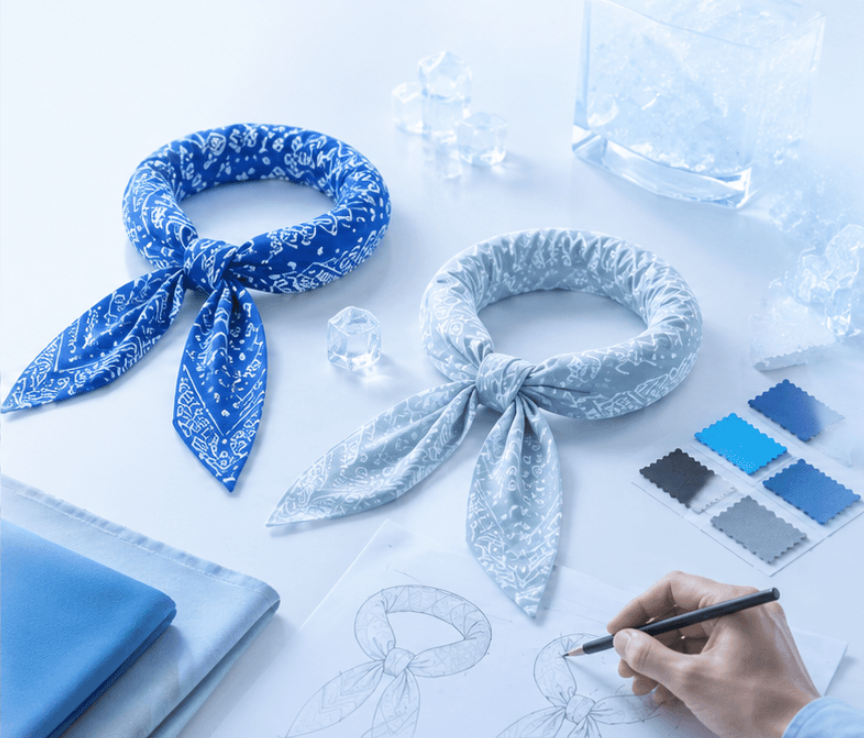
A cooling scarf (also known as a neck cooling scarf) is a personal cooling product worn around the neck that uses different materials and technologies to help remove heat from the skin’s surface.
Currently, cooling scarves on the market mainly employ three cooling methods:
Evaporative Cooling
PCM Phase Change Material (PCM)
Gel/SAP Technology
Many products choose the neck as the cooling area because the skin there is thin and close to important blood vessels. Reducing heat around the neck helps the body achieve a cool and comfortable feeling more quickly.
Evaporative Cooling Scarf
Evaporative cooling scarves are currently the most widely used type of product.
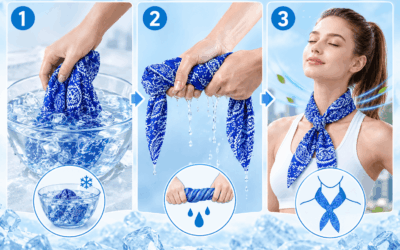
To use, simply immerse the scarf in water to activate it, squeeze out the excess water, and then wear it. As the water in the material gradually evaporates, heat is carried away from the scarf’s surface and the skin, resulting in a cooling effect.
This technology, with its simple structure and lack of batteries or refrigeration equipment, is widely used in sports, outdoor activities, and high-temperature working environments.
Different materials have varying water absorption capacities. Some products activate in just a few minutes, while highly absorbent materials may require longer soaking times for a more lasting cooling effect.
PCM Phase Change Cooling Scarf
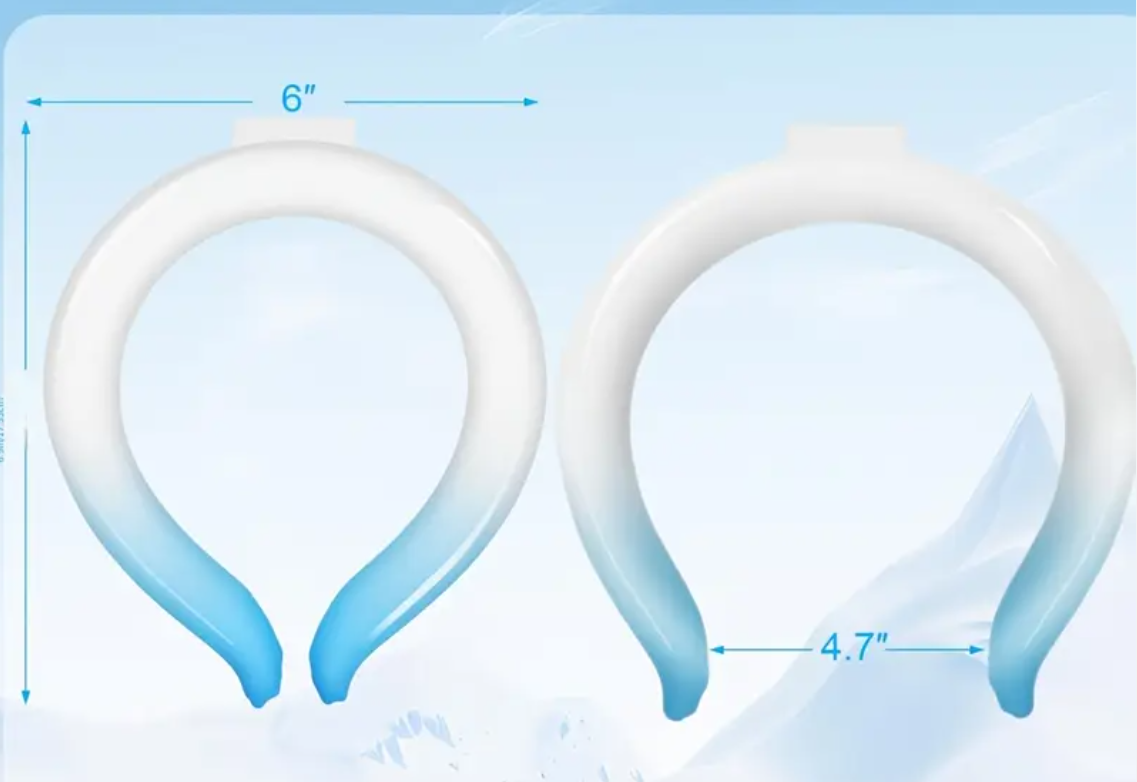
PCM cooling scarves utilize phase change materials, absorbing heat through the process of the material changing from a solid to a liquid state.
Unlike evaporative cooling products, PCM is not dependent on air humidity and does not need to be kept moist. It only needs to be pre-cooled before use, providing a more stable cooling sensation when worn.
Common PCM materials are typically designed to undergo a phase change within a specific temperature range, such as approximately 15–20°C, thus avoiding the extreme cold stimulation associated with ice.
These products are suitable for scenarios requiring a stable cooling experience where frequent rehydration is inconvenient.
Gel and Polymer Bead Cooling Scarves
These products utilize absorbent gels or superabsorbent polymers to store a large amount of moisture and maintain a cooling sensation by slowly releasing it.
Compared to regular evaporative cooling scarves, they typically store more moisture, thus providing a longer-lasting moist and cooling experience.
Some ice gel products deliver cooling directly through low-temperature materials, resulting in faster cooling, but the duration usually depends on the cooling source’s capacity and the ambient temperature.
When choosing a cooling scarf, the most important question isn’t which technology is “best,” but rather which best suits your usage style:
If you need lightweight, equipment-free daily cooling, evaporative cooling is generally more convenient;
If you need a stable cooling sensation unaffected by humidity, PCM is a better choice;
If you seek a more noticeable cooling effect in a shorter time, gel or ice pack products may be more suitable.
Truly effective cooling products need to be matched to your environment, activity level, and usage habits.
How to Choose the Right Cooling Scarf? 6 Key Factors
When choosing a cooling scarf, don’t just focus on the “continuous cooling for X hours” advertised. What truly matters is: your usage scenario, environmental conditions, cooling method, and long-term user experience.
The following factors can help you choose a product that’s more suitable for you.
1. Consider Your Usage Scenario First
Different scenarios require completely different cooling scarves.
For activities like running and cycling, lightweight, fast-activating evaporative or PCM (polydimethylformamide) scarves are more suitable, avoiding any burden during wear.
For outdoor workers, stable cooling time and durability are more important; PCM or highly absorbent materials are usually more suitable.
If it’s just for daily commuting or short-term use, a lightweight cooling scarf will suffice.
2. Choose According to Climate
Ambient humidity directly affects cooling effectiveness.
Evaporative cooling scarves perform best in dry, well-ventilated environments because moisture evaporates quickly, carrying away heat.
In high-humidity environments, the air cannot quickly absorb moisture, significantly reducing evaporation efficiency. In such cases, PCM or other humidity-independent cooling technologies may be more suitable.
3. Focus on Activation Method and Duration
Different technologies have different usage methods.
Evaporation-type products typically only require soaking in water, offering convenience and speed; PCM products require pre-cooling but provide a more consistent cooling sensation.
When choosing, consider your actual wearing time, not simply the longest advertised duration.
4. Consider Wearing Comfort
Cooling scarves are in prolonged contact with the skin, so weight, thickness, and fit are all important.
Designs that are too thick or heavy may affect comfort during activities. Adjustable designs and soft fabrics generally provide a better wearing experience.
5. Check Materials and Safety
Different materials affect absorbency, breathability, and lifespan.
High-quality products usually clearly state the materials used, such as PVA, SAP, and superabsorbent fibers, and provide relevant safety testing information.
For products used in close contact with the skin for extended periods, material safety is especially important.
6. Focus on Reusability
Cooling scarves typically require repeated use, so durability is also an important factor.
When choosing, pay attention to whether the product has undergone cycle testing and whether its absorbency and cooling effect remain stable after long-term use.
The key to choosing a cooling scarf is not finding the “coldest” product, but rather finding a cooling solution that best matches your environment, usage time, and needs.
What are the differences between different cooling scarf materials?
Different cooling scarves use different materials, resulting in differences in absorbency, cooling time, usage, and comfort.
Understanding the characteristics of the materials is more important than simply focusing on the “longest cooling time” advertised.
Microfiber: Lightweight, fast-acting, suitable for everyday use
Microfiber is currently a widely used cooling material.
Its characteristics include rapid water absorption, light weight, and ease of use. When soaked, water quickly distributes between the fibers and carries away heat through evaporation.
These products typically require minimal maintenance, are easy to clean, and are suitable for everyday activities such as running, outdoor activities, and commuting.
Its drawback is its relatively limited water retention capacity, so its sustained cooling time is usually shorter than that of highly absorbent materials.
PVA Cooling Material: More noticeable cooling sensation, suitable for high-temperature environments
PVA (polyvinyl alcohol) is a common highly absorbent cooling material.
Compared to ordinary fibers, PVA can store more moisture, thus typically providing a more noticeable and longer-lasting cooling sensation after activation.
However, PVA material may harden after drying and needs to be rehydrated to restore its softness. Care should also be taken to avoid folding and squeezing during storage.
These products are more suitable for:
Outdoor sports;
High-temperature work;
Dry and hot environments.
PCM Phase Change Material: Stable cooling, unaffected by humidity
PCM (Phase Change Material) uses a different cooling method than evaporative cooling.
It absorbs heat during a phase change, thus maintaining a relatively stable temperature. Its biggest advantage is that it is unaffected by air humidity, making it more stable in humid environments.
Compared to evaporative cooling products, PCM usually requires pre-cooling, but does not require continuous rehydration during use.
Suitable for:
High humidity areas;
Prolonged wear;
People who need a stable cooling sensation.
Microfiber + PCM Hybrid Materials: Balancing Comfort and Performance
Some high-end cooling scarves combine multiple materials, such as the soft comfort of microfiber with the stable cooling capabilities of PCM.
This design reduces the shortcomings of a single material:
It is less dependent on ambient humidity than pure evaporative cooling materials;
It is softer and more comfortable than pure PCM products;
While maintaining a good wearing experience.
However, hybrid materials are generally more expensive, so the choice should be based on actual usage needs.
Which material is best?
No single material is suitable for all situations:
For lightweight and quick use → Microfiber
For noticeable cooling and longer duration → PVA
For high humidity environments or stable cooling needs → PCM
For balancing comfort and performance → Hybrid materials
A truly good cooling scarf doesn’t use the “strongest” material, but rather chooses a technology that matches the environment in which it will be used.
|
Material |
Cooling Window |
Best Climate |
Maintenance |
|---|---|---|---|
|
Microfiber |
45–90 min |
Humid or mixed |
Machine-washable |
|
PVA |
2–4 hrs (up to 5) |
Dry heat |
Flat-dry only |
|
PCM |
45+ min, steady |
Humid, extended wear |
Higher cost, low upkeep |
|
Hybrid |
Up to 4 hrs |
Any |
Higher cost |
If you want fast, repeatable cooling for everyday humid-weather use, pick microfiber. If you’re chasing a strong chill during one long dry-heat session, PVA earns its stiffness. If humidity is your real enemy, PCM is the only material on this list not fighting the air to work.
How to Properly Activate, Wear, and Maintain a Cooling Scarf?
Many people feel their cooling scarves aren’t very effective, but the problem isn’t necessarily with the product itself. Often, it’s due to incorrect activation, preventing the materials from fully functioning.
The correct usage is simple, but a few details directly affect the cooling experience.
Properly Activating a Cooling Scarf
The activation methods differ depending on the material.
For PVA or evaporative cooling scarves, simply wetting them with water is usually sufficient. After ensuring the material is fully absorbed, gently squeeze out the excess water, keeping the scarf damp but not dripping.
For products using SAP superabsorbent polymers or gel materials, a longer absorption time is needed to allow the internal materials to fully expand and evenly store moisture.
Note that using hot water for activation is not recommended, as high temperatures may affect the structure and lifespan of some absorbent materials.
Keep it “Moist but Not Wet”
A cooling scarf isn’t necessarily more effective the wetter it is.
If there’s too much moisture, it will drip when worn, affecting comfort; if there’s too little moisture, it won’t be able to continuously remove heat through evaporation.
Ideally, it should feel damp and cool to the touch, but not constantly dripping.
Wearing position affects the experience.
Most people wear the cooling scarf around their neck, as this is where the cooling sensation is most easily felt.
Depending on the product design, it can also be placed on the shoulders, wrists, etc., to help alleviate localized heat.
If the product contains absorbent particles, it’s recommended to simply adjust the internal material before use to ensure more even moisture distribution and avoid areas that are too thick or too thin.
How to reactivate during use?
When the cooling sensation gradually weakens, most evaporative cooling scarves only need to be rehydrated to restore their effectiveness.
For extended outdoor activities, prepare a spare cooling scarf for rotation to maintain a continuous cooling experience.
How to store after use?
Before long-term storage, ensure the cooling scarf is completely dry.
Especially with highly absorbent materials, storing them while they are still damp can easily lead to unpleasant odors and even affect their absorbency next time.
The correct way is to let them air dry naturally before storing them in a dry, well-ventilated place.
Properly activating and maintaining a Cooling Scarf isn’t complicated, but these small details can significantly impact the product’s cooling performance and lifespan.
How to Choose the Right Cooling Scarf for Different Use Cases?
No single cooling scarf suits everyone. The truly suitable product depends on your usage environment, wearing time, and ease of rehydration or cooling.
Prolonged Outdoor Work: Prioritize Stable Cooling
For workers in construction, landscaping, logistics, and other industries who require prolonged exposure to high temperatures, cooling duration and sustained stability are often more important than lightweight.
If the work environment has refrigeration facilities, a PCM cooling scarf can provide a more stable cooling sensation, unaffected by air humidity.
If there is no refrigerator or refrigeration equipment, an evaporative cooling scarf made of highly absorbent material is more convenient. It only requires rehydration to reactivate, making it suitable for work scenarios requiring frequent movement.
If you need to wear a helmet or other protective gear, it is recommended to choose a thinner design with a better fit to avoid increasing neck strain.
Running, Hiking, and Cycling: Lightweight is More Important Than Duration
For sports activities, a cooling scarf needs to meet two requirements:
First, it should be lightweight so as not to hinder movement;
Second, it should be easily reactivated.
Evaporative cooling scarves are generally more suitable for these scenarios because they require no additional equipment and can be used simply by soaking in water.
For short-duration, high-intensity exercise, PCM products can also be considered for a more stable cooling experience.
Daily Cooling and Heat Relief: Comfort First
For daily use, such as summer commutes, environments with significant temperature differences between indoors and outdoors, or for those needing relief from sudden heat, comfort is more important than extremely low temperatures.
Soft evaporative cooling scarves or PCM neck cooling products provide a gentle, continuous cooling sensation while avoiding the excessive cold stimulation of ice packs.
For Children and Family Use: Safety and Comfort are Paramount
For family use, it is recommended to prioritize soft, lightweight, and safe cooling scarves.
Compared to rigid cooling products, lightweight evaporative materials are generally more comfortable and suitable for daily activities.
During use, the wearing time should be adjusted according to actual comfort levels, and the product status should be checked regularly.
Travel and Commuting: Choose Based on Ease of Cooling
The most important question for travel scenarios is:
Do you have easy access to a refrigerator or freezer? If not, a water-activated cooling scarf is more convenient, as the cooling sensation can be restored with water at any time.
If you have stable refrigeration conditions, a PCM cooling scarf can provide a longer and more stable cooling experience, reducing the hassle of frequent rehydration.
The best cooling scarf for you depends on your lifestyle.
In short:
High-temperature work environment → Focus on duration and stability
Sports activities → Focus on lightweight and quick activation
Daily use → Focus on comfort and ease of maintenance
Travel and outdoor activities → Focus on ease of reactivation
When choosing a cooling scarf, don’t just look at the advertised “lowest temperature” or “longest duration.” What’s truly important is whether it suits your actual usage scenario.
How to Determine the Safety and Quality of a Cooling Scarf?
When choosing a cooling scarf, many products emphasize selling points such as “safe,” “environmentally friendly,” and “non-toxic.” However, for products used in close contact with the skin for extended periods, these descriptions alone are insufficient.
A truly reliable safety claim should provide corresponding testing evidence, not just be advertising wording.
First, pay attention to whether the product has clear testing standards or certification information. More valuable than simply stating “certified” or “eco-friendly” are specific testing standards, certification numbers, and third-party laboratory reports.
Secondly, material information is also crucial. A high-quality cooling scarf will usually clearly specify the fabric, absorbent materials, dyes, and other functional coatings used, rather than using vague descriptions like “environmentally friendly materials” or “high-grade fabrics.”
Furthermore, the test report should ideally correspond to the actual product, not just a certification logo image. A single sample passing a test does not necessarily mean that every batch of products maintains the same quality.
When Should You Be Cautious?
If a product claims to offer “all-day cooling,” “100% safe,” or “completely non-toxic” effects without providing testing conditions, material specifications, or supporting evidence, it should be viewed with caution.
Similarly, if the material descriptions on the product page and packaging are inconsistent, or if it only emphasizes an “exclusive formula” without disclosing the basic ingredients, it’s difficult to judge the product’s actual performance.
The same applies to claims about cooling duration. A description like “24-hour continuous cooling” doesn’t tell much. Truly valuable information should include the testing environment, temperature conditions, usage methods, and specific testing procedures.
How to Choose a More Reliable Cooling Scarf?
To determine if a cooling scarf is trustworthy, focus on three core questions:
What materials is it made of?
What tests has it undergone?
Under what conditions was its cooling effect verified?
Transparent material information, reliable testing data, and consistent production quality speak louder than exaggerated claims.
For corporate buyers and brand clients, these factors also determine a product’s reputation and long-term performance after entering the market.
How to Choose the Right Cooling Scarf?
There are many types of cooling scarves on the market, but the right one for you depends on your usage environment, wearing habits, and cooling needs.
Before purchasing, consider the following:
1. Identify Your Usage Scenarios
Different people require different cooling methods.
If primarily used for running, cycling, or outdoor activities, a lightweight, quick-activating evaporative cooling scarf is usually more suitable.
If used for high-temperature work or prolonged wear, you need to focus on duration and stability; PCM or high water-retention materials may be more suitable.
2. Consider Ease of Cooling and Rehydration
This is an important factor in choosing the technology.
If your daily environment doesn’t have a refrigerator or freezer, a water-activated cooling scarf is more convenient, requiring only water to restore coolness.
If you can pre-cool and want to reduce frequent rehydration, a PCM cooling scarf provides a more stable experience.
3. Choose Materials Based on Local Climate
Ambient humidity significantly affects cooling effectiveness. Dry, well-ventilated environments are better suited for evaporative cooling materials because moisture is released quickly and carries away heat.
In high-humidity areas, the air is nearly saturated with moisture, slowing evaporation. In these cases, humidity-independent technologies like PCM (Polymer Chloride Mold) have an advantage.
4. Consider Weight and Comfort
Cooling scarves are in contact with the neck for extended periods, so comfort is crucial.
Overly thick or heavy products can impair mobility, especially during exercise or long hours of work.
Choosing soft fabrics, a reasonable weight, and a snug fit is generally more important than simply seeking maximum cooling.
5. Understand Maintenance and Lifespan
Different materials require different maintenance methods.
Some evaporative cooling products require regular washing and thorough drying, while PCM products require proper cooling and storage.
Understanding whether a product is reusable and has undergone cycle testing before purchasing helps determine its long-term value.
6. Don’t Just Look at the Price, Consider Long-Term Cost of Use
A more expensive cooling scarf that can be reused long-term may actually have a lower cost than a cheaper product that requires frequent replacement. When comparing products, focus on material quality, durability, and the actual cost per use, not just the purchase price.
What’s the difference between a Cooling Scarf and a Cooling Towel?
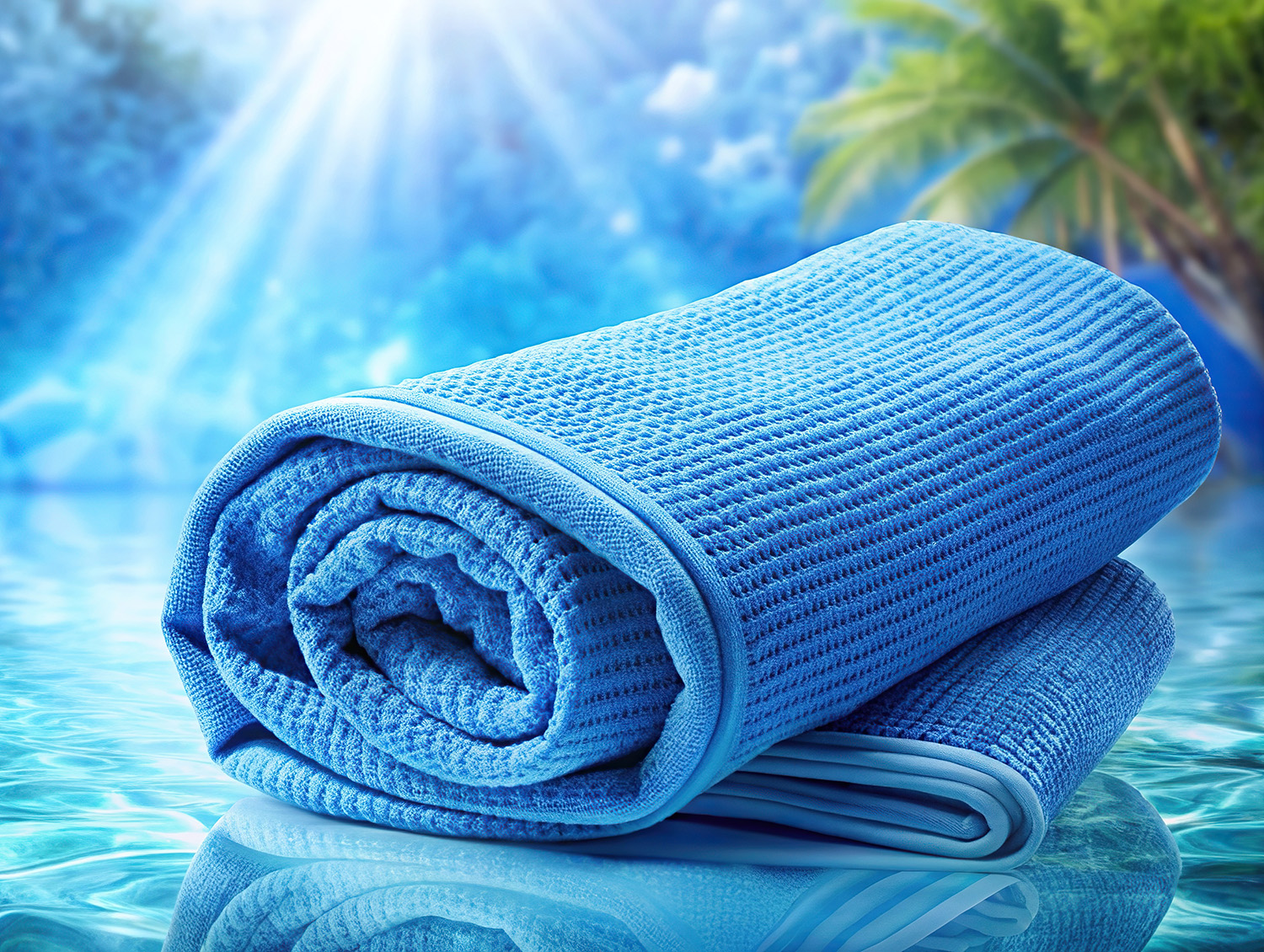
While both are cooling products, they have different design goals.
A Cooling Scarf prioritizes a snug fit around the neck, everyday wear, and extended comfort, making it suitable for commuting, outdoor activities, and daily cooling.
A Cooling Towel typically has a larger absorbent surface area, making it more suitable for sports, fitness, or situations requiring quick wiping to cool down.
In short:
If you need to wear it for extended periods and want it to look like an everyday accessory, a Cooling Scarf is more suitable;
If you prioritize quick absorption and immediate cooling after exercise, a Cooling Towel may be more appropriate.
FAQ: Common Questions About Neck Cooling Scarves
After narrowing down their choices, people often have the following questions:
How long does a cooling scarf last after each activation?
The duration varies depending on the material. Microfiber scarves last 1.5-3 hours, polyvinyl alcohol (PVA) scarves last 2-4 hours, while polymer bead scarves last the longest, up to 4-6 hours. Some sources indicate that gel-based cooling scarves can last up to 15 hours under ideal conditions, but this is only the upper limit of best-case scenarios and not an absolute guarantee.
How many times can a cooling scarf be reused?
If thoroughly dried after each use, polymer bead scarves can be reactivated hundreds of times. Evaporative cooling scarves, if properly cared for, can typically last 2-3 years. Phase change material (PCM) cooling scarves can maintain their cooling effect for 12-18 months. Peltier (electronic) cooling scarves can last approximately 18-24 months before battery aging begins to affect usage time.
What is the correct activation method?
Soak the vapor cooling pack in cool water for 30-60 seconds. Beaded cooling packs require a longer soaking time. After soaking for 5 minutes, gently separate the beads with your hands to prevent clumping. Some cooling packs with more granules may require 15-30 minutes of soaking, so always check the specific instructions for your product before deciding whether to soak quickly.
Is the cooling pack safe for the skin?
For most people, it is safe in most cases. However, prolonged wet contact should be avoided. Wearing it continuously for more than 6 hours may cause maceration of the skin, and people with eczema, psoriasis, or sensitive skin should be cautious of skin irritation. If the cooling pack feels icy and stinging instead of cool and comfortable, remove it immediately. Prolonged direct contact with extremely cold cooling packs may cause skin damage.
Does it need a break?
If you need to wear it all day, you need to take a break. Remove the cooling pack every 2-3 hours for 5-10 minutes to allow your skin to dry and breathe before putting it back on.
Does humidity affect the performance of the moisture-wicking scarf?
Humidity significantly affects the performance of moisture-wicking scarves. Evaporative moisture-wicking scarves lose their effectiveness at relative humidity levels exceeding 65%. Phase change material (PCM) and Peltier element moisture-wicking scarves are completely unaffected by humidity, but PCM scarves require pre-cooling, while Peltier element scarves require battery power and add weight.
How to clean and dry?
Most evaporative and PCM moisture-wicking scarves can be gently machine washed in cold water. Never use bleach or fabric softener, as these will reduce the scarf’s absorbency and subtly undermine its moisture-wicking mechanism. Peltier element and electronic moisture-wicking scarves should only be spot cleaned and never soaked. After each use, thoroughly air dry all items. Beaded moisture-wicking scarves should be hung in a well-ventilated area for 3-5 days to prevent mold growth.
Is it better for running or work?
For running, lightweight evaporative or microfiber/PVA moisture-wicking scarves are superior due to their rapid moisture recovery and low volume. Long-distance running in high humidity environments is an exception; phase change materials perform better there. The U.S. Occupational Safety and Health Administration (OSHA) states that cooling scarves can serve as supplemental personal protective equipment (PPE) when working in high-temperature environments. However, they cannot replace hydration or actual heat stress monitoring, and therefore should not be considered the sole safety measure in high-temperature work environments.
Conclusion
When choosing a cooling scarf, the most important thing is not to find the “most cooling” product, but to find a technology that suits your usage environment and needs.
If you frequently exercise or work outdoors in dry, hot conditions, an evaporative cooling scarf, with its lightweight and power-free features, is a practical choice.
If you prioritize a stable cooling sensation and want to reduce frequent rehydration, PCM or other phase change cooling products may be more suitable for extended use.
What truly affects the user experience is not just the cooling time, but also the activation method, wearing comfort, material performance, and daily maintenance requirements.
A good cooling scarf should integrate into your daily habits, not be relegated to a corner due to inconvenience.
ICEBEAR offers a variety of cooling scarves, cooling neck wraps, and OEM/ODM customization solutions to help brands and enterprise clients develop cooling products more suitable for different application scenarios based on various market demands.