You’re standing in 85% humidity, sweat already soaking through your shirt, and you’re wondering if that fan cooling vest you’re eyeing will actually do anything—or if you’re about to waste $80 on glorified air movement. Fair question. The whole system relies on sweat evaporation, and evaporation is exactly what humid air fights against. So does that mean fan cooling vests are dead weight in swampy climates?
Not quite, but the truth is more nuanced than the marketing copy suggests. We pulled real test data across 30%, 60%, and 90% relative humidity to see exactly where performance falls off—and where it doesn’t. You’ll get the actual numbers, a simple decision rule for your specific climate, and if fan-based cooling isn’t your answer, a breakdown of PCM and hybrid alternatives that might be. No guesswork, just what actually works when the air’s already soaked.
Do Fan Cooling Vests Actually Work in Humid Conditions?
Fan cooling vests work in humidity, but the cooling effect drops as the air gets wetter.
Fan cooling vests work by evaporative cooling. The fan doesn’t create cold air; it speeds up evaporation of sweat on your skin or in the vest’s fabric. That phase change, liquid turning to vapor, pulls heat away from your body. No evaporation, no cooling.
Humidity throws a wrench into that. As moisture in the air rises, the vapor‑pressure gradient between your wet skin and the surrounding air shrinks. There’s less room for sweat to evaporate into. It just sits there or drips off, doing nothing for you.
The Numbers Don’t Lie
Controlled testing backs this up hard. One study increased relative humidity from 20% to 40% at 35°C with 0.4 m/s airflow, and cooling capacity dropped by 28% on average. Another comparison is even more stark: evaporative cooling delivered about 8°C of temperature reduction at 25% RH, but only 2°C at 75% RH. That’s a 75% performance cliff just from humidity alone.
But don’t write these vests off yet. Field data tells a more forgiving story. At 34°C and 60% RH—genuinely humid, genuinely hot—ventilated cooling vests still boosted torso heat loss by 200% to 275% compared to running the fan off. That’s real, measurable heat stress relief, even in conditions plenty of people assume would kill the effect entirely.
Cooling fan vests work in humidity, but their output gets throttled the wetter the air gets. They’re strongest in dry‑to‑moderate humidity zones, weaker as the air approaches saturation. In a swampy, near‑100%‑RH environment, expect diminished returns, not zero returns, just smaller ones than you’d get in Arizona.
How Much Does Humidity Reduce Fan Cooling Vest Performance?
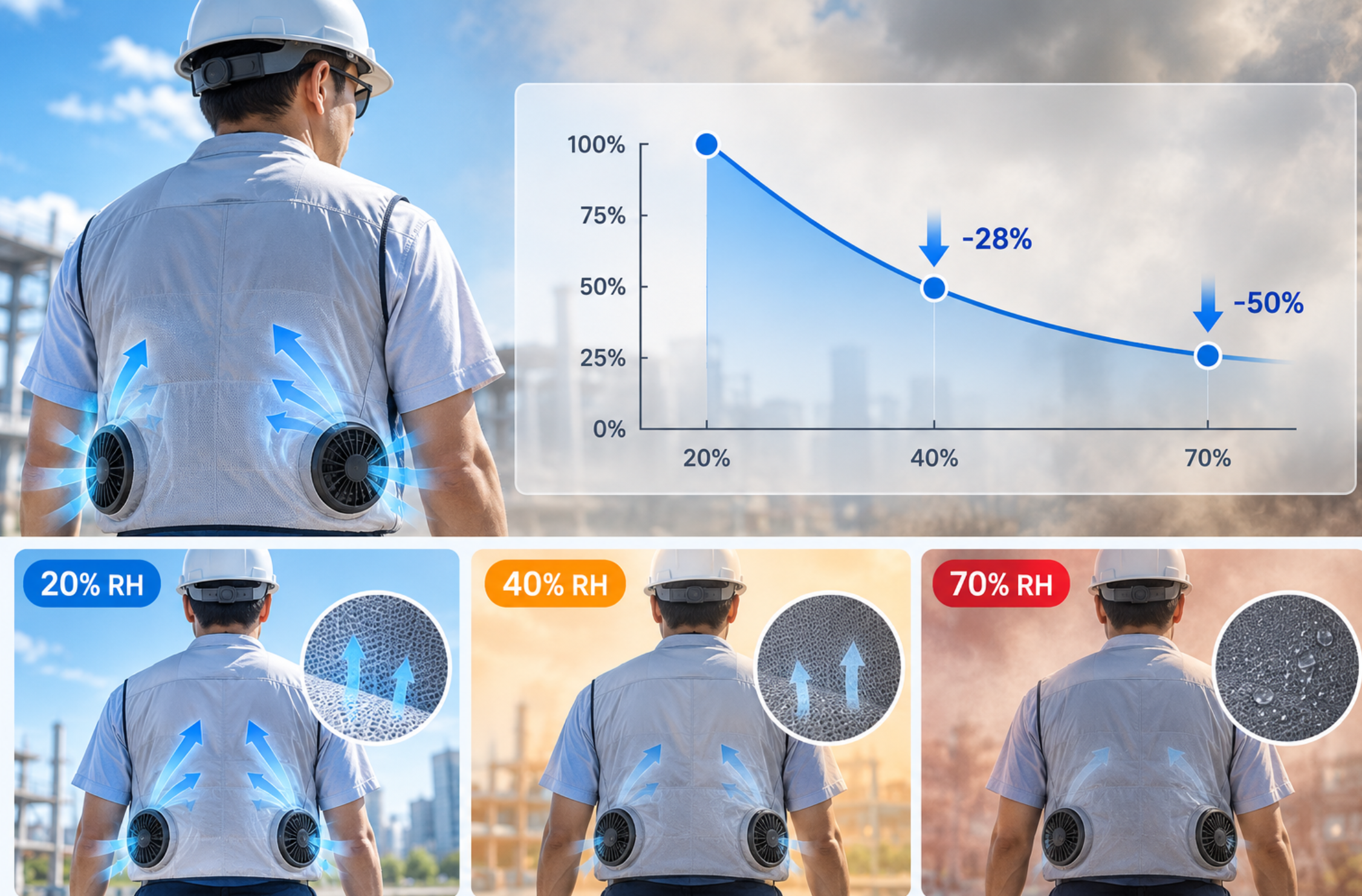
Here’s the curve you need to see, laid out step by step.
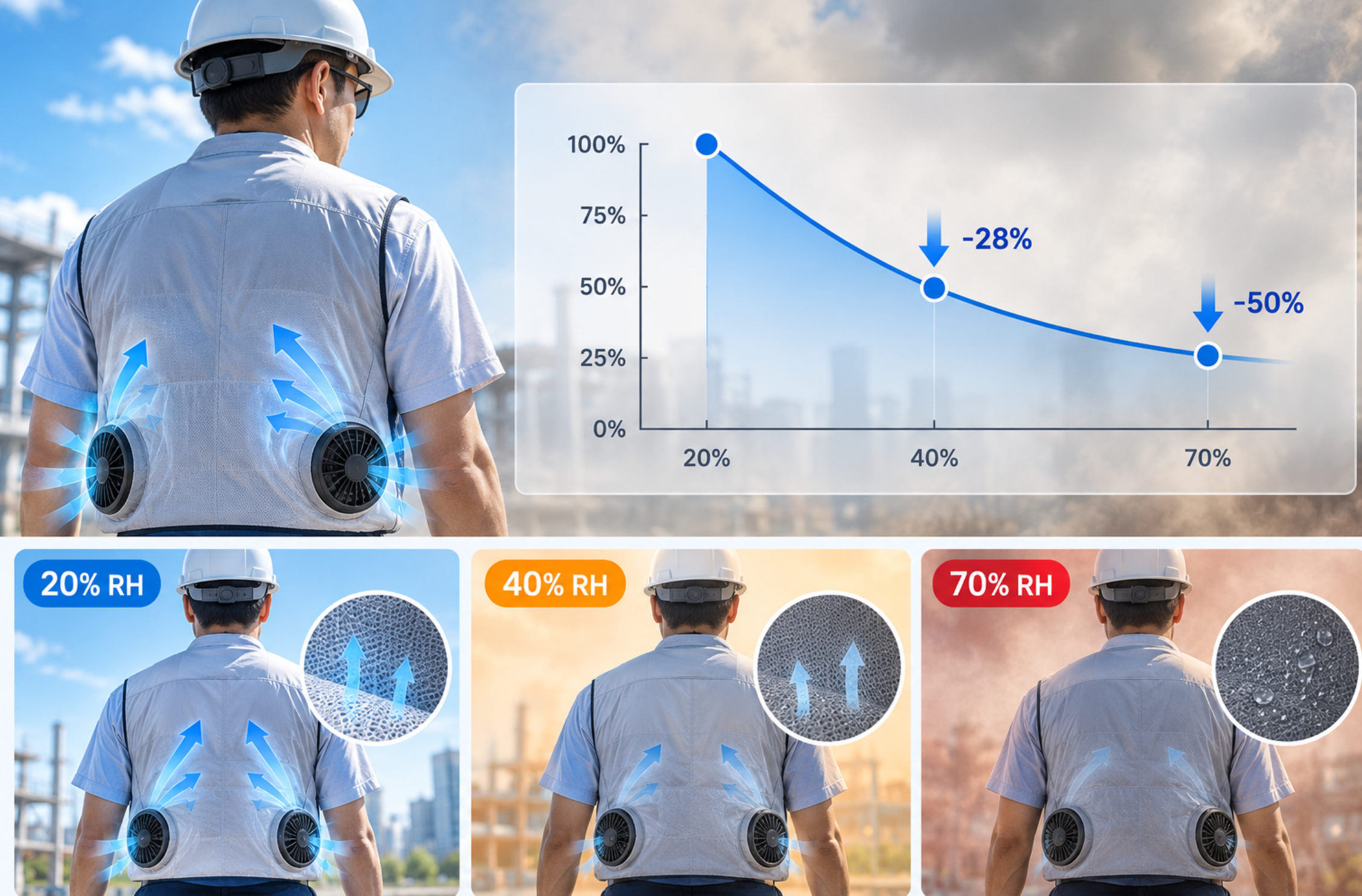
One vest-structure test raised relative humidity from 20% to 40% at a constant 35°C. Cooling capacity dropped by about 28% on average. That’s the first hit, and it happens fast, before you’ve even reached what most people would call “humid.”
Push further to 70% RH, and the drop compounds. At 40% RH, both maximum cooling power (Pmax) and effective cooling power (Peff) came in about 2.0× higher than at 70% RH. Going from 40% to 70% humidity cuts your evaporative cooling vest’s output to about half.
The Humidity Penalty, Step by Step
-
20% RH: peak performance zone for sweat evaporation cooling
-
40% RH: noticeable ~28% loss vs. 20% RH, still functional
-
70% RH: performance craters to about half of what you got at 40% RH
That’s a steep, front-loaded penalty. Most of the damage happens before you even hit “swampy” conditions.
Where Hybrid Vests Change the Math
This is where air circulation vest tech gets interesting. A hybrid evaporative-fan cooling vest (EFCV), tested at 35°C and 40% RH, improved cooling capacity by 31–58% compared to standalone evaporative cooling. Against fan-only cooling, the same design delivered 116–174% better performance, or 1.16x to 1.74x the output.
|
Condition |
Result |
|---|---|
|
20% RH → 40% RH |
~28% lower cooling capacity |
|
40% RH vs 70% RH |
~2.0× higher Pmax/Peff at 40% RH |
|
Hybrid vs evaporative-only (40% RH) |
+31–58% |
|
Hybrid vs fan-only (40% RH) |
+116–174% |
If you’re shopping in the 40% RH range, hybrid designs are where the real gains live.
The Humidity Decision Rule: When Fan Cooling Vests Work Best vs When They Fail
Forget the marketing. Check your weather app for relative humidity, then act on it.
-
Below 40% RH: You’re golden. Dry air pulls sweat off your skin fast, and a fan cooling vest will feel like a real difference.
-
40–60% RH: Gray zone. Results depend on airflow strength, how hard you’re working, and how much you’re sweating. Same vest, same day, different outcome depending on effort level.
-
60–70% RH: Diminishing returns. The vest starts feeling like plain airflow instead of true cooling.
-
Above 70% RH: This is the wall. Multiple evaporative cooling benchmarks show output falling to roughly 5°F or less past this threshold. Practically, that’s largely ineffective.
The No-App Test
If you don’t have a humidity number, your skin already knows the answer. Air feels sticky and clammy, sweat won’t dry, clothes stay damp? You’re sitting at 60%+ RH, right where fan cooling starts losing its grip. Sweat evaporates quickly, airflow feels genuinely cool against skin? You’re under 40–50% RH, prime conditions for this vest to shine.
Why 70% Is the Real Cutoff
One controlled study at 75% RH still found the vest improved moisture removal versus no cooling at all. But the benefit was modest, and skin temperature stayed elevated. The fan kept moving air, kept nudging evaporation forward, but humidity capped how much relief that translated into.
Cooling capacity dropped roughly 28% going from 20% to 40% RH. Push past 70%, and you’re looking at a different category of problem entirely.
Best Cooling Vest Alternatives for High-Humidity Climates
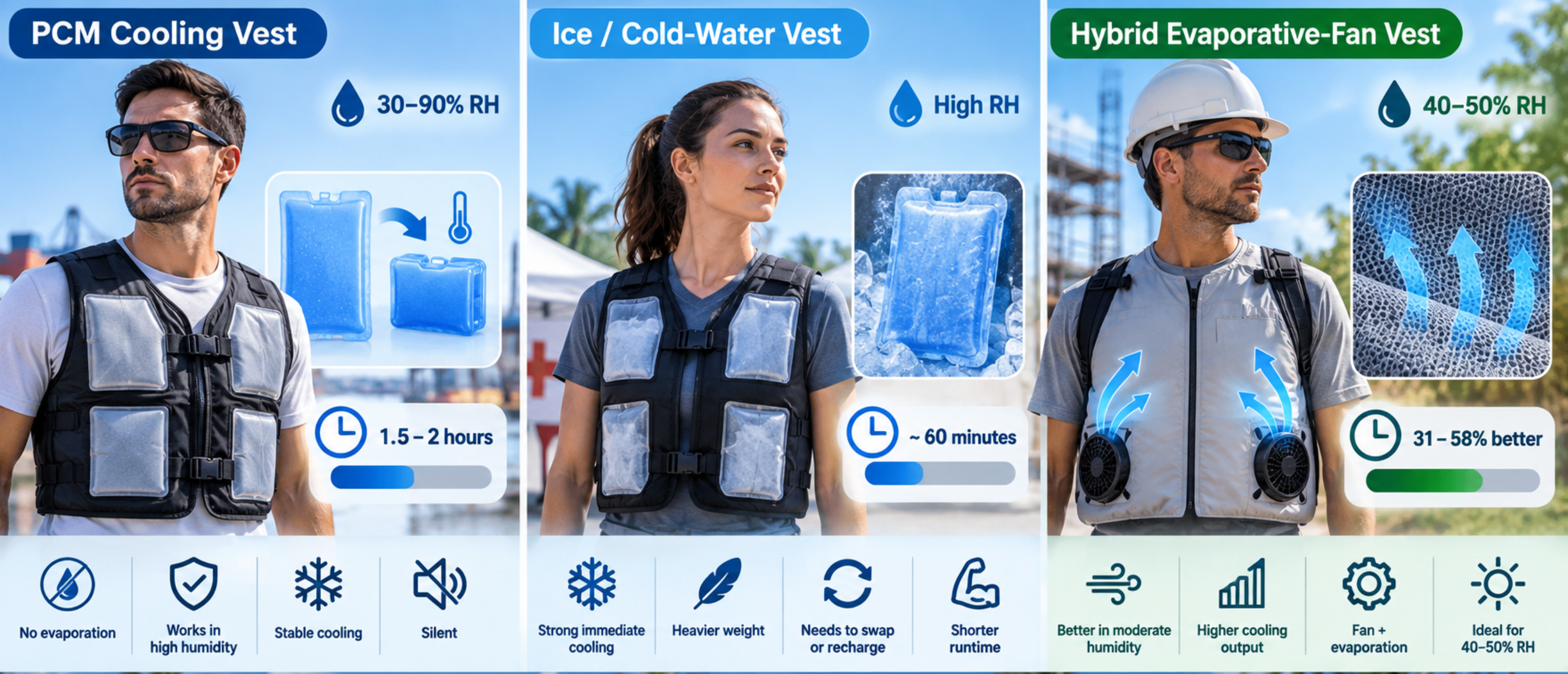
Three cooling technologies work outside the fan-only category, and each handles humidity differently. One ignores moisture in the air completely. One overwhelms it with raw cooling power. One lands somewhere in between.
PCM (phase-change material) vests don’t evaporate anything. They absorb heat through a physical phase change, solid to liquid, inside sealed packs. Since they don’t rely on air pulling moisture away from your skin, humidity barely matters. You get roughly 1.5 to 2 hours of steady cooling whether the air outside is 30% or 90% RH. That makes PCM vests the most humidity-proof option on this list.
Ice or cold-water vests take a different approach: brute force. They give you the strongest immediate temperature drop of any category, but you trade that for weight and shorter runtime. Industry benchmarks put effective cooling time at around 60 minutes per session before you need to swap packs or recharge. Strong, but short-lived.
Hybrid evaporative-fan vests sit in the middle. At 35°C and 40% RH, research shows they outperform pure evaporative cooling by 31–58%, while dropping micro-environment humidity by 23–31%. They’re not humidity-proof like PCM, but they hold up better than fan-only designs in the 40–60% RH range.
Quick Comparison Table
|
Technology |
Best Humidity Range |
Duration |
Weight |
Price |
|---|---|---|---|---|
|
PCM |
High humidity, minimal impact |
1.5–2 hrs |
Medium |
$100–$300 |
|
Ice/Cold-water |
Works, but not climate-dependent |
~60 min |
Heavy |
$30–$100 |
|
Hybrid evap-fan |
Mid to mid-high humidity |
Several hours |
Medium-light |
$50–$200 |
|
Fan/evaporative-only |
Low humidity only, weak above 60% RH |
2–10 hrs |
Light |
$20–$60 / $50–$200 |
For humid climates, PCM gives you the most stable cooling, ice gives you the strongest blast, and hybrids give you the best balance. Pure fan-only vests are the worst choice once you’re consistently above 60% RH.
How to Maximize Fan Cooling Vest Effectiveness in Humid Weather
Even in sticky air, a few smart habits can keep your vest cooling longer.
Pre-wet the evaporative panels. Soak the vest in water for 1–2 minutes, then gently squeeze out the excess. One test protocol used 500g of 15°C water over the same 2-minute soak. Don’t skip this step and don’t oversaturate. Too little water shortens cooling duration; too much causes dripping and discomfort. One engineering study put the sweet spot at roughly 1kg of stored water per charge.
Layer smart underneath. A thin, moisture-wicking base layer spreads sweat evenly across the vest instead of letting it pool. That matters most when your vest relies entirely on evaporation.
Push airflow to the max. Testing at 0.4 m/s versus 1 m/s showed stronger airflow boosts evaporative performance, but only up to what humidity and temperature allow.
Time it right. Skip peak midday humidity. Start earlier, take shaded breaks, and save the vest for lower-humidity windows.
Add misting sparingly. A quick spray refreshes the skin-vest interface, but only helps when paired with active airflow, not when the air is already saturated.
Fan Cooling Vests for Specific Humid-Climate Use Cases

Job sites, motorcycles, and tropical commutes punish a fan cooling vest in different ways. Generic humidity thresholds only get you so far.
Construction sites are the toughest test. At 34°C and 60% RH, turning the fan on versus off barely changed thermal comfort or heat stress. Thick PPE blocks airflow, and long shifts under a hot sun compound the problem. Adding PCM bought workers roughly 60 extra minutes of usable cooling. In Southeast Asia or similar high-humidity job sites, PCM or PCM-hybrid vests outperform fan-only setups. The same holds on the humid US Gulf Coast, where RH regularly sits above 60% and shade is scarce.
Motorcycle riders face a different problem. High humidity makes hot air coming through the vest feel like a blast of heat. PCM pulls heat through phase change, so ambient moisture doesn’t affect performance. That makes it the better choice for long, humid rides. Fan vests still work well in dry heat or when wind speed is already strong.
Tropical cities like Singapore or Miami follow the same rule. For outdoor exposure with thick gear and low airflow, choose PCM or a hybrid vest. For short trips between air-conditioned spaces, PCM gives you a scheduled burst of cold, and a fan vest works when air is moving.
Cooling Vest Buying Guide: How to Choose the Right Type for Your Humidity Level
Your climate should decide your vest, not the other way around. Here’s the shopping checklist that matters.
Fan power matters less than you’d think above 95°F. Once ambient air hits skin temperature, moving that air around stops helping. Check battery life too: most active vests run 4–6 hours per charge, with swap-battery setups stretching to 8–12 hours.
Evaporative panels need to hold water evenly and dry fast. They’re built for dry air, not swamp conditions.
PCM packs melt at 21°C, 28°C, or around 58°F, giving you a fixed cooling dose regardless of humidity.
Runtime Benchmarks by Type
|
Type |
Runtime |
Best RH Range |
|---|---|---|
|
Evaporative |
0.5–3 hrs |
<40% |
|
PCM |
1.5–4 hrs |
40–80% |
|
Active/hybrid |
4–6 hrs |
High humidity, poor airflow |
If you’re wearing PPE or FR gear, slim PCM packs beat bulky active systems every time.
Conclusion
Fan cooling vests don’t stop working in humidity – they just get less efficient as evaporation slows above 60% relative humidity. Below that threshold, they’re still one of the lightest, most breathable options for staying comfortable in the heat. Above it, especially in tropical or coastal climates pushing 80-90% humidity, you’ll want to pair your evaporative cooling vest with a water-mister assist, or switch to a PCM or hybrid cooling vest that doesn’t rely on sweat evaporation.
Match the technology to your climate, not the marketing claims. If you work construction in Florida summers or ride motorcycles through Southeast Asia, don’t guess – check our humidity decision chart above before you buy. Browse icebeartech.com climate-specific cooling vest lineup and filter by your local humidity range.