A battery-powered cooling vest and a fan-cooled work jacket look like they solve the same problem, but they perform very differently once you’re moving, lifting, or standing in direct sun for eight hours straight. That’s why grabbing whatever cooling gear is on sale at 2 PM in August often means realizing weeks later you bought the wrong one.
This guide breaks down exactly where a cooling vest wins, where a jacket pulls ahead, and why the right choice depends less on price and more on how you work. You get a side-by-side comparison of coverage, battery life, weight, and cost, plus scenario-based picks so you match gear to your actual conditions before you spend a dollar.
What Is a Cooling Fan Vest?
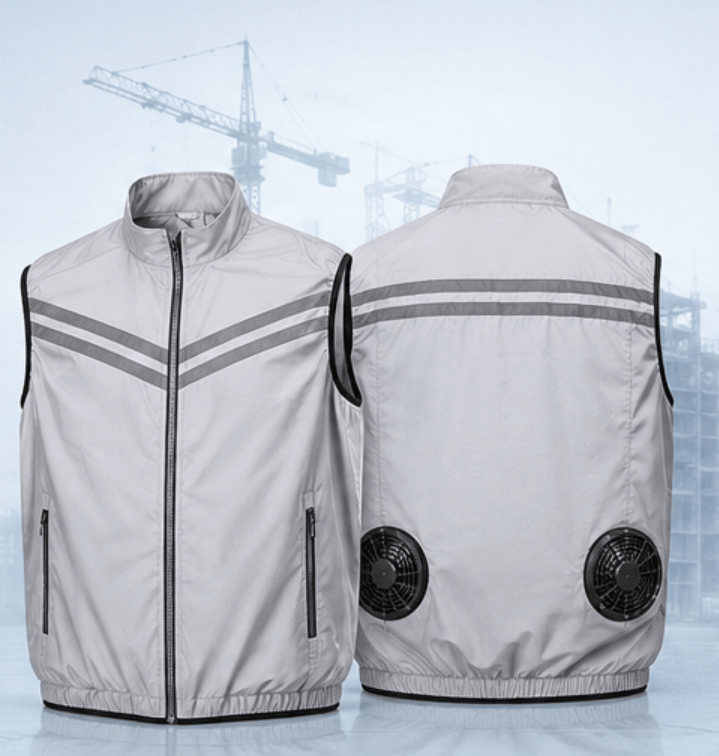
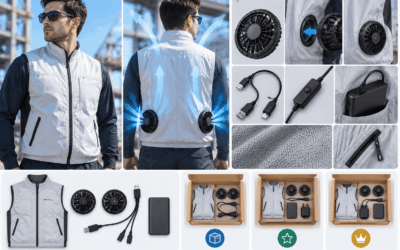
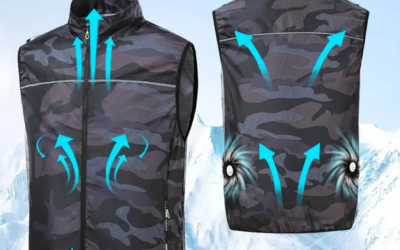
A cooling fan vest works by pulling ambient air through internal channels against your skin using two to four small battery-powered fans stitched into the vest. It uses active airflow cooling with no ice, gel packs, or melting.
Moving air speeds up sweat evaporation, pulling heat off your skin. That’s why a battery powered cooling vest can drop your perceived temperature by up to 13°C in real-world use. It’s the same principle as standing in front of a box fan, except this one is wearable and runs on demand.
Most units on the market run on rechargeable lithium packs, either 5V USB cooling fan vest systems or higher-voltage 18V–30V setups. Battery capacity typically falls between 6,500mAh and 20,000mAh, giving you 4–8 hours of runtime on moderate settings. Charging takes 2–6 hours depending on battery size.
A complete cooling vest with battery pack usually lands around 6–9 lbs, light enough that construction crews, delivery riders, and utility techs wear them through full shifts without feeling weighed down.
What Is a Cooling Fan Jacket?
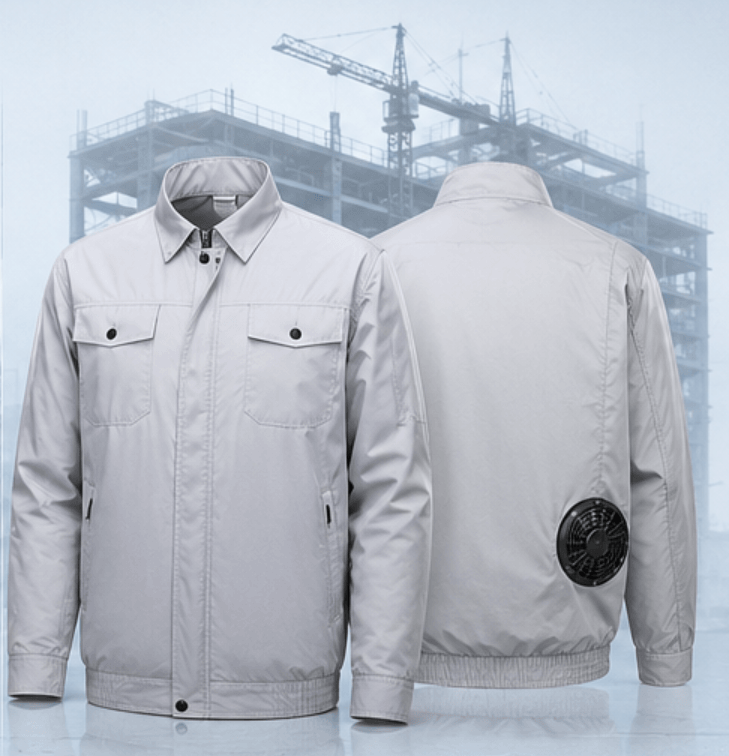
A fan-cooled work jacket moves air across your entire torso. That’s the core difference from a vest, and it’s built into the hardware.
Inside the jacket, 2–4 brushless DC fans sit at the waist or lower back. They pull outside air in and push it through a sealed channel that runs across your chest, back, underarms, and torso. Then it vents out through the collar, cuffs, and hem. You get forced convection pulling hot air off your skin, plus faster sweat evaporation. That’s where the real heat loss happens.
That full-body air channel is the jacket’s defining trait. A vest cools your core; a fan-cooled work jacket extends that airflow into your arms and sides too.
Typical specs to expect:
-
Battery life: 5–8 hours standard, up to 6–18 hours on higher-capacity packs
-
Weight: 450–480g for lightweight USB models; 0.6–1.2kg for heavy-duty B2B/PPE-grade jackets
-
Noise level: 35–55dB, quieter on low settings
This is air-conditioned clothing for work built for people who need coverage over comfort trade-offs — roofers, road crews, warehouse teams, and anyone logging full shifts outdoors.
Cooling Fan Vest Vs Cooling Fan Jacket: Side-by-Side Comparison Table
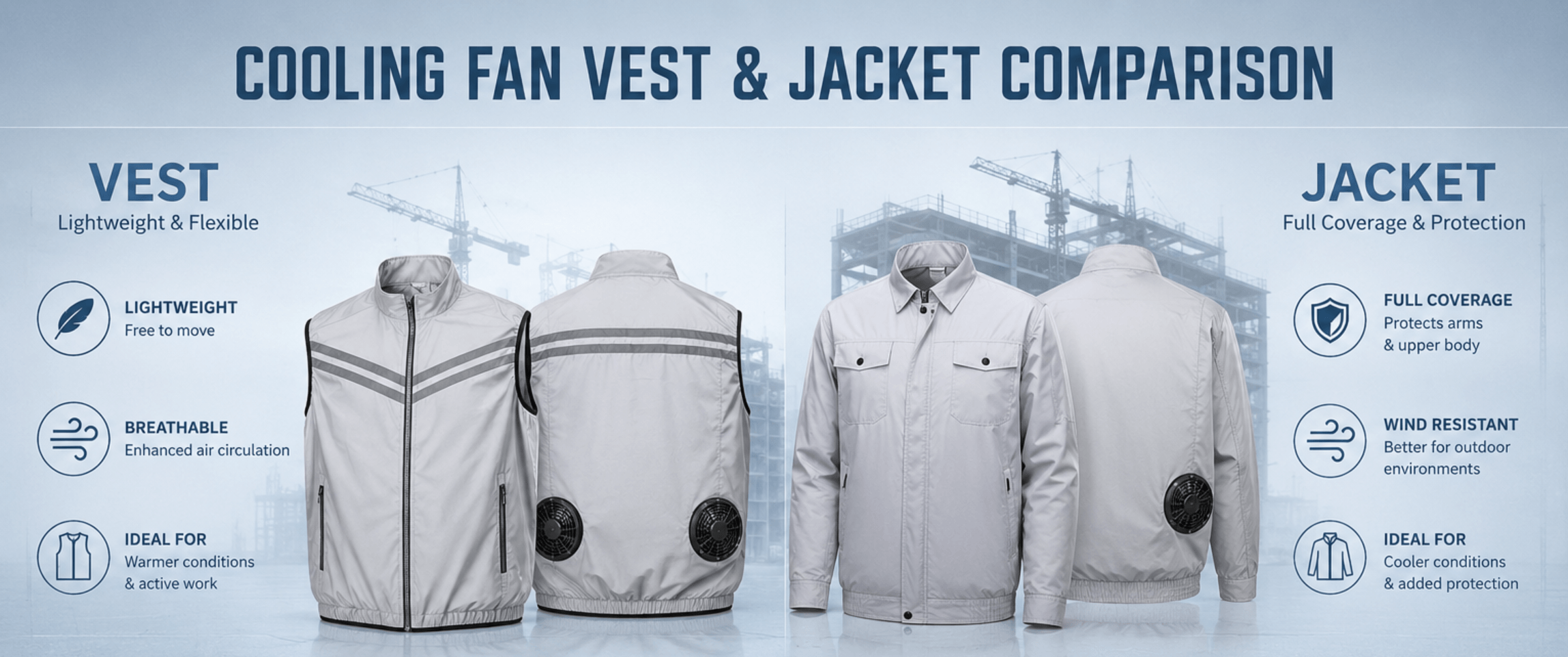
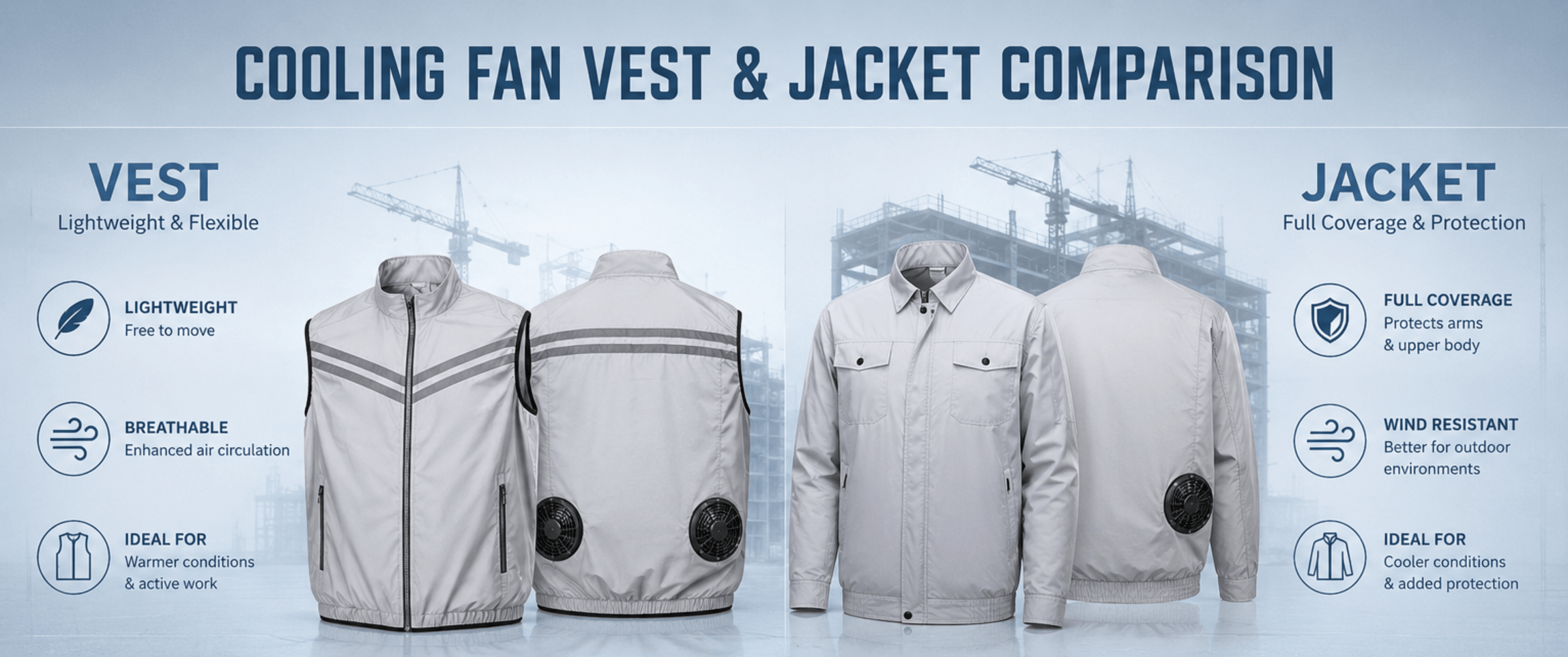
Numbers settle arguments faster than opinions. Here’s how a battery powered cooling vest stacks up against a fan cooled work jacket across the metrics that actually matter on a job site.
|
Factor |
Cooling Fan Vest |
Cooling Fan Jacket |
Winner |
|---|---|---|---|
|
Coverage |
Torso-focused |
Full upper body: chest, back, underarms, sides |
Jacket |
|
Weight |
0.6–1.2 kg |
0.6–1.2 kg (heavier with bigger battery) |
Tie |
|
Battery Life |
6–18 hours |
4–8 hours, up to 12 on premium packs |
Vest |
|
Noise |
35–55 dB |
35–55 dB (under 45 dB on top-tier motors) |
Tie |
|
Price |
$59–300 |
$80–300 (up to $199 with tool-battery kits) |
Tie |
|
Humidity Sensitivity |
Drops off past 60% RH |
Holds up better in wet heat |
Jacket |
A 2023 heat-stress trial tested both at 40°C, 50% RH, during two 30-minute rides at 40% VO2max. The jacket group’s rectal temperature landed at 37.54 ± 0.19°C versus 38.01 ± 0.19°C for the control — a 0.5°C drop. The vest-style water-cooling group only managed 37.72 ± 0.12°C, about 0.3°C lower.
Pick the vest for longer runtime and lighter feel, and the jacket when core-temperature control in humid, high-heat conditions matters more than battery hours.
Coverage & Protection: Which Offers Better Body Protection?
Sleeve length decides more than comfort. It decides how much skin is shielded from sun, debris, and hazards on the job. A vest leaves your arms bare. A fan-cooled work jacket, especially long-sleeve models, closes that gap.
A long-sleeve shirt can outperform a short-sleeve shirt in UV protection even at the identical UPF rating. More fabric covers more skin. Sun protection guidelines recommend collars and sleeves at least three-quarter length, with long sleeves to the wrist for anyone working outdoors for extended stretches.
Beyond UV, a long-sleeve fan jacket for construction workers adds real protection against dust, dirt, cuts, scratches, hot sparks, and slag splashes, the everyday hazards on a job site. Short sleeves trade that protection for airflow and mobility, which is why they’re common in vests. You’ll need sunscreen on exposed forearms to compensate.
PPE compatibility matters too. Standards require protective gear to work with other equipment without leaving skin exposed during movement. That’s why long-sleeve jackets often layer under hi-vis vests on construction sites. In arc-rated or flame-retardant environments, short sleeves don’t even qualify. Some workwear guides state short-sleeve items can’t be certified for electric arc exposure, making a long-sleeve FR base layer mandatory.
Bottom line: if your job puts you around UV exposure, debris, sparks, or arc hazards, a long-sleeve fan jacket for construction workers wins on protection. If your priority is airflow and lighter movement over full-body coverage, a vest is the trade-off — just plan for sunscreen and separate arm protection.
Weight & Mobility: Which Feels Lighter During Movement?
Numbers on a spec sheet don’t tell you how gear feels at hour six of a shift. Real-world testing does.
A cooling vest often weighs 1.5–3.5 kg once the battery pack is loaded, while a fan-cooled work jacket sits at 0.6–1.2 kg. That gap matters more than it looks. Wearable-load research found that 0.54 kg of added gear noticeably increases fatigue rate, and jumping from 0.2 kg to 0.54 kg amplifies that burden fast. With weight closer to 5%–10% of body weight, performance drops kick in earlier—10% BM loads cause fatigue sooner than 0% or 5% BM.
Fit matters as much as weight. Oversized or too-snug gear can cut range of motion by up to 24% on movements like hip flexion, more than fabric weight alone.
For climbing, hauling, or repetitive lifting, a lightweight fan jacket wins. It interferes less with shoulder swing, torso rotation, and overhead reach. If a vest is your only option, keep total load near 5% of body weight and skip anything form-fitting.
Battery Life & Cooling Performance: Which Lasts Longer & Cools Better?
Fan speed settings change everything about runtime, and most buyers never check this before purchase.
Vests run 2–4 hours on standard use, stretching to 4–8 hours for fan/pump hybrids. Solid-state or heat-exchange models manage 4–6 hours per battery. Swap in a second charged pack and you get 8–12 hours total.
Jackets run longer across the board. Expect 6–18 hours depending on fan speed, with 7–9 hours being the common real-world number at medium airflow. Drop to low speed and you’ll see 10–13 hours. Crank it to high, and premium units fall back to 3–5 hours because more airflow drains the battery faster.
Speed settings tell the real story. A jacket on low runs 8 hours. Medium drops to about 5 hours. High cuts that to 3 hours. A standard 10,000mAh battery on medium speed lands around 5.5 hours. Brands often advertise “up to 10 hours,” but that’s best-case, low-speed math.
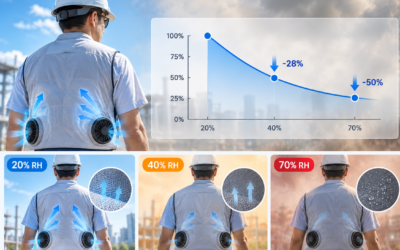
Humidity changes the equation. Evaporative cooling vests work well below 60% RH and hold cooling for 2–6 hours. Push past 60–65% RH, and evaporation slows down fast. Sweat has nowhere to go, and you’re left with a damp, warm feeling instead of cooling relief. Fan jackets don’t have this problem. They work at any humidity or temperature because they use moving air, not evaporation.
Noise is the trade-off for airflow. Anything under 30dB feels office-quiet, good for tight spaces or long shifts near others. Most mid-to-high fan settings land at 35–55dB. That’s noticeable, but standard for job sites and warehouse floors.
Price Comparison: Cooling Fan Vest Vs Jacket Cost Analysis
Sticker price alone won’t tell you which option is easier on your budget. A battery-powered cooling vest starts at $30–$80 for entry models, goes up to $80–$150 for mid-range, and tops out at $150–$250+ for pro-duty kits. A fan-cooled work jacket runs $60–$150 for basic to mid-range, then $150–$300+ for heavy-duty bundles. Real-world listings show vests at $28.68, $29.99, $35.99 and jackets at $79, $99.98, $149.99.
Many listings skip the battery entirely. You’ll need a separate 10,000–20,000mAh power bank that runs 4–8 hours depending on the fan count. That “cheap” $30 vest can become a $50–$100+ purchase once you add power.
For the lowest upfront cost, get a cooling vest for outdoor work plus a standalone USB power bank.
A fan jacket for construction workers priced around $79–$150 with the battery included gives you the best bundled value. You skip compatibility guesswork and pay $20–$80 more upfront for less hassle long-term.
How To Choose: Match The Right Product To Your Work Scenario
Six factors decide which cooling gear you should buy. None of them are about how it looks. Match your work conditions to the list below and skip the guesswork.
You climb, bend, or lift all day. Go with a vest. Less coverage means less fabric fighting your shoulders and hips. Cooling vests for outdoor work are built for frequent movement. Jacket sleeves would get in the way.
You’re on a construction site or warehouse floor for 8–12 hour shifts. Pick a fan jacket for construction workers. Full torso coverage keeps you cooler longer, and jackets layer more easily under PPE without leaving gaps in protection. Anyone logging long, sustained shifts outdoors uses this setup.
Your job site is hot and dry with decent airflow. Evaporative cooling wins here. Dry heat makes evaporative products perform best because sweat evaporates fast and airflow does the rest.
Quick-Pick Cheat Sheet
-
Frequent movement / heavy lifting → Vest
-
Long shifts / construction / warehouse / PPE layering → Jacket
-
Dry heat + airflow → Evaporative
Real User & Industry Expert Recommendations
Gear reviews tell a consistent story once you filter out the marketing noise. Industry buyers and everyday wearers agree that a battery powered cooling vest wins for mobility and layering, while a fan cooled work jacket wins for full-body coverage and sustained heat protection.
What Buyers Say About Vests
Real reviews of lightweight, packable vests describe them as ideal for “ball games, hiking, or just sitting around to take a chill off,” with buyers noting the “fabric is nice” and that it packs into its own pouch. One popular fishing vest style holds a 4.6/5 average rating, with reviewers praising design, comfort, and utility over style. Another long-line vest racked up 22,000+ five-star reviews, with shoppers calling it “slimming” and an “ideal lightweight vest,” though some flagged that it “lacks much stretch,” meaning sizing up helps if you’re layering underneath.
What Buyers Say About Jackets
Multi-pocket, feature-heavy jackets split opinion. Some reviewers love that they’re “great for holding several different devices” and “versatile, seasonless.” Others complain the fit runs like “a TENT” with “wonky pockets that don’t work.” For a fan jacket for construction workers, more features can mean a bulkier fit if the design isn’t dialed in.
Vests deliver freedom of movement and packability; jackets deliver coverage and durability. Match that trade-off to your job, not your budget.
FAQ
Straight answers to the questions that come up right before checkout.
Can I use a cooling vest and jacket together?
Layering both adds bulk and blocks the jacket’s airflow. Pick one based on your task: vest for reaching and lifting, jacket for full coverage.
Best pick for summer commuting?
A lightweight cooling vest. It’s less restrictive for cycling or walking than a sleeved jacket.
How long does a fan jacket battery last?
Battery life depends on the speed setting. On one common battery, LOW runs 17–40 hours, MEDIUM hits 11.5–26.5 hours, and HIGH drops to 6–18.5 hours depending on pack size.
Will it work under hi-vis or FR gear?
Check fan placement, thickness, and harness clearance first. Not every cooling vest for construction workers passes ANSI/ISEA hi-vis or FR compatibility.
Where To Buy: Cooling Fan Vest & Jacket Recommendations
Decision made? Here’s exactly where to go next.
Want continuous airflow? Browse Icebeartech’s fan jacket and custom cooling fan vest category. These run 4–8 hours per charge, recharge in 2–4 hours, and give you 3–5 fan speed settings to dial in performance for industrial or outdoor shifts.
Still weighing fan cooling against PCM or ice-pack systems? Read Cooling Vest Vs Fan Jacket: Which One Should You Choose first, then how fan jackets work before you commit.
Sourcing for a brand or workwear line? Head to the OEM Manufacturer page. Standard OEM runs 30–35 days; full custom design, fabric, and packaging takes 35–40 days.
Need bulk pricing or MOQ details? Check the factory page. MOQs start at 500 pieces per color, with lead times as fast as 15–20 days on some custom orders.
Conclusion
If you’re working full shifts in extreme heat—construction, welding, warehouse work—a fan-cooled work jacket covers your arms and torso where a vest can’t reach. If you need something lighter for quick tasks, mowing, or moderate outdoor labor, a battery-powered cooling vest gives you solid airflow without the bulk.
Heat stress creeps up on you mid-shift when you don’t have protection. Both options beat sweating through your shirt with nothing.
Ready to gear up? Browse icebeartech.com’s full lineup of cooling vests and jackets, match the specs to your job site conditions, and order before the next heat wave hits.