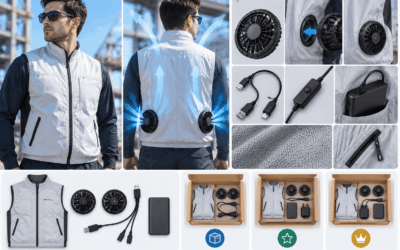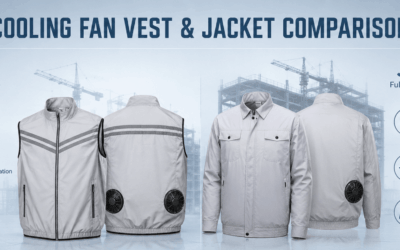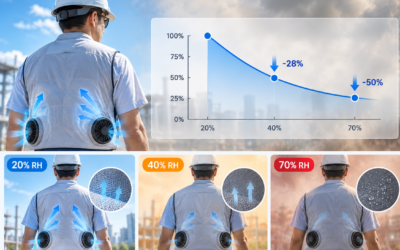
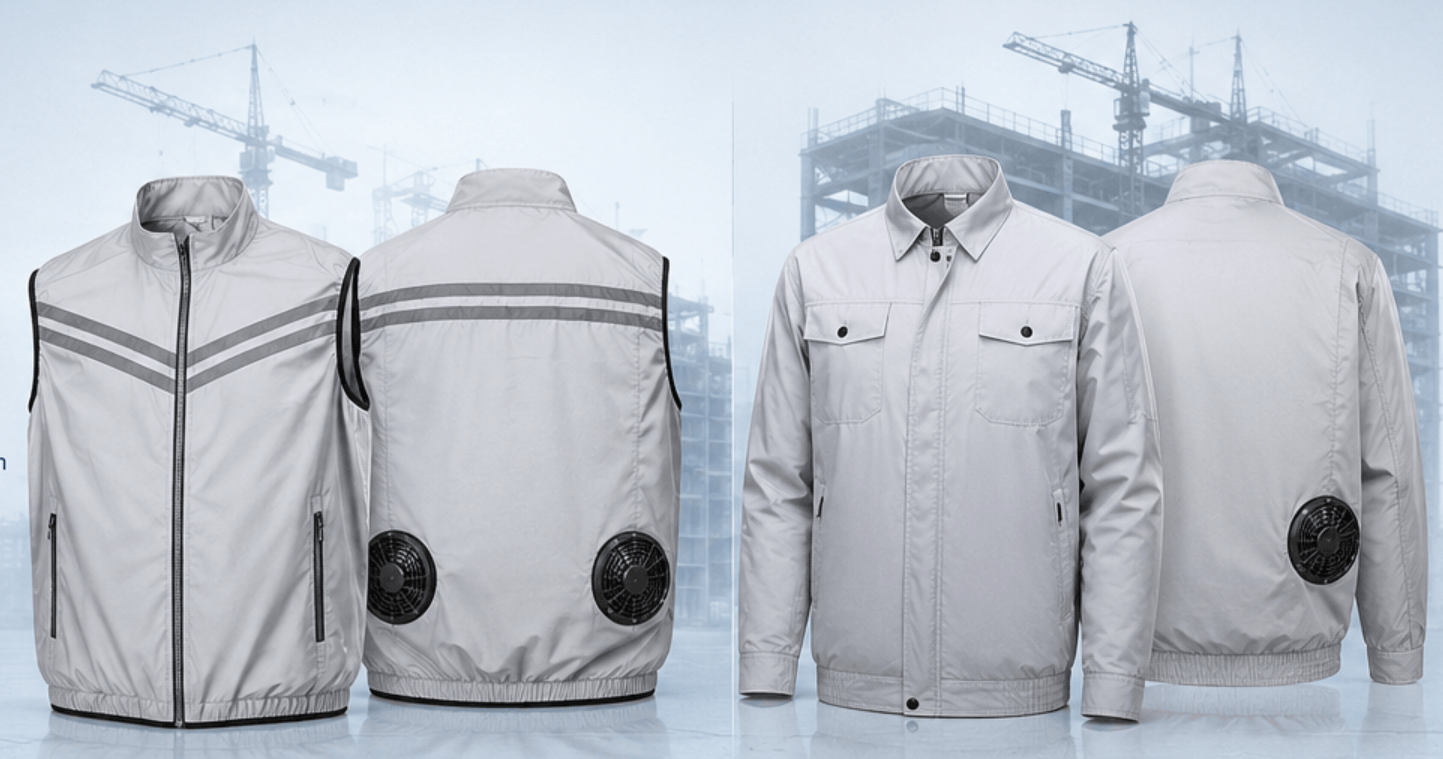
Japan is one of the earliest and most technologically mature markets for cooling fan vests. From fan structure and battery systems to lightweight fabrics and garment airflow design, Japanese companies have accumulated extensive product development experience in this field.
For brand owners, distributors, and industrial supplies buyers seeking OEM/ODM partners, choosing a cooling fan vest supplier cannot be based solely on product appearance and price. Airflow, battery life, fan lifespan, fabric durability, wearing comfort, and mass production stability all directly impact the product’s performance in the market.
This article compiles a list of 10 Japanese cooling fan vest manufacturers and brands to watch in 2026, including Kuchofuku, an early entrant into the fan vest market, and other companies specializing in industrial workwear, fan systems, and high-temperature work equipment.
We will analyze these companies from the perspectives of product technology, main application markets, manufacturing and supply capabilities to help B2B buyers more clearly compare different suppliers and find a cooling fan vest manufacturer that best suits their market and procurement needs.
Kuchofuku Co., Ltd. — The Original Kuchofuku Inventor

A former Sony engineer named Hiroshi Ichigaya spent a business trip through Southeast Asia in 1994 sweating through his shirt and thinking, “there has to be a better fix than this.” A decade later, in 2004, that idea became Kuchofuku — a company that put small battery-powered fans inside a jacket and invented an entire product category. Every cooling fan vest on the market today stands on this company’s shoulders.
The mechanism is simple once you see it. Fans pull outside air in through the garment, that air moves across your skin, sweat evaporates faster, and you feel cooler. It’s moving air to where evaporation can do its job. Kuchofuku sells this as workwear cooling technology rather than a novelty item, and the market agreed. When Japan hit its 2011 power shortage and everyone suddenly cared about not running the AC, sales reportedly jumped tenfold.
Where the Data Gets Fuzzy
Kuchofuku states its lithium-ion pack runs 11 hours per charge. A solid, verifiable number. Claims floating around about 103 L/s airflow, IP68 waterproofing, or 25V battery systems don’t trace back to confirmed Kuchofuku sources. They may belong to newer variants or competitors borrowing the name’s credibility.
What is well-documented is that this heat stroke prevention clothing started with factory workers and construction crews, then spread to delivery drivers and office staff. If you’re benchmarking OEM candidates, Kuchofuku is the historical reference point. Not necessarily the easiest export partner to reach.
SUN-S – Mature Industrial Workwear and Fan Cooling Systems
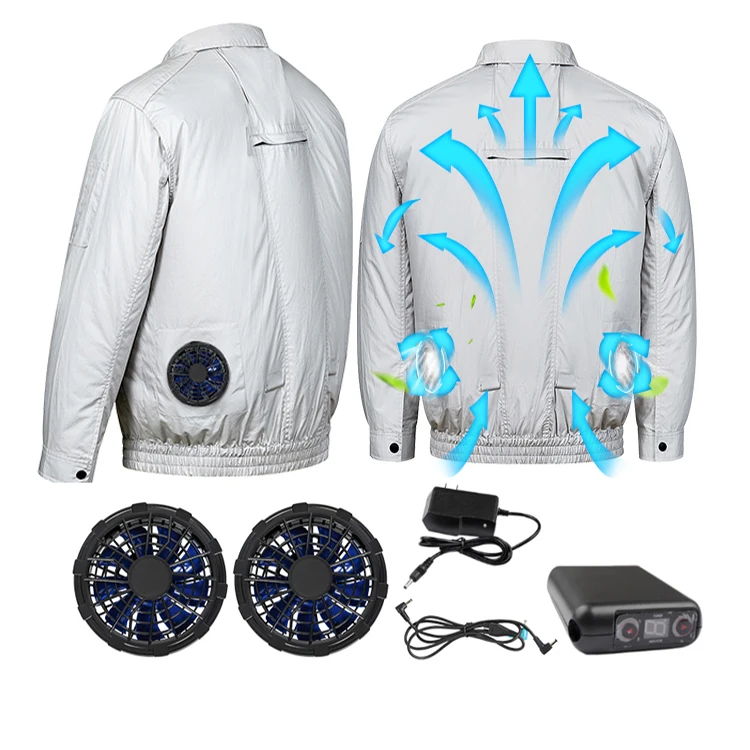
SUN-S is one of the most established brands in the Japanese industrial workwear sector. Its Kuchofujin-fuku series combines workwear, fans, and battery systems, primarily targeting construction, factory, warehouse, and other high-temperature summer work environments.
Technically, SUN-S’s new generation system uses a 24V fan platform, with an official airflow of approximately 100 L/s (approximately 6.0 m³/min) in TURBO mode. Compared to the earlier 12V system, the overall airflow is significantly improved, making it more suitable for industrial work environments requiring strong air circulation.
The battery system is also a crucial component of its products. Some models support multiple fan speed settings, with the high-speed mode providing approximately 8 hours of working time, while medium and low speeds further extend battery life. The battery also complies with Japanese PSE electrical safety requirements, a point of interest for B2B buyers who prioritize battery safety and compliance documentation.
Product Design Targeting Real-World Work Environments
SUN-S offers various styles, including long-sleeved Cooling Fan Jackets and Cooling Fan Vests, with some sizes available to accommodate larger workwear dimensions. Features such as detachable fans, side fan layouts, back air circulation structures, and cooling bag pockets indicate that its products are geared towards practical industrial use, rather than just everyday outdoor cooling.
Overall, SUN-S’s strength lies in its comprehensive ecosystem of workwear, fans, and batteries, making it suitable for buyers in the construction, warehousing, and industrial supplies sectors.
However, its public channels primarily focus on branded finished products and the Japanese domestic market; bulk purchase prices, MOQ, and Private Label/OEM support are not fully disclosed. If the goal is to develop a private-brand Cooling Fan Vest, it is recommended to further confirm its customization scope, export support, and bulk cooperation terms.
BURTLE — Fashion-Forward High-Output Cooling Vest Brand
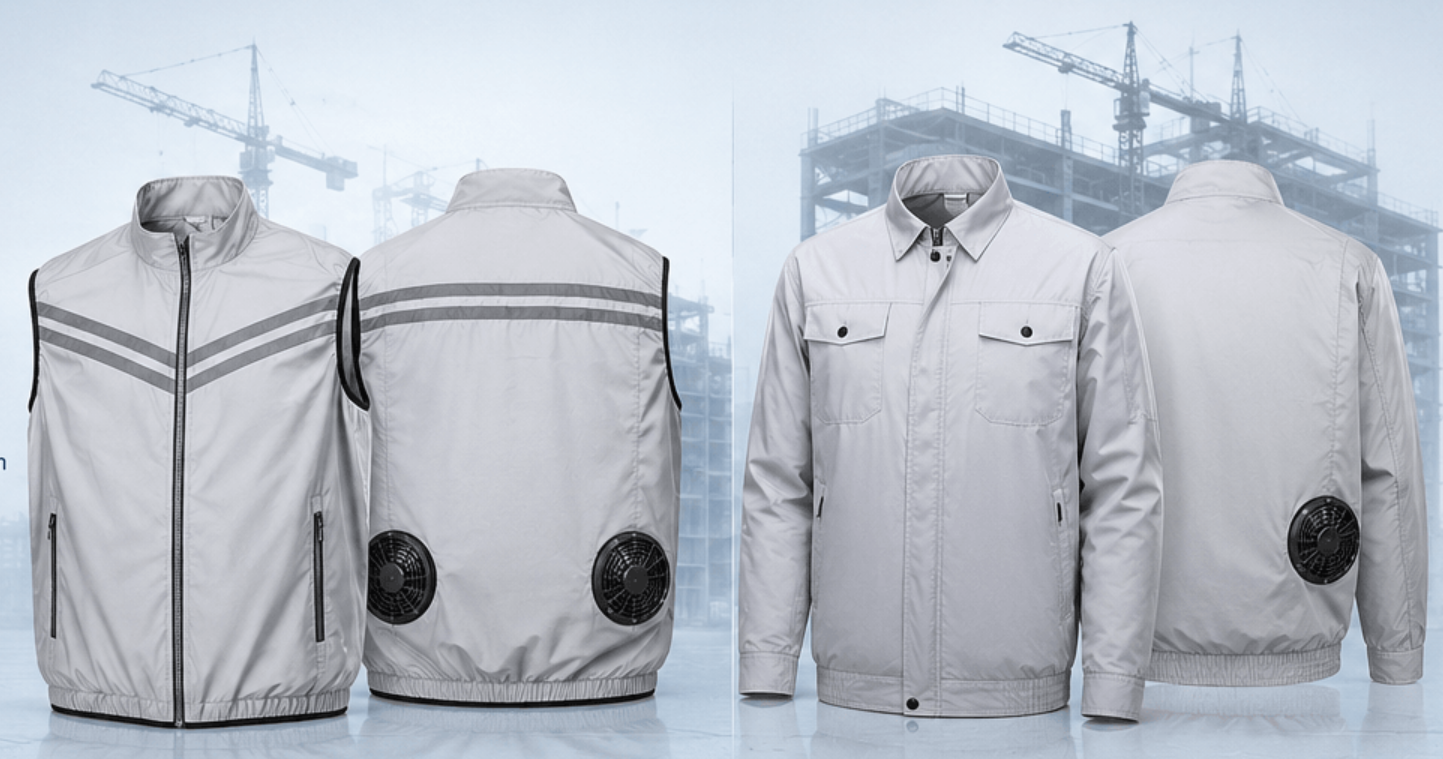
Take a leaf blower, shrink it to fit inside a jacket pocket, and you’ve got BURTLE’s engineering pitch. Under the AIRCRAFT line, this Japanese workwear brand treats airflow like a competitive sport. The 2026 flagship pushes 30V and 120 L/s, roughly two kiddie pools of air moved past your skin every minute. Run it wide open for an hour, then it throttles down to 23V for another five hours, giving you a six-hour shift without a mid-afternoon dead battery. The 2025 model sits at 24V/105 L/s with a similar 1+5 hour split, and the 2024 version tops out at 22V/100 L/s with clean step-downs at 15V (72 L/s), 10V (49 L/s), and 7V (34 L/s) for anyone who wants granular control instead of “more” or “less.”
What Makes BURTLE Different From Pure Industrial Suppliers
BURTLE doesn’t hide the fact this is fan cooling jacket tech wearing a fashion costume. Sizes run M to 3XL. Colorways lean black, charcoal, olive, and navy — a streetwear palette, not hi-vis safety orange. Retailers even suggest sizing up a notch to let more air circulate. The battery is a 5000mAh/73Wh pack, roughly 400 grams, charging in about 4 hours. Fabric gets an aluminum coating, UPF40 sun protection, and a washable, water-resistant finish. It’s already moving through retail channels in Hong Kong and Taiwan, though a formal export distributor list isn’t publicly documented yet.
Murakami Hifuku (HOOH) — High-Spec Titanium-Coated Cooling System
Titanium shows up inside jet engines and expensive watches. Murakami Hifuku puts it on the inside of a work jacket. The company’s 2026 product page makes one specific claim: a titanium coating plus a reflective inner lining gives you a -9°C heat-shielding effect. That’s the headline spec, and it’s the one detail the manufacturer can back up in its own materials.
What’s Confirmed vs. What’s Marketing Fog
HOOH’s documented core features are narrower than the rumor mill suggests:
-
Titanium treatment: rated at -9°C thermal reflection
-
Inner-lining coating: traps airflow inside the garment instead of letting it leak out the seams
That covers the hard numbers. Claims about a magnetic quick-release washable fan, a 28V battery system, or 105 L/s airflow don’t trace back to any confirmed HOOH documentation. For context, 105 L/s converts to roughly 378 m³/h — a genuinely high-tier number for a battery powered cooling vest, if it’s real. Most twin-fan setups in air conditioned workwear top out around 60–100 L/s combined, so that figure would put HOOH near the top of the pack. It just isn’t verified yet.
If you’re vetting HOOH as a cooling vest supplier, ask for battery model numbers, fan RPM ratings, and IP-rating documentation before trusting the spec sheet floating around online. OEM terms aren’t publicly listed either, though the brand’s broad workwear catalog suggests some room for logo and fabric customization on request.
Kurodaruma — Value-Performance Balanced Side-Fan Design
Eighty-eight grams. That’s roughly the weight of a smartphone, and it’s exactly what Kurodaruma’s individual fan units weigh in the AIRSENSORneo/KS-250-1 kit. Multiply by two fans, subtract from your shoulders, and you get a cooling fan vest that doesn’t announce itself every time you reach for a tool.
The numbers matter more than the branding here. Kurodaruma runs a 20V system topping out at 106 L/S airflow, with four selectable tiers: 56, 78, 95, and 106 L/S. Runtime scales inversely, as it always does: roughly 20 hours on low, 8.5 hours on medium, dropping to 5 hours at max output (or a blended 20V/0.5hr + 14V/7.5hr combo, depending how you push it).
Compare that to the older KS-100: 15V, 86 L/S peak, 48/60/70/86 L/S tiers, 4-to-13-hour runtime spread. The jump from 86 to 106 L/S is a 23.3% airflow gain, a real generational leap in workwear cooling technology.
Kurodaruma is a longstanding workwear manufacturer based in Fuchu City, Hiroshima Prefecture, with products distributed through its own site plus retail/wholesale channels like SSSU.jp and masaya.shop-pro.jp. No public market-share figures exist for its footprint among Japan’s smaller industrial cooling apparel buyers, but the multi-channel distribution suggests a supplier built for steady procurement.
Buyer takeaway:
– If you’re chasing airflow on a fixed budget, 106 L/S is the number to watch.
– If long shifts matter more than peak power, the ~20-hour low-tier setting paired with 88g fans covers that.
– If you need supply consistency for a heat stroke prevention clothing line, Kurodaruma’s decades-old manufacturing base and established retail presence answer that question better than any marketing copy could.
SOWA — Broad B2B Apparel Supplier for Industrial Workwear
SOWA does not specialize in cooling fan vests, and that’s the point. Officially 株式会社桑和, headquartered in Kojima, Kurashiki, Okayama, with a manufacturing site at the Sōja Plant, SOWA operates as a general workwear department store. You can reach them at 086-473-2071, and their site directs product inquiries through a portal labeled 製品情報 — “product information,” a fitting name for a catalog that wide.
What’s Confirmed on the Product Side
The clearest documented item is anti-static workwear meeting JIS T8118, a Japanese industrial-protection standard. Independent product indexing also tags SOWA under “Work Clothing for safety work and factory,” so their assortment covers factory-safety apparel as well as seasonal cooling gear.
On the B2B side, industry coverage describes SOWA as running a global production structure across multiple Asian bases, handling both large factory orders and small custom runs for workshops and retailers. If MOQ matters to your sourcing plan, that flexibility is worth a look.
What Still Needs Direct Confirmation
No airflow specs, fabric composition, or export terms are publicly documented. If cooling vest sourcing is your goal, pull SKU-level catalog data and ask about OEM options, lead time, and overseas shipping before assuming SOWA fits your air conditioned workwear pipeline.
Shinmen — Lifestyle-Work Hybrid with Quick-Dry UV-Resistant Fabric
Strip away the marketing language and Shinmen’s pitch is that work clothes shouldn’t look like work clothes. The brand leans hard into “赤外線・紫外線からしっかりガード” (solid infrared and UV protection), plus fast sweat evaporation and a lightweight feel, all wrapped in something you’d wear on a Saturday, not just a job site.
A concrete example makes this less abstract. Shinmen’s cotton-like long-sleeve tee on Rakuten runs S–3L, is 100% polyester, and lists quick-dry, stretch, lightweight feel, and a built-in odor-control tape. The formula is synthetic performance fabric disguised as cotton comfort. It’s aimed at commuters and light outdoor workers who want heat stroke prevention clothing that doesn’t announce itself.
Where the Documentation Runs Thin
No third-party test reports surface for UPF ratings, moisture-vapor transmission, or wash-cycle durability. A commonly cited spec (10V battery, roughly 8-hour runtime) doesn’t trace to any confirmed Shinmen fabric or garment listing. If you’re sourcing this as a battery-powered cooling vest, ask directly for voltage, rated capacity, and whether that 8-hour figure means continuous use or a low-power setting. The fabric claims read solid; the electronics claims need paperwork.
Jichodo / Z-DRAGON — Safety-Focused Harness-Compatible Workwear
Working forty feet up a scaffold changes your priorities. Comfort still matters, but a fan vest that snags your safety harness matters more, in the “possibly fatal” sense. Z-DRAGON, a Jichodo brand launched in 2013, built air conditioned workwear that stays out of the harness’s way.
The labels show it. Multiple Z-DRAGON pieces, including short-sleeve and long-sleeve blousons in the 74130/74140 series, carry an explicit “ハーネス対応” (harness-compatible) tag. Sizes run S–5L. Retail descriptions specifically call out high-altitude work and mention high-strength materials that handle the friction and load of harness anchor points without shredding.
Where JIS Standards Fill In the Safety Story
Static electricity and construction sites don’t mix. Jichodo’s 71500 jumper addresses this with JIS T8118 anti-static compliance, a polyester 65%/cotton 35% twill blend, and a deodorizing function. Sizing spans SS to 5L. There’s also a Cordura stretch denim cargo pant (cotton 60%/polyester 24%/nylon 14%/polyurethane 2%) for buyers who prioritize industrial cooling apparel durability over airflow numbers.
What Needs Confirming Before You Order
Claims about a 25V battery system on harness-compatible models aren’t independently verified. Neither is flame-retardant certification on specific SKUs. Ask for documentation before treating either as fact.
AITOZ — Century-Old Heavy-Duty Industrial Brand
2026 minus 1917 equals 109. AITOZ’s own materials confirm that number outright, calling itself “創立より109年目”, the 109th year since founding. Their English-language site, though, rounds down to “over 90 years,” which is technically true the way saying you’re “over 20” is true at 45. Split the difference and call it century-class, not exactly 100.
The company started as Ito Kiyo Shoten, a workwear wholesaler in Osaka’s Kita ward, back when “cooling fan vest” wasn’t even a phrase anyone could say with a straight face. It became a proper corporation in 1950 with ¥500,000 in capital, then rebranded to AITOZ in 1992. Today headquarters sits in Osaka’s Chuo ward, with domestic outposts in Tokyo, Imabari, Sapporo, Gifu, and Okayama, plus logistics centers in Higashi-Osaka and Takasaki. Manufacturing runs through Shanghai, Dalian, Myanmar, and Laos.
Scale, roughly speaking:
– ~190 employees (LinkedIn)
– ¥25 million capital
– ~16.6 billion yen in 2011 sales
Their 空調服® line exists and keeps getting refreshed. What doesn’t exist — at least not in anything I could verify — is a published 18V battery spec sheet, harness-compatibility documentation, or industrial durability test data. If your sourcing decision hinges on those numbers, ask AITOZ directly before assuming they match the marketing.
Toraichi — Heritage Japanese Workwear with Washable Fan Technology
1959 predates the entire fan-vest category by 45 years. Toraichi built its name on Tobi-style construction wear long before anyone thought to wire a fan into a jacket, and that heritage still shows. Headquartered in Kojima, Kurashiki, Okayama, with a Tokyo office in Chiyoda-ku and roughly 70 employees in Japan, the brand feels more like a workwear archive that happens to sell electronics than a tech startup.
The Cooling Angle
Toraichi’s summer lineup pairs fan-powered airflow with ice-pack pockets, marketed as “double cooling.” There’s also a Peltier vest using direct-contact cooling plus circulation. It’s explicitly built to be washable, which is a real differentiator, since most electronics-in-fabric setups fear the laundry machine.
What’s Missing: Hard Voltage Numbers
No confirmed 18V spec exists for Toraichi’s own fan system, so treat airflow claims as unverified. For a benchmark, comparable Japanese fan-uniform testing showed a ~3°C surface-temperature drop after 30 minutes, with battery weight cut roughly 50%. That’s the category standard Toraichi should be measured against.
Sourcing Reality
Signals point to a Japan-first distribution model, possibly Japan-only shipping. It’s a good fit for buyers wanting authentic aesthetics, but weaker for global fulfillment needs.
How to Choose the Right Cooling Fan Vest Manufacturer for Your Business
Use four filters to avoid a costly mistake: compliance, performance, delivery, customization. Run every candidate through them, in that order, before you ask about price.
Compliance comes first. For industrial or occupational use, confirm CE marking under EU 2016/425 (the PPE regulation), plus technical files covering use, maintenance, and expected lifespan. High-heat environments need a manufacturer who can explain whether their design fits Category II or Category III risk classifications — that distinction changes your legal liability.
Performance data comes next. Use this as your RFQ scoring sheet:
|
Metric |
What to Ask |
Rule of Thumb |
|---|---|---|
|
Battery voltage |
12V, 7.4V, 5V? Dual-battery support? |
12V suits industrial/long-heat use; 7.4V fits lighter wear |
|
Airflow (L/s) |
Per-fan and full-garment output, tier settings |
Ask for test methodology over peak numbers |
|
Waterproof rating |
IPX4/5/6, fan vs. battery separately rated |
IPX4 minimum for workshop/outdoor splash exposure |
|
Washability |
Detachable fan/battery? Machine or hand wash? Cycle limit |
Get written washing instructions rather than verbal promises |
|
Certifications |
CE, RoHS, ISO 9001, EPI documentation |
CE + EPI for safety use; add RoHS/ISO 9001 for export |
Match the manufacturer to your use case. Industrial buyers need EPI compliance files and PPE compatibility with harnesses and flame-retardant gear. Sports/outdoor brands should prioritize lightweight builds with tiered airflow and confirmed noise levels — request a sample garment. Fashion retailers need private-label capability: MOQ, pattern-development fees, packaging customization. OEM buyers need stable capacity, a BOM with named material brands, and willingness to accept third-party inspection.
Before quoting, get MOQ by color/size/voltage/logo type separately, a three-stage lead time (sampling, first order, reorders), private-label scope across labels/tags/cartons, and a broken-down quote (samples, tooling, printing, packaging, shipping, tax).
One filtering rule works across every category: any supplier offering “cool and comfortable” without test data gets cut immediately.
Key Questions to Ask Before Placing an OEM/ODM Order with Japanese Suppliers
Once you’ve found a suitable Cooling Fan Vest manufacturer, it’s not advisable to decide on a partnership based solely on the quote. For B2B buyers, MOQ, sample development, battery and fan specifications, lead time, and compliance documentation are often more important than the initial unit price.
First, clarify the MOQ and quote range. Is the MOQ calculated per style, color, or size? Are the initial and repeat orders subject to the same minimum order quantity? If you plan to test the market, you can request tiered quotes for quantities of 300, 500, 1,000, or higher, and confirm whether the price includes packaging, labeling, and basic quality control to avoid additional costs later.
The sample stage is equally important. Besides confirming the sample production time, understand whether the quote includes modified samples, functional test samples, and final pre-production samples. For Cooling Fan Vests, simply confirming the garment design is insufficient; airflow, noise level, battery life, fan lifespan, and the actual air circulation effect during wear should all be verified during the sample stage.
Before placing a formal order, it’s necessary to confirm the production cycle for both the initial and repeat orders, as well as whether peak season capacity can meet demand. If the product is for export, it’s also essential to ascertain in advance whether relevant compliance documents such as CE, RoHS, REACH, and EMC required by the target market can be provided, regarding battery, electrical safety, and compliance.
If developing your own brand is involved, it’s recommended to include the logo, fabric, color, pattern, fan position, battery specifications, packaging, and ownership of molds or designs in the cooperation agreement. For products intended for long-term sales, it’s crucial to confirm the continuous supply of accessories such as fans and batteries; otherwise, after-sales service and replenishment may become problematic.
In short, don’t just ask “how much per piece.” A truly suitable Cooling Fan Vest OEM/ODM manufacturer for long-term cooperation should also be able to answer: how to do it, how long it will take, what standards can be achieved, and whether the same quality can be consistently replicated afterward.
Conclusion
Japan is one of the more mature markets for cooling fan vest technology. From Kuchofuku to SUN-S, BURTLE, AITOZ, and Toraichi, different companies have developed their own strengths in fan systems, workwear design, battery life, and industrial applications.
Therefore, there is no single “best Japanese manufacturer” suitable for all buyers. Industrial PPE sourcing, professional workwear channels, and consumer retail brands all have different requirements regarding product structure, price, certifications, and customization capabilities. For B2B buyers, a more reasonable approach is to first screen 2-3 suppliers based on the target market, then compare airflow, battery life, noise, comfort, and build quality through sample testing, and finally decide on a long-term partner.
If your sourcing focus extends beyond Japanese brands and also includes finding cooling fan vest manufacturers that can provide more flexible OEM/ODM customization and mass production, you can also include the Chinese supply chain in your comparison.
ICEBEAR boasts over 10 years of experience in developing personal thermal management products, covering multiple series including Cooling Fan Vest, Cooling Fan Jacket, PCM Cooling Vest, and Water Cooling Vest. They also offer customization services for B2B projects, including fabrics, colors, sizes, fan systems, electronic components, logos, and packaging.
For companies developing their own brand of Battery Powered Cooling Vests, industrial cooling workwear, or seeking long-term OEM/ODM partners, comparing Japanese suppliers with professional manufacturers like ICEBEAR under the same standards allows them to find the most suitable supply solution for their market by considering factors such as technical parameters, customization flexibility, MOQ, delivery time, and mass production capabilities.