
Halfway through a scorching shift, you rip off your cooling vest. Not because it stopped working, but because it’s become the problem. Chafing at the shoulders, sweat pooling where airflow should be, that dead-weight sag once the ice packs shift. Sound familiar? You’re not imagining it, and you’re not alone.
Most cooling vest discomfort traces back to a handful of fixable culprits: wrong fit, mismatched cooling duration for your shift length, or breathability that fails the moment you start sweating. Some issues are design flaws baked into cheaper builds; others are a mismatch between vest type and your specific work environment.
Below, we break down what’s causing your discomfort—fit problems, weight distribution, material choices, and more—so you can stop tolerating gear that fights you and start choosing one that works for the long haul.
Why Cooling Vests Feel Uncomfortable During Long Shifts: The Fit & Sizing Problem
Fit is where most cooling vest problems start—and end. Get it wrong in either direction, and you’re setting yourself up for a rough shift.
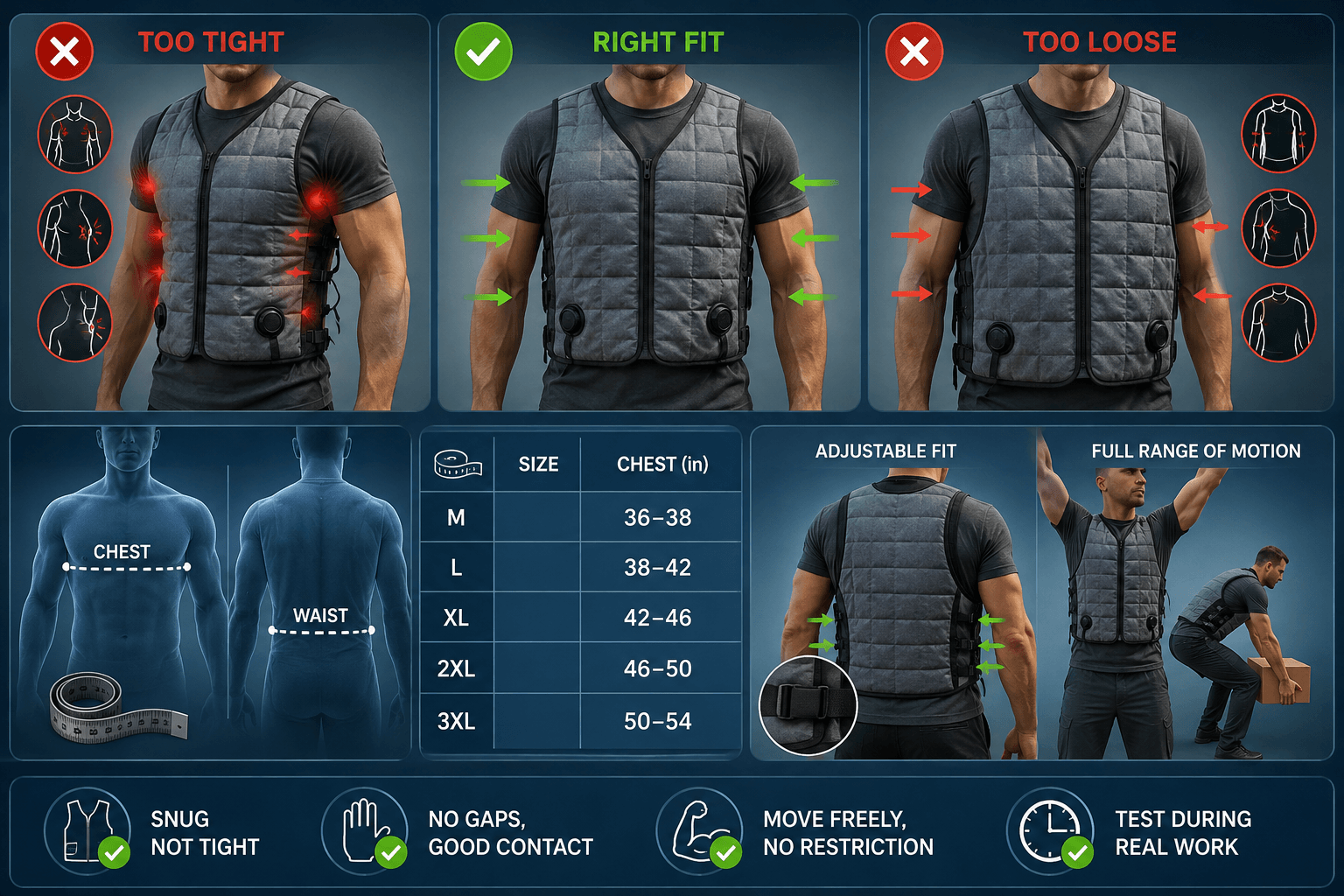
Too tight, and your vest fights you all day. Cooling vests are supposed to sit snug, not squeeze. Manufacturers measure chest size around the shoulder blades, underarms, and the fullest part of the chest, horizontally, with the tape “snug but not tight.” When you size down, pressure concentrates at the ribcage, underarms, and shoulder straps. That’s exactly where cooling vest chafing starts. Reach overhead or bend to lift something, and a too-tight vest pulls and restricts. Over an 8-hour shift, that friction point becomes a hot spot—literally.
Too loose, and you’re paying for cooling you’re not getting. The physics is simple: cooling only happens where the vest touches your skin. Any gap between the fabric and your body is wasted cooling capacity. A simple test tells you if you’re in trouble—can you slide a flat hand into the chest area with ease? Can you pinch a fold of loose fabric? If yes, you’ve lost contact area. Loose vests also shift during work. Raise your arms, and if the hem rides up or you’re constantly resetting straps, that’s your sizing telling you something.
Getting the Fit Right
-
Measure chest and waist, then size to the larger number. This matters if your job involves bending or twisting.
-
Common chest ranges: 36–38″ (M), 38–42″ (L), 42–46″ (XL), 46–50″ (2XL), 50–54″ (3XL)
-
Adjustable vests with expandable straps (often +10″ per extension) handle body changes or layering over workwear better.
-
Test fit during a full hour of real work, not just standing still.
The target zone is close enough that cooling panels stay put, and loose enough that your shoulders and arms move freely.
The Weight Issue: How Ice/PCM Inserts Cause Fatigue During Extended Wear
A single PCM cooling insert weighs 300–370g. Multiply by four (the standard configuration), and you’re carrying 1.2–1.48kg in inserts alone. Heavier-duty phase change cooling vest options push individual inserts to 450–510g, putting a four-pack near 1.8–2.0kg. Add the shell, straps, and pockets, and a fully-loaded ice cooling vest can hit 2.3kg. Gel-based vests aren’t lighter by default. Fully saturated versions run 1.3–2.5kg, with industrial-grade options reaching 2.95kg (6.5lbs).
Over a shift, that weight adds up. A Hong Kong construction site study found cooling vests improved fatigue recovery, and 91% of workers said they’d use one during breaks. But the same research flagged weight as the tradeoff. These vests scored just 3.5/5 on portability and ease of use, well below cooling collars or portable fans. Overall performance ratings hit 4.75/5, yet “easy to use” scores dragged the average down. The cooling works.
Solutions That Reduce Load
-
Choose distributed insert layouts. Four smaller panels (around 300g each) spread weight evenly instead of concentrating it at one pressure point.
-
Drop insert weight, not insert count. Shifting from 450–510g panels to 300–340g panels saves 0.5–0.8kg total. That’s noticeable by hour three.
-
Check shell material. Cotton-polyester blends (roughly 70/30) keep total vest weight near 2.3kg without sacrificing durability.
-
Match cooling duration to shift length. Lightweight PCM options trade some cooling time (2–4 hours) for significantly less fatigue. That’s often the better call for full 8-hour shifts.
Climbing a ladder shouldn’t feel like wrestling your own gear. But that’s what happens when external tubing, fluid reservoirs, or rigid fan housings turn a cooling vest into an obstacle course. Bend, kneel, or reach overhead, and every move gets fought by hardware that wasn’t built for range of motion.
Fan-based vests are usually the bulkiest offenders—too thick to wear under a fall-protection harness, which rules them out for construction work entirely. Tube-and-reservoir systems bring their own risk: snag hazard. Any protruding line or pack is something scaffolding, rebar, or machine guards can catch on.
Matching Flexibility to the Job
Construction: Prioritize harness compatibility, zero snag risk.
Warehouse/logistics: Favor low-profile, no-external-parts designs for frequent turning and reaching.
Factory/manufacturing: Slim, tubeless builds matter most near tight equipment.
Foundry/steel: Balance cooling duration against mobility—PCM or compressed-air often wins.
A vest that can’t move with you gets removed—and then it protects no one.
Cooling Duration Mismatch Makes Vests Feel Heavy and Ineffective Mid-Shift

Your vest doesn’t fail all at once. It fails gradually, right when you need it most. That’s cooling duration mismatch, and it’s why your gear feels heaviest when it’s doing the least.
Every cooling method has a shelf life, and none last a full shift on their own.
Ice and gel packs peak fast and crash. You get 60–90 minutes of real cooling in typical conditions, or a conservative 1–2 hours in industrial settings. What matters is what happens after the drop-off. Once the ice nears melt point, the cold sensation disappears, but the weight doesn’t. You’re left carrying dead water weight strapped to your torso. That “still heavy, no longer cold” contrast is the single most common cooling vest complaint on record.
Phase change material (PCM) inserts typically run 2–3 hours, with some products claiming 2–4 hours and certain 64°F (18°C) packs holding up to 4 hours. Melting point drives duration directly: 6.5°C packs run about 2 hours, 15°C around 2.5 hours, 21°C near 3 hours, 24°C roughly 3.5 hours, 29°C up to 4.5 hours. The failure mode is a slow plateau. Past the 2–3 hour mark, temperature support fades gradually, and workers describe it as feeling “stuffy” or “tired” rather than outright hot.
Evaporative cooling vests claim 2–4 hours, but conservative real-world ranges run 0.5–3 hours, heavily dependent on humidity. Dry environments hold steady. Humid ones cause early failure, sometimes cutting effective cooling in half.
Matching Cooling Type to Shift Length
Under 2 hours: Ice/gel, coldest and fastest, best for short high-intensity tasks
2–3 hours: PCM, most stable match for a single mid-length shift
2–4 hours, dry conditions: Evaporative works, but skip it in high humidity
4–8+ hours: No single passive system covers a full shift. Plan a second PCM pack swap or a re‑wetting break for evaporative vests, or rotate ice modules
If you’re matching gear to a full 8-hour shift, single-cooling-cycle vests will always feel heavy by hour four, because functionally they’ve already stopped working.
Breathability Failure: How Poor Airflow Causes Sweat Buildup and Skin Irritation

Fabric science has a number for this, and it’s not flattering to most budget vests. RET (water vapor resistance) measures how easily sweat escapes your vest’s microclimate. Under 6 is “very breathable.” 6–13 is “good.” Past 20, you’re in trouble. That’s where sweat pools on high-activity wear, and breathability stops mattering.
Mesh: 150–300+ CFM airflow. Best for backs, underarms, chest sides, wherever sweat hits hardest.
Jersey/quick-dry knits: 50–100 CFM. Fine for moderate exertion.
Dense knits: Under 50 CFM. This is where sweat buildup and that clammy, itchy feeling start.
MVTR (moisture vapor transmission rate) tells a similar story. Basic breathable fabric hits 10,000 g/m²/24h. Good performance starts at 15,000. High-output work should target 20,000+. Anything below that traps vapor against skin, and trapped moisture plus friction is a direct path to rashes and heat-related skin irritation, especially at pressure points already stressed by fit issues.
Humidity makes it worse for evaporative cooling vest side effects. These vests still cool in high-humidity conditions, but push into high-humidity-plus-exertion territory, and the cooling benefit can flip negative. The evaporation the whole system depends on can’t happen fast enough.
The fix is fabric selection:
– Mesh panels at sweat-heavy zones
– MVTR ≥15,000 g/m²/24h as your baseline
– Skip anything with RET >20 or CFM under 50
If your vest feels swampy by hour two, check the fabric spec sheet before blaming the cooling method.
Temperature Extremes: When “Too Cold” Becomes a Discomfort Factor
Comfort has a ceiling on the cold side too. Ice-pack vests can overcool localized skin, and long-term contact irritates tissue. Some ice vests have zero flexibility, which makes that irritation worse. Low-melting-point PCM behaves the same way: aggressive cooling triggers erythema and skin discomfort instead of relief.
Tuning matters. A 24°C PCM insert outperformed a 28°C version on torso and mean skin temperature, without tipping into overcooling. Manufacturers should aim for torso stabilization in the low-to-mid 30°C range. Comfort improves with a 1–3°C reduction, not a dramatic drop.
The data backs it up:
– PCM vests cut torso skin temperature roughly 2–3°C, settling near 33.3°C
– Sweat rate dropped 14–18% with proper PCM cooling
– Comfort ratings moved from “uncomfortable” (no vest) to “comfortable” (well-matched PCM)
Match the melting point to your environment and your budget.
Environmental Factors: Sun Exposure, Humidity, and Dark Colors Adding Heat Load
Your vest’s color and your work environment can undo hours of good cooling design. Military heat-load testing found black uniforms absorb 145 kg-cal/hr of solar heat versus 92 kg-cal/hr for white, a 17% jump in total heat load. Surface temperatures tell the same story: black cotton fabric hits roughly 55°C in direct sun, while white cotton stays near 45°C. That’s a 10°C swing from color alone, and darker fabrics generally run 4–6°C hotter than light ones in similar conditions. Weaker reflectance means more absorbed heat. Dark cotton’s heat contribution measured 73.7%, versus 43.7% for light khaki.
Humidity is the other silent killer, especially for evaporative cooling vests. These systems perform best under 40% RH. Push past 70% RH and cooling drops to nearly nothing.
Matching Vest Type to Conditions
-
Bright sun, low humidity: Light-colored, reflective, breathable shells; evaporative works well under 40–50% RH
-
Bright sun, high humidity: Keep the light shell, switch to fan-based or active-airflow cooling
-
Indoor/warehouse, dry air: Evaporative still delivers
-
Dark-colored shells: Reserve for shaded or indoor work only. Direct sun adds heat load you can’t cool away.
Matching Cooling Vest Type to Your Shift Length and Work Environment
No single cooling vest works everywhere. The environment you’re in and the length of your shift decide which cooling method actually holds up—and picking the wrong one guarantees discomfort by lunch.
Dry heat, outdoor, access to water: Evaporative wins here. You get 2–4 hours per soak, sometimes 4–8 hours on certain products, and dry air keeps performance stable. This is the default for construction, trades, maintenance, and landscaping work—open-air jobs with enough airflow to make evaporation work.
Humid, low-airflow, enclosed spaces, or under PPE layers: PCM takes over. It runs 2–4 hours regardless of humidity. Research on hot-humid conditions shows PCM adds about 60 minutes of extra cooling compared to no insert at all. That predictability matters when you’re layered under protective gear with no breeze to rely on.
8–12 hour shifts: Passive systems—ice, PCM, most standard vests—max out at 60 minutes to a few hours. For full-length shifts, active battery-powered or circulating (chilled water) systems are the only realistic option. Warehouse-focused products built for this use case often deliver 8–12 hours per charge, weigh under 3 lbs, and are marketed to cover a standard sorting shift plus overtime.
Heavy physical labor: Prioritize lightweight, low-resistance builds regardless of cooling method. Product lines built for construction, material handling, warehousing, and iron/steel fabrication consistently favor slim, flexible designs over bulkier alternatives.
Selection Checklist by Priority
-
Weight: Under 3 lbs for long shifts or warehouse work
-
Duration: Match coverage to 50–100% of shift length; 8–12 hour shifts need swap-battery support
-
Breathability: Skip evaporative-only designs in humid or enclosed settings—choose circulating or PCM instead
-
Flexibility: Low-profile, PPE-compatible builds for bending, lifting, welding
Maintenance Problems That Compound Discomfort Over Time
Discomfort doesn’t stop when your shift ends. It carries over into how the vest holds up day after day, and that’s where a lot of cooling gear quietly fails you.
Fan-based vests generate real noise, usually 50–60 dB at working speed, with heavier-duty units hitting 67.6, 70, even 80.9 dB. For reference, 70 dB sits near a noisy restaurant. Quieter benchmarks target under 40 dB, but most fan vests cluster at 40–55 dB even before you push airflow higher.
Recharge cycles add friction too. PCM inserts need 5–10 minutes in ice water, 30 minutes at 8°C, or up to 2–3 hours at room temperature. Some cooling packs firm up in 10–15 minutes with a “quick top-off” around 20 minutes. Cycle through work-recharge-wear too often, and that waiting window becomes its own heat exposure problem.
Washability matters more than most buyers realize. Without wet-cleaning or stain-resistance standards like ISO 3175-4 or ISO 14419 backing the fabric, expect yellowing, sweat odor buildup, and stiffening after repeated washes.
Signs of Low-Maintenance Design
-
Recharge time: 10–20 minutes (ice water) beats 1+ hour room-temp options
-
Noise: 40–55 dB fan output, avoid models exceeding 70 dB at full speed
-
Cleaning: Removable cooling modules or machine-washable shells
-
Build: Reinforced seams and fan housings for repeated daily use
FAQ: Common Questions About Cooling Vest Discomfort and Solutions
Numbness or a cold, clammy feeling is usually harmless. In a sample of 25 users, 23 reported no discomfort, 2 had mild issues, and only one experienced numbness. That’s a low-risk pattern. Dizziness, confusion, or sweating that suddenly stops are stop-work signals. Get cool, hydrate, and see a medic.
You need to swap inserts every 2 hours for most cooling vest designs, though extreme heat shortens that window. Icebeartech’s ice pack inserts are rated for 500+ freeze-thaw cycles with ≥95% gel retention, built for crews swapping packs multiple times a shift.
Match cooling type to shift length: under 2 hours, use an ice pack or fan-based vest; 4–6 hours, a PCM vest gives steadier output; for 6+ hours, rotate spare inserts as scheduled maintenance.
Conclusion
Discomfort is your body telling you the gear doesn’t fit the job. Most cooling vest problems trace back to three fixable issues: mismatched sizing, cooling duration that doesn’t match your shift, and materials that trap sweat. Once you identify which one is sabotaging your comfort, choosing between ice pack, evaporative, or phase change designs becomes a lot less confusing.
The real goal is finding a cooling vest that matches your specific shift length, movement demands, and environment closely enough that you forget you’re wearing it. That’s when heat stress prevention actually works, because nobody removes gear that feels right.
Before your next shift, run through the fit and breathability checklist above. If you’re still stuck, IceBearTech’s team can help match a cooling vest to your exact work conditions.