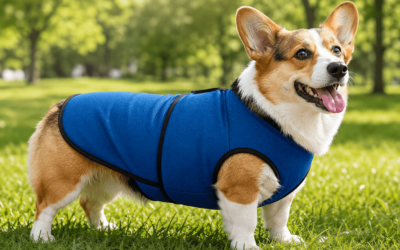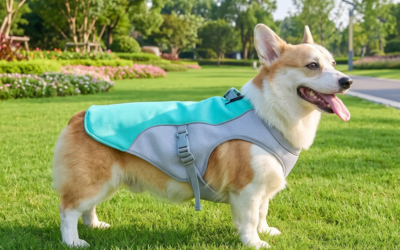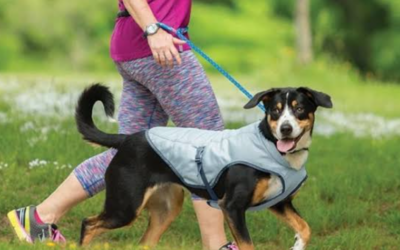
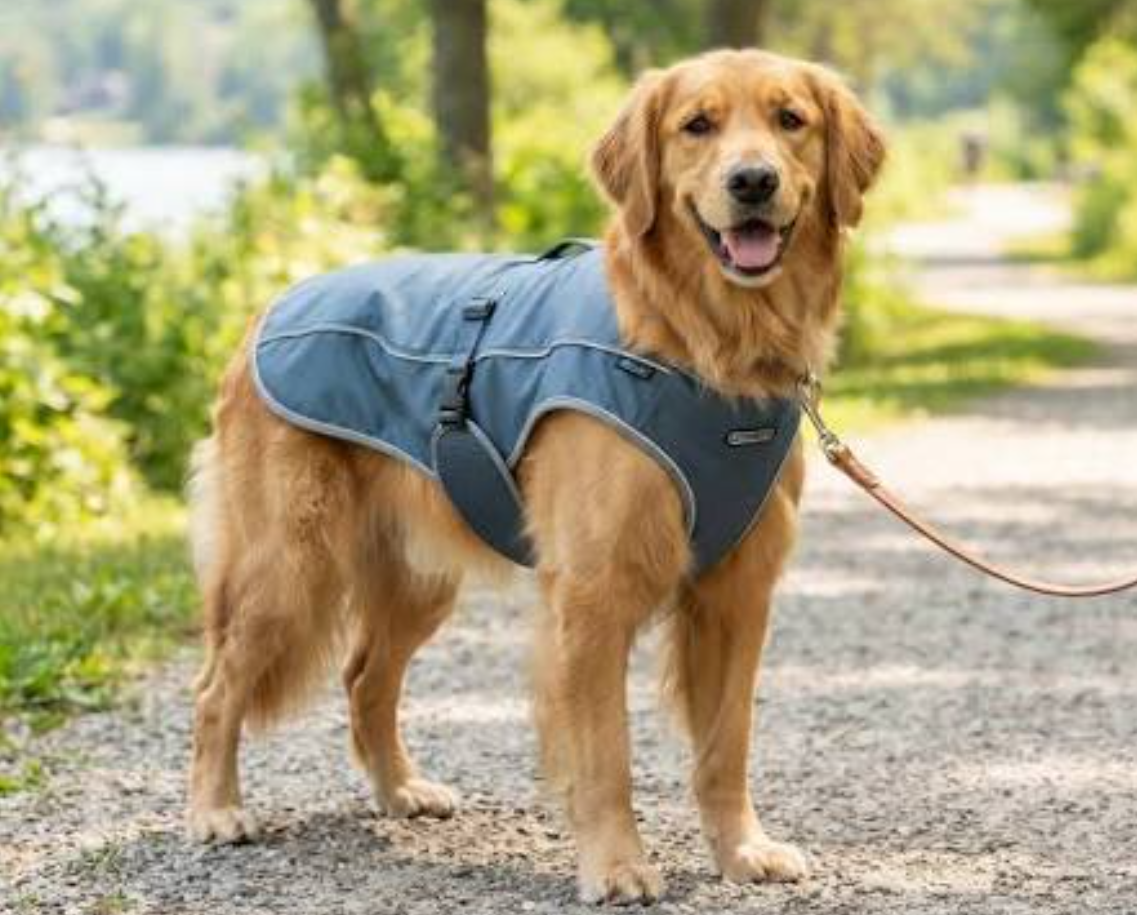
You bought a dog cooling vest expecting instant relief for your panting, overheated pup. You soaked it, strapped it on, and then wondered if it was doing anything on that sweltering, humid afternoon. You’re not imagining it, the reason an evaporative cooling vest that works brilliantly in Phoenix can feel practically useless in Houston comes down to humidity, a factor most product pages never mention.
Dog cooling vest effectiveness is a sliding scale tied to how much moisture is already in the air around your dog. The scale goes from “working great” to “barely helping.” We’ll explain what’s happening at the molecular level when evaporation stalls and, if you live somewhere humid, what you can do about it. Your dog’s safety is worth five minutes of reading.
Quick Answer: Do Cooling Vests Work in High Humidity?

Yes, but with real limits. Evaporative cooling dog vests start losing effectiveness around 50–60% relative humidity. Once you cross 70% RH, most vests are barely functioning—some testers call it “almost not working” territory. At 100% RH, evaporation stops.
One test showed a wet cooling vest hitting 14°F below ambient temperature at 30% RH. At 60% RH, that dropped to just 6°F. Cooling duration shrinks too, often to 45–60 minutes in humid air versus much longer in dry heat.
These vests work best in hot, dry climates. In humid regions, use them as a supplement. They won’t prevent heatstroke on their own.
The Science: How Evaporative Cooling Dog Vests Work
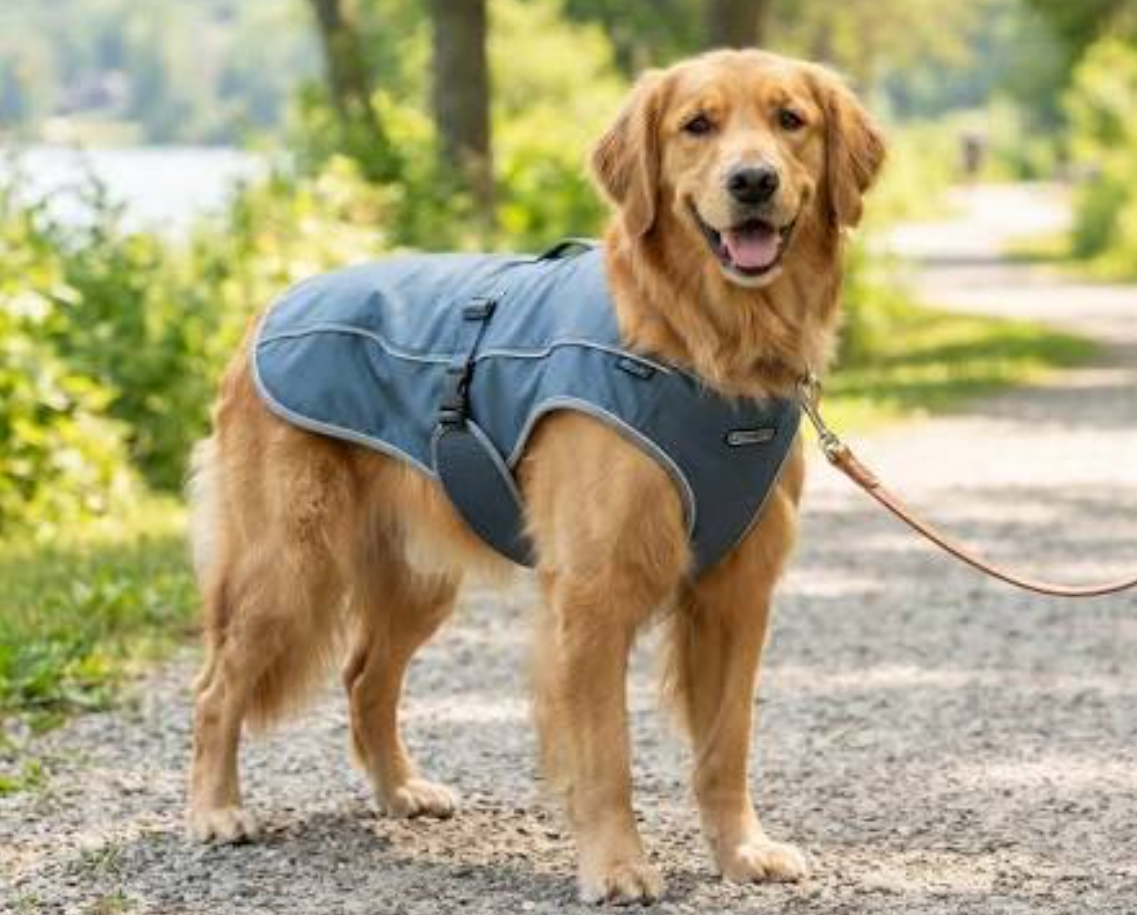
On your dog’s back, water changes from liquid to vapor, and that phase change pulls heat out of the fabric and off your dog’s skin. Basic physics. Every gram of water that evaporates from the vest absorbs 2,260 joules of heat. The entire cooling mechanism is the same principle behind sweating, swamp coolers, and every wet-fabric cooling trick humans have used for centuries.
Evaporation needs somewhere to send that water vapor.
This is where humidity wrecks the equation. Dry air has room to absorb moisture, so water leaves the vest fast and pulls heat with it. Humid air is already saturated, with little to no capacity left. Push that toward 100% relative humidity, and dry-bulb and wet-bulb temperatures converge. Evaporation grinds to a halt.
The Wet-Bulb Depression Rule
Efficient evaporative cooling needs a wet-bulb depression of at least 15–20°F (8–11°C). That’s the engineers’ benchmark. The air needs to be dry enough to accept more moisture. Without that gap, you’re not cooling, just carrying wet fabric.
HVAC and cooling-tower systems calculate evaporation using airflow, wet-bulb depression, and saturation efficiency. The exact same physics governs your dog’s vest. More airflow plus drier air equals more evaporation equals more cooling.
Why Your Vest Behaves Differently
|
Humidity Level |
Evaporation Rate |
Cooling Effect |
|---|---|---|
|
Low RH (dry air) |
Fastest |
Strongest |
|
Moderate RH |
Slower |
Reduced but noticeable |
|
High RH (80–90%) |
Sluggish |
Minimal |
|
Near 100% RH |
Nearly stalled |
Cooling largely fails |
In a humid climate, a soaked cooling vest acts like a wet insulating layer, water sitting on the fabric with nowhere to go. That’s the science behind why the same product feels different depending on your zip code.
Humidity Threshold Breakdown: When Does Effectiveness Drop?
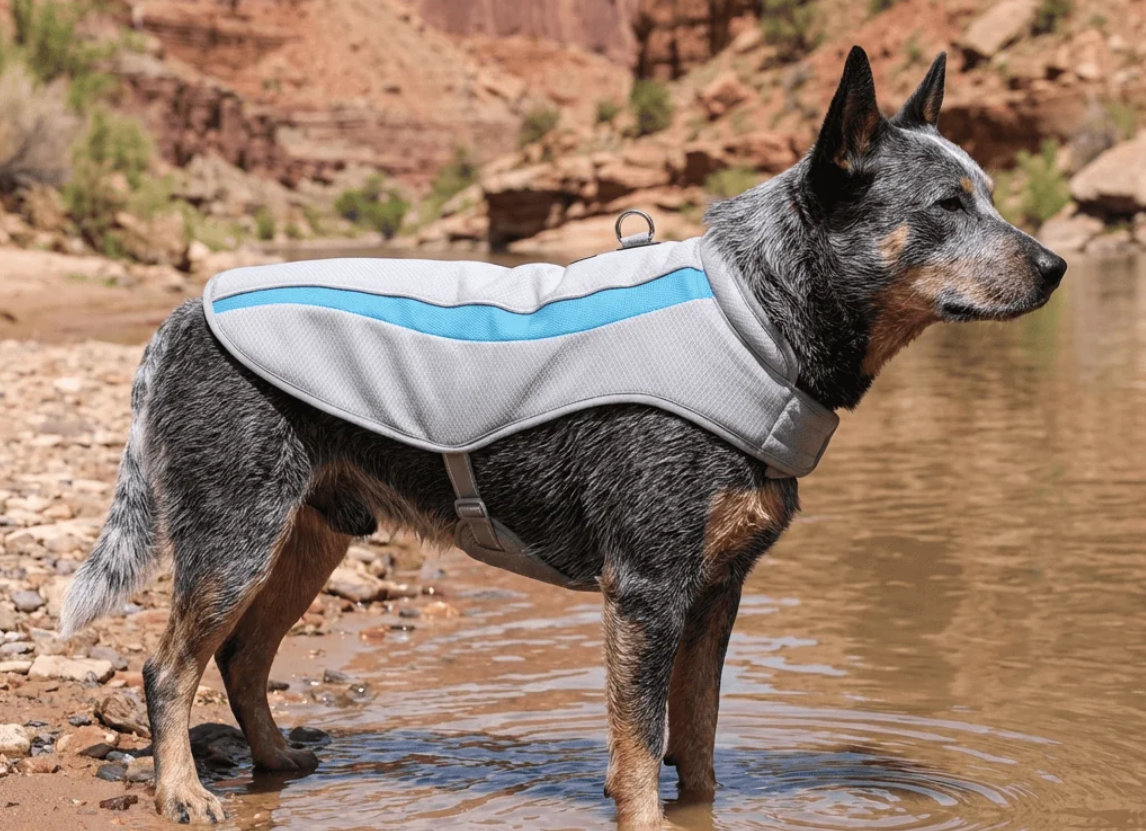
The number to remember is 50% humidity. That’s where the wheels start coming off for evaporative cooling. Below 50%, your dog cooling vest works near its full potential. Above it, you’re on a downward slope that gets steeper the higher the humidity climbs.
Break it down by range, and the pattern gets obvious fast:
|
Humidity Range |
Performance Rating |
What’s Happening |
|---|---|---|
|
Below 50% |
Excellent |
Evaporation runs fast, cooling stays strong |
|
50–60% |
Good, trending down |
Efficiency starts slipping noticeably |
|
60–70% |
Poor |
Vest works, just not like it used to |
|
Above 70% |
Nearly ineffective |
Cooling power collapses, risk of “wet sweater” effect |
In dry heat, surface temperatures under an evaporative vest can drop 10–15°F. Add airflow, and the microclimate around the vest can run 5–15°F cooler than ambient air. But the microclimate reading doesn’t translate directly to your dog’s actual body temperature. Measured improvement to core comfort typically lands around 2–3°F—useful, but nowhere near a magic fix.
Geography matters. Owners in Arizona or Nevada get genuine, high-value cooling. Owners in Florida, the Gulf Coast, or anywhere in the Southeast come August are fighting physics the whole time. Once humidity sits at 70% or higher on a regular basis, an evaporative dog cooling vest stops being your primary defense. That’s the point where ice pack or PCM cooling vests start making more practical sense.
What Happens to Your Dog’s Cooling Vest in Very High Humidity
A soaked vest in saturated air doesn’t stay a cooling tool. It becomes a wet blanket. Literally.
Multiple product reviews converge on the same warning: above 60% humidity, evaporative cooling vests “do not work well.” Push to 70%, and cooling effect drops to roughly 6°F—barely noticeable on a hot day. At 100% humidity, one benchmark reports little to no cooling effect at all. Evaporation needs somewhere for that moisture to go. Saturated air offers nowhere.
The “Wet Sweater” Failure Mode
This is the real risk with a wet cooling vest for dogs in humid climates. Water sits on the fabric instead of evaporating. The vest stays damp, heavy, and warm—trapping heat against your dog’s body instead of pulling it away. Reviewers describe this exact scenario: the vest feels wet, looks like it’s working, but isn’t actually cooling anything.
That’s the dangerous part. Some buying guides flag 50% humidity as the point where you should start considering PCM or hybrid cooling solutions instead of pure evaporative designs. A practical rule from field reviews: evaporative vests perform decently below ~70% humidity with a light breeze. Above that threshold, performance falls off fast, and your dog may be no cooler than without the vest at all.
How to Maximize Cooling Vest Performance in Humid Climates
Physics won’t bend for you, but you can still squeeze more performance out of an evaporative cooling dog vest. It comes down to how you soak it, wring it, and keep air moving across it.
Start with a proper soak. Testing protocols activate cooling vests by submerging them in roughly 35°C water for 1–2 minutes. That’s your baseline. Skip this step and you’re starting from a deficit before your dog even steps outside.
Wring it out—don’t leave it dripping. A soggy vest traps water against the fabric instead of letting it evaporate. “Saturated but not dripping” is the sweet spot testers use, and it matters more than most owners realize.
Airflow is non-negotiable. At 35°C, moving from still air to 0.4 m/s and then 1.0 m/s measurably increased evaporative cooling capacity in controlled tests. A fan, a breeze, or just walking your dog instead of standing still all generate that airflow. Standing in dead air kills the effect fast.
Field Routine for Humid Days
-
Soak the vest until fully saturated
-
Wring until it stops dripping
-
Get your dog moving or near airflow immediately
-
Check periodically—when cooling fades, re-wet
-
Shorten continuous wear time as humidity rises
At 35°C with 0.4 m/s airflow, cooling capacity dropped 28% when humidity climbed from 20% to 40% RH. That’s a steep falloff from a fairly modest humidity increase.
Even so, one hot-humid test (34°C, 60% RH, 0.4 m/s) recorded 3 hours of continuous cooling—proof the vest still contributes, just not at dry-climate levels. Plan on a roughly 60-minute buffer from supplemental cooling strategies (shade breaks, water access, reduced activity) rather than expecting the vest alone to carry the load.
Treat re-wetting as maintenance, not a last resort. In humid air, evaporation slows before your dog’s comfort visibly drops. Waiting until the vest feels dry means you’ve already lost cooling minutes you can’t get back.
Better Alternatives for Humid Weather: Ice-Pack & PCM Cooling Vests
Water evaporation isn’t the only way to pull heat off a dog. Phase-change material (PCM) and ice-pack cooling vests work differently. They use pre-frozen inserts or gel packs that absorb heat directly through a phase change, skipping the moisture-evaporation mechanism entirely. No air saturation problem or humidity ceiling—that’s the appeal.
The selection rule is simple:
-
Low humidity, dry heat: evaporative vests win on cost and weight
-
High humidity (70%+ RH): PCM or ice-pack vests hold their advantage
-
Mixed climates: hybrid designs cover both scenarios
What PCM Vests Actually Deliver
One source puts PCM cooling duration at roughly 4 hours after proper pre-freezing. A separate gel-pack study measured a 0.492°C drop in core body temperature at the 15-minute recovery mark (statistically significant, p = 0.015). That’s a real, measurable cooling effect—one that doesn’t degrade as the air gets thicker with moisture.
The trade-off is weight and stiffness. PCM inserts need freezer time before use, and once the cold releases, you can’t recharge it the way you re-wet an evaporative vest mid-walk. The cooling window is fixed, not renewable on demand.
Dog Cooling Coat vs Vest: Coverage Isn’t Everything
Cooling coats typically extend past the vest’s usual footprint, covering more of the back, chest, and torso, sometimes reaching near the tail. In dry heat, that extra surface area helps evaporation happen faster.
In humid air, bigger coverage doesn’t translate to better cooling. If evaporation has already stalled, more wet fabric just means more wet weight.
Stacking Reflective Layers with PCM
Reflective or sun-shade layers block heat before it ever hits the skin. Pair a reflective outer shell with a PCM inner layer and a breathable structure, and you get a setup built for humid, sun-heavy conditions—hiking, training, or outdoor work where evaporation alone won’t cut it.
The Complete Heat Management Combo: Beyond Just a Vest
No cooling vest, evaporative or PCM, works alone. Shade, hydration, rest, and ventilation make up the real system, according to veterinary and animal welfare guidance. The vest is one component.
Ventilation has to pair with the vest itself. A fan, moving air, or air conditioning combined with evaporative cooling works. A wet cooling vest in still, humid air does nothing. The same physics problem from earlier applies to your whole routine and the fabric.
The Four-Part Combo, Made Actionable
-
Shade first. Tree cover, building shadow, a canopy, or anything that blocks direct sun before you worry about cooling gear.
-
Hydration on a schedule. Check in every 10–15 minutes. Offer small sips. Don’t force water down.
-
Rest in short bursts. Walk, stop, rest in shade, repeat. Use a fan, AC, or car climate control to recover between stretches.
-
Airflow with the vest. Without a breeze, the vest holds heat against your dog’s skin.
Timing Matters As Much As Gear
Skip the 10 a.m.–4 p.m. window. Move walks and training to early morning or evening. At 25°C+ with high humidity, shorten activity and add rest breaks. Past 28°C, cancel structured training. Above 75% relative humidity, your dog relies almost entirely on panting to dump heat; evaporative cooling, including the vest, is compromised.
A workable daily template:
-
Morning: short walk, shaded route
-
Midday heat: indoor only, no exceptions
-
Evening: second short outing, activity resumes
-
Humid, muggy days: treat as high-risk regardless of actual temperature. Shorter duration and more breaks.
Know the Warning Signs
Watch for heavy panting, thick or stringy drool, red gums or tongue, restlessness, wobbling, or vomiting. Collapse, seizures, confusion, or inability to stand are emergencies. Stop activity and cool your dog immediately. No vest, cooling vest or otherwise, is a substitute for recognizing these signs early.
FAQ: Common Questions About Dog Cooling Vests in Humidity
Readers keep sending the same handful of questions, so here they are, answered straight.
How often should I re-wet the vest in humid weather?
Every 30–45 minutes on trail if it’s hot and humid. In milder conditions, wear time stretches to 1–4 hours before you need to re-soak, depending on sun exposure, activity level, and how thick the air feels. If you’re doing a dog cooling vest walking routine, check the fabric every 30–60 minutes. The second it feels warm or dry instead of cool and damp, re-wet it.
Is there a humidity number where I should just switch products?
Yes. At or above 50% RH, start looking at PCM or hybrid designs. Pure evaporative vests are fighting an uphill battle past that point, and by 70% RH they’re barely contributing anything.
What if evaporative fabric just isn’t cutting it anymore?
A smaller-coverage item, like a cooling bandana, can actually outperform a full vest in humid heat. Less wet fabric means less risk of that trapped-heat, wet-sweater problem covered earlier.
How do I get the sizing right?
Measure neck, chest, and back length before buying. Kurgo’s published chart is a solid reference: Small runs 16 in neck, 19–27 in chest, 13 in back. Medium: 19 in / 26–35 in / 20 in. Large: 23 in / 30–39 in / 23 in. X-Large: 26 in / 35–45 in / 27 in. Chest measurement is usually the tightest fit point, especially for deep-chested or barrel-chested breeds.
What’s the best cooling vest for dogs in 2026 if I live somewhere humid?
Look for hybrid or PCM options first, evaporative-only vests still work, just plan around their humidity ceiling.
Conclusion
An evaporative cooling dog vest works through evaporation. Once humidity climbs past 70%, the soaked fabric stops pulling heat away efficiently, no matter the brand. That’s physics at work.
Match the tool to your climate. If you live somewhere sticky and humid, pair your vest with shade, fresh water, and shorter outdoor sessions—or switch to an ice-pack or PCM cooling vest that doesn’t rely on evaporation at all. If you’re in drier heat, a wet cooling vest for dogs remains one of the smartest, most affordable tools in your kit.
Don’t let one product carry the whole job. Check the humidity, adjust your approach, and give your dog layered protection instead of a false sense of security.