You’ve probably wondered if there’s a smarter way to beat the heat than melting ice packs down your back. That’s exactly why PCM cooling vests keep popping up in your searches. They promise hours of steady, hands-free relief using phase change material technology instead of traditional ice. But PCM cooling packs aren’t automatically better for every situation, every body, or every budget. Before you drop money on one, you need to know what these vests deliver, where they fall short, and how they compare to evaporative and ice-based alternatives, so you can match the right cooling tech to your actual work, workout, or heat-sensitivity needs.
How PCM Cooling Vests Work: The Phase Change Material Technology Explained

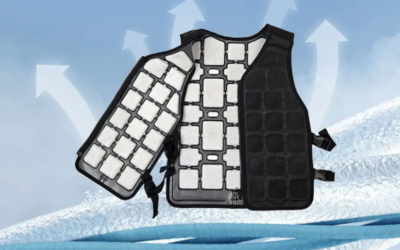
PCM cooling packs are sealed pouches filled with a substance designed to melt at a specific, predictable temperature. You freeze them solid, strap the vest on, and as your body heat warms the packs toward that melting point, the material shifts from solid to liquid. That phase change absorbs heat without the pack itself getting hotter.
How PCM Is Different from a Cold Pack
This effect is called latent heat of fusion. Instead of warming up quickly like a regular ice pack, the PCM material stays at one temperature while it melts, absorbing heat steadily. You get consistent cooling rather than a hot-cold cycle.
Melting Point Determines Cooling
Not all PCM vests cool the same way, and melting point is why:
-
15°C packs: aggressive cooling, favored for high-heat industrial exposure, roughly 2.5 hours of active cooling
-
20–24°C packs: the sweet spot for comfort and performance—one study found 24°C vests outcooled 28°C vests on torso and mean-skin temperature, with about 3.5 hours of runtime
-
28–29.76°C packs: milder, gentler on skin-cold sensitivity (gallium, for reference, melts at 29.76°C)
-
32°C packs: least aggressive cooling, longer comfort but less heat-pulling power
Design engineers typically keep the melting point in a 15–35°C range, low enough to feel cool against skin but not so low it causes cold stress.
Why PCM Works Under Gear Where Evaporative Vests Fail
Unlike an evaporative cooling vest, PCM doesn’t need airflow or sweat evaporation to function. The cooling happens internally, from the material itself absorbing your body heat. That’s why PCM vests hold up under PPE, fire-retardant coveralls, CBRN suits, and other sealed gear. They’re a go-to cooling vest for heat stress in humid climates or static work environments, where evaporative designs stall out.
6 Key Advantages of PCM Cooling Vests
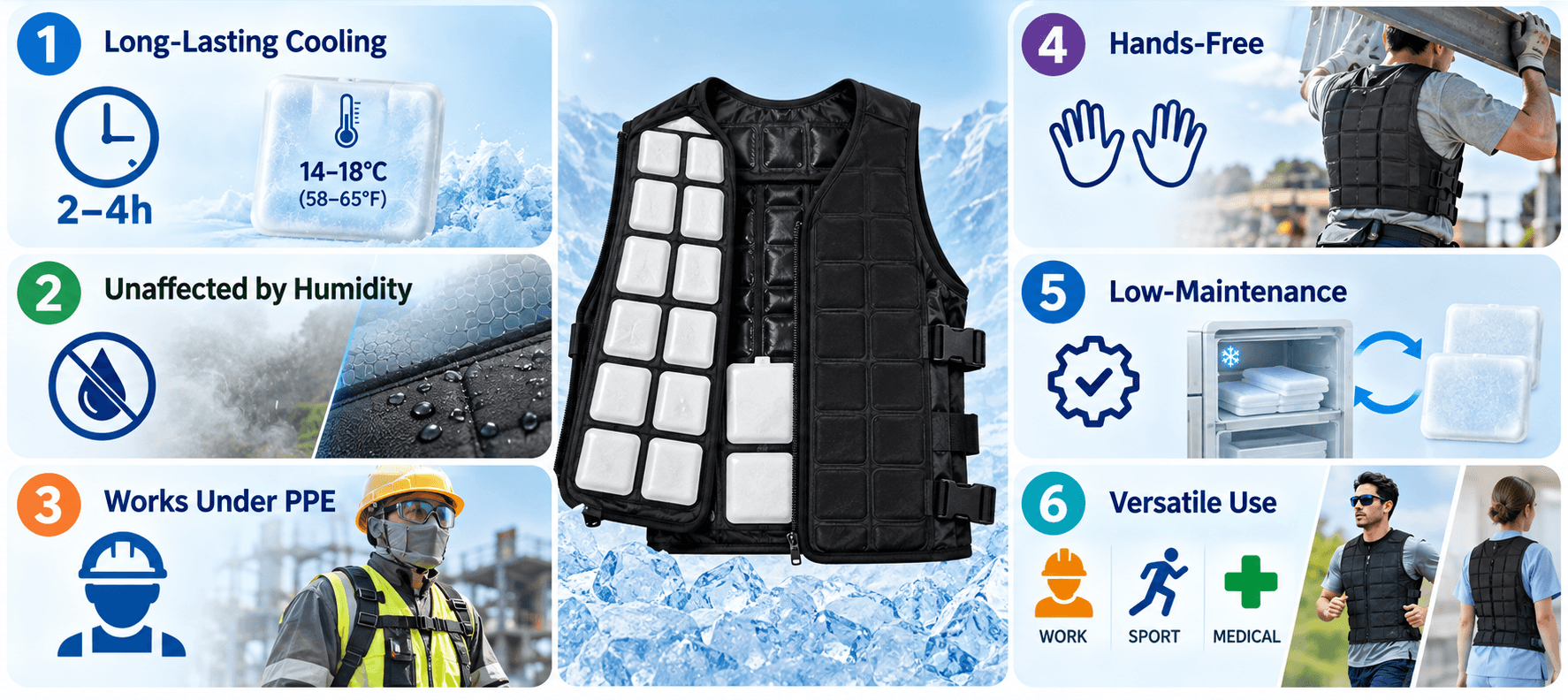
Six reasons keep showing up in reviews, lab studies, and worker-safety reports when people talk about why PCM cooling vests earn their price tag.
1. A steady cooling window you can plan around
PCM inserts hold a near-constant temperature, usually 58–65°F (14–18°C), for a predictable stretch of time. Most vests deliver 2–4 hours of real-world cooling. Some industrial-rated models push that to a full 4 hours, depending on your workload and outside heat. Worker-safety reports confirm inserts hold around 60°F for 2–4 hours. That means you can plan a shift, a race, or a job site rotation around known cooling time instead of guessing.
2. Humidity doesn’t kill the effect
PCM cooling has nothing to do with evaporation, so sticky, stagnant air doesn’t slow it down. Once relative humidity climbs past 60–70%, evaporative vests lose their effect—there’s not enough dry air left to pull moisture off the fabric. Field research in hot, humid conditions confirmed this: evaporative cooling dropped sharply in both test environments, while PCM kept delivering effective cooling the whole time.
3. It still works under PPE
PCM vests deliver cooling under heavy protective layers. Airflow-based cooling can’t do much when there’s no airflow, but PCM doesn’t need any. One test shows a vest rated for 2–4 hours of open-air cooling still delivers 45 to 120 minutes of usable cooling underneath heavy PPE. That’s a meaningful buffer for workers whose gear blocks evaporation.
4. Hands stay free
You wear it like a garment. That sounds obvious until you’re driving, lifting, swinging tools, or managing a medical condition and need both hands doing something other than holding a cooling device. PCM works as a passive layer—you don’t have to manage it like a separate tool.
5. Low-maintenance by design
No pumps, no batteries, no soaking the fabric in water. You freeze the inserts and swap them in. Reset time runs on the same cold-storage cycle, and runtime lands in that familiar 2–4 hour range. That makes PCM vests easy to rotate across shift changes or haul between job sites without extra gear.
6. It fits work, sport, and medical use differently—but well
In hot-work settings, you get steady heat control across a task window. In sport or field use, it’s predictable cooling without soaked fabric weighing you down. In medical and rehab contexts, passive cooling matters because it’s quiet, wearable, and doesn’t require the user to manage anything.
6 Critical Disadvantages and Limitations of PCM Vests

That 2-4 hour cooling window has a catch nobody mentions in the marketing copy: when it ends, it ends hard.
1. The cutoff isn’t gradual—it’s a cliff
Once the phase change material fully melts, cooling doesn’t taper off slowly. It drops fast. You go from comfortable to sweating within minutes, with almost no warning. Most PCM packs run 1.5–4 hours, with 2–4 hours being the realistic window most users report. Some 18°C/64°F packs claim up to 4 hours; other listings cite just 3 hours from a 45-minute freeze, or 2-3 hours depending on the refreeze method. Know your pack’s actual runtime before you’re mid-shift.
2. Recharging eats real time
Unlike grabbing a fresh ice pack from a cooler, PCM inserts need a proper refreeze cycle. Ice water baths take 10-20 minutes. A standard freezer needs 2-3 hours. A regular fridge? 5-6 hours. Industrial users often cite 60-90 minutes at -18°F as the benchmark. If you’re planning a reusable cooling vest rotation, you need a freezer nearby—not an afterthought.
3. Bad fit for continuous, multi-shift work
Because recharge time runs from minutes to hours, PCM vests work best with built-in downtime between uses. If you’re doing back-to-back shifts or mobile work with zero freezer access, you’ll need spare packs on rotation—or you’ll be stuck without cooling exactly when you need it most.
4. They’re heavier than you’d expect
A fully loaded PCM vest isn’t light. CPWR guidance puts them at 3.6-5 lb. One popular Ergodyne model runs 6 lb (S/M) to 9 lb (L/XL) once packs are loaded. Comparison charts across multiple products show a 2.8-5.5 lb range. For a cooling vest for outdoor work worn all day, that’s noticeable weight on your shoulders.
5. Higher upfront cost
Expect to pay $85-$220 for most PCM vests, with branded industrial models running as high as $344.15. Some industry summaries place the category at $200-$400 overall—well above basic evaporative options.
6. Fixed temperature, no adaptation
PCM holds a constant surface temp (often ~18°C/64°F) until spent—it can’t ramp down cooling when heat load spikes. In high-sweat conditions, there’s no moisture removal, so microclimate moisture builds up. In hot, dry extremes, research even shows the net cooling benefit can turn negative.
Who Should (and Shouldn’t) Use a PCM Cooling Vest: Best Use Cases
The right cooling vest depends on the scenario, not just the specs on the box.
Where PCM Vests Excel
PCM cooling vests work well in these situations:
-
Hot, humid environments: PCM doesn’t need airflow to work, so it keeps cooling when an evaporative vest stalls in sticky air.
-
Work under PPE, FR gear, hazmat, or airtight suits: No airflow needed, so PCM works under sealed protective layers. Military, emergency response, and tactical teams use it in layered gear.
-
Short shifts with recharge access: A second chilled insert set stretches PCM to a full workday. That backup keeps you cool for the whole shift.
-
Break-based cooling strategy: Wearing the vest during rest periods between intense work bouts reduced strain more than ordinary breaks alone.
-
Industrial manufacturing work: Workers in chemical or airtight suits use them on the job.
-
Motorcycling, motocross, and cycling: Riders freeze packs before each trip and typically get 2–3 hours per set, with some reporting ~59°F for up to 2.5 hours.
Data Backs Specific Conditions
At 35°C with 17–27% RH and 3 MET workload, PCM-only vests do the job. Push conditions to 40–45°C or 6 MET, and hybrid PCM-fan or PCM-desiccant systems outperform PCM alone, especially as humidity climbs.
MS patients and other heat-sensitive users benefit too. Cooling vests reduce fatigue and improve gait in relapsing-remitting MS, and some MS support pathways list them as standard therapy.
When to Skip PCM as Your Primary Solution
-
You need all-day cooling with zero recharge access—inserts warm up, get heavy, and lose their edge.
-
You’re working in extreme heat with high metabolic load—hybrid or active systems handle 40–45°C+ better.
-
You’re a rider expecting full-day desert performance from passive cooling.
How to Choose the Best PCM Cooling Vest: 7 Buying Priorities
Spec sheets lie by omission. Two vests can list “up to 4 hours of cooling” and perform differently on your actual job site. Here’s what to check before you buy.
1. Match runtime to your shift length. Most PCM cooling vests run 1.5–3 hours. Some models claim 2–4 hours, and premium formulations push 6–8 under ideal conditions. A 4-hour shift needs a vest rated at least 2–3 hours with easy swap capability, while an 8-hour shift needs replaceable modules or mid-shift recharging. For 12-hour shifts, treat PCM as a relief layer and stack multiple pack sets with freezer access.
2. Pick PCM melting point based on heat load. Lower-temp packs (13–16°C/55–60°F) drop skin temperature 3–4°C within minutes. These are good for high-exertion outdoor work. Mid-range packs (14–18°C) balance chill and endurance. Higher-temp packs (21–29°C) trade intensity for longer, gentler wear under PPE.
3. Weigh charged weight against mobility needs. PCM vests run about 1–1.5 kg loaded, heavier than evaporative vests at 400–600g.
4. Confirm PPE compatibility. PCM performs best under FR gear, Level A suits, and other airtight layers where evaporative options fail.
5. Check recharge method and time. Freezer, ice water, or fridge. Some 23–24°C packs solidify in a standard fridge in as little as 2 hours. Ice-water resets can take 20–30 minutes.
6. Trial-fit with your actual work layers. Test under your FR shirt, harness, or outer shell before committing.
7. Match shift length to freezer access. If you have no cold storage on-site, bring spare pre-charged inserts or pick longer-runtime packs. Otherwise PCM becomes a one-cycle tool.
Frequently Asked Questions About PCM Cooling Vests
Real answers to the questions that come up right before checkout.
How long does a PCM cooling vest actually last?
You can expect 2–4 hours of cooling per charge in typical conditions. On a hot, strenuous job, that drops to 45–120 minutes. Your runtime shifts based on the pack’s melting point, ambient temperature, how hard you’re working, and how much PPE you’ve got layered underneath.
Is a PCM vest better than an ice vest?
Depends on the job. PCM gives you stable, 2–4 hour cooling through a full shift. Ice gives you max cold fast, but it only lasts about 60–90 minutes.
How durable are PCM packs?
Expect 3–5 years with basic care. Industrial users have gotten 7+ years, and some manufacturers say their material lasts 10 years under average use. No batteries, no pumps. Just freeze it and reuse it.
Conclusion
For the right person, PCM cooling vests are pretty close to a magic bullet. If you need 2–4 hours of steady cooling without fussing over ice packs every hour, this phase change material technology earns its price tag—especially for outdoor work, endurance sports, or anyone managing heat sensitivity day after day. The tradeoffs are real, though. You’re locked into a fixed melting point, you’ll need freezer access to recharge packs, and the upfront cost stings more than a bargain ice cooling vest.
Match the vest to your actual conditions, not the marketing copy. If you’re working in Arizona construction heat all day, your needs differ from a weekend trail runner. Check your typical ambient temperature, session length, and budget against the buying priorities above—then choose the PCM melting point that fits your real world.